
基于二甲基吡唑的硝化抑制剂对硝化和反硝化细菌的影响,以减少 NO 排放。
Dimethyl pyrazol-based nitrification inhibitors effect on nitrifying and denitrifying bacteria to mitigate NO emission.
机构信息
Department of Plant Biology and Ecology, University of the Basque Country (UPV/EHU), Bilbao, Spain.
Ikerbasque, Basque Foundation for Science, Bilbao, Spain.
出版信息
Sci Rep. 2017 Oct 23;7(1):13810. doi: 10.1038/s41598-017-14225-y.
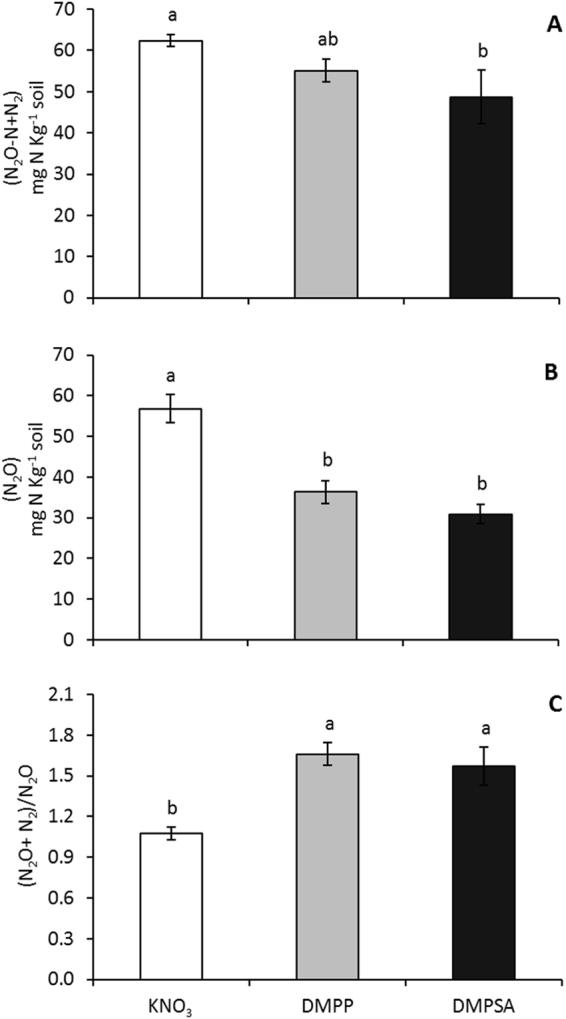
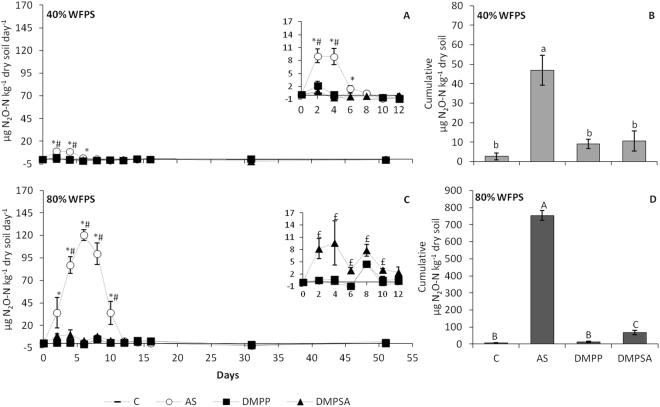
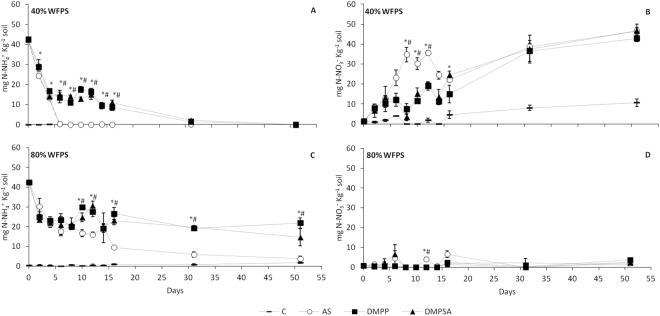
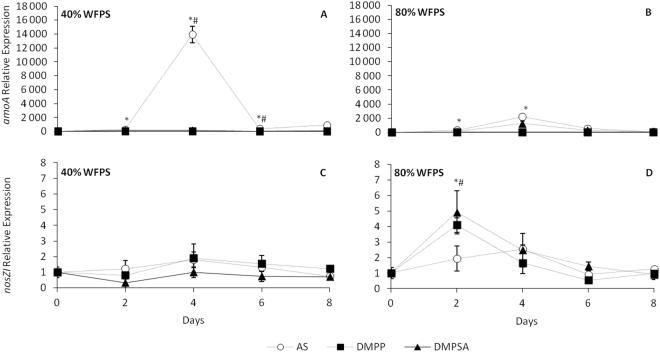
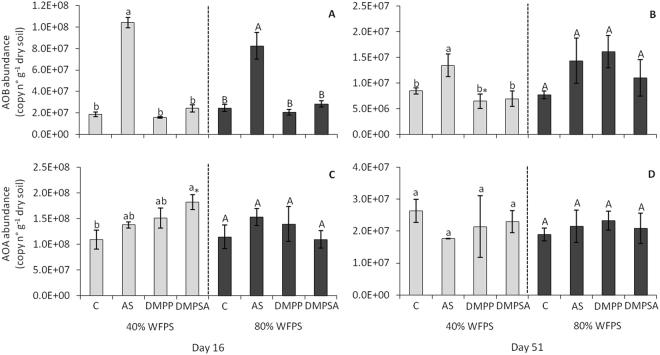
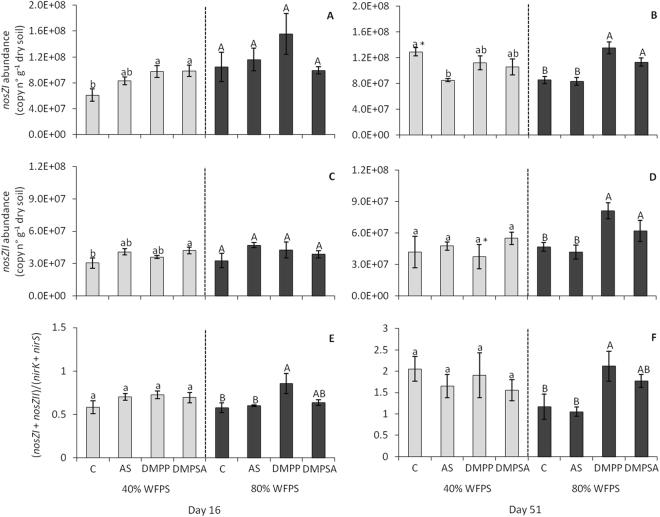
Nitrous oxide (NO) emissions have been increasing as a result of intensive nitrogen (N) fertilisation. Soil nitrification and denitrification are the main sources of NO, and the use of ammonium-based fertilisers combined with nitrification inhibitors (NIs) could be useful in mitigating NO emissions from agricultural systems. In this work we looked at the NO mitigation capacity of two dimethylpyrazol-based NIs, 3,4-dimethylpyrazole phosphate (DMPP) and 2-(N-3,4-dimethyl-1H-pyrazol-1-yl) succinic acid isomeric mixture (DMPSA), on soil nitrifying and denitrifying microbial populations under two contrasting soil water contents (40% and 80% soil water filled pore space; WFPS). Our results show that DMPP and DMPSA are equally efficient at reducing NO emissions under 40% WFPS conditions by inhibiting bacterial ammonia oxidation. In contrast, at 80% WFPS DMPSA was less efficient than DMPP at reducing NO emissions. Interestingly, at 80% WFPS, where lowered oxygen availability limits nitrification, both DMPP and DMPSA not only inhibited nitrification but also stimulated NO reduction to molecular nitrogen (N) via nitrous oxide reductase activity (Nos activity). Therefore, in this work we observed that DMP-based NIs stimulated the reduction of NO to N by nitrous oxide reductase during the denitrification process.
一氧化二氮(NO)排放因集约化施氮而增加。土壤硝化和反硝化是 NO 的主要来源,使用铵基肥料并结合硝化抑制剂(NIs)可能有助于减轻农业系统中的 NO 排放。在这项工作中,我们研究了两种基于二甲基吡唑的 NIs,3,4-二甲基吡唑磷酸盐(DMPP)和 2-(N-3,4-二甲基-1H-吡唑-1-基)琥珀酸异构体混合物(DMPSA),在两种不同土壤含水量(40%和 80%土壤水填充孔隙空间;WFPS)下对土壤硝化和反硝化微生物种群的 NO 缓解能力。我们的结果表明,DMPP 和 DMPSA 在 40% WFPS 条件下通过抑制细菌氨氧化同样有效地减少 NO 排放。相比之下,在 80% WFPS 下,由于氧气供应减少限制了硝化作用,DMPSA 减少 NO 排放的效率低于 DMPP。有趣的是,在 80% WFPS 下,DMPP 和 DMPSA 不仅抑制了硝化作用,而且通过亚硝酸盐还原酶活性(Nos 活性)刺激了 NO 还原为分子氮(N)。因此,在这项工作中,我们观察到 DMP 基 NIs 在反硝化过程中通过亚硝酸盐还原酶刺激 NO 还原为 N。
 Zotero 插件