
社区为基础的心理社会干预措施在中低收入国家中对精神分裂症患者的效果:系统评价和荟萃分析。
Community-based psychosocial interventions for people with schizophrenia in low and middle-income countries: systematic review and meta-analysis.
机构信息
Centre for Global Mental Health, Department of Population Health, London School of Hygiene and Tropical Medicine, London, UK.
Centre for Chronic Conditions and Injuries, Public Health Foundation of India, New Delhi, India.
出版信息
BMC Psychiatry. 2017 Oct 30;17(1):355. doi: 10.1186/s12888-017-1516-7.
BACKGROUND
There is consensus that the treatment of schizophrenia should combine anti-psychotic medication and psychosocial interventions in order to address complex social, economic and health needs. It is recommended that family therapy or support; community-based rehabilitation; and/or self-help and support groups should be provided for people with schizophrenia in low and middle-income countries. The effectiveness of community-based psychosocial interventions in these settings is unclear.
METHODS
Studies evaluating community-based psychosocial interventions for people with schizophrenia were identified through database searching up to April 2016. Randomised controlled trials were included if they compared the intervention group with a control group receiving treatment as usual including medication. Only studies set in low and middle-income countries were included. Random effects meta-analyses were performed separately for each intervention type.
RESULTS
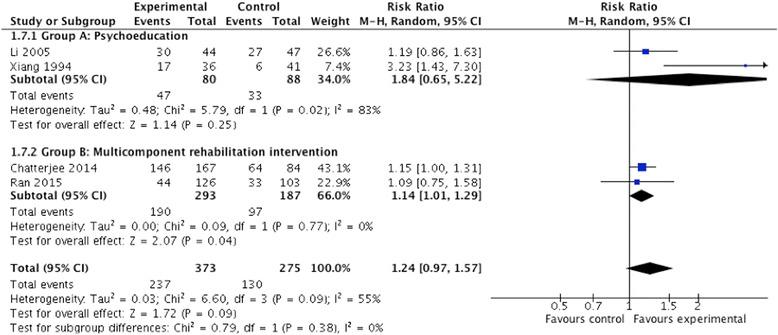
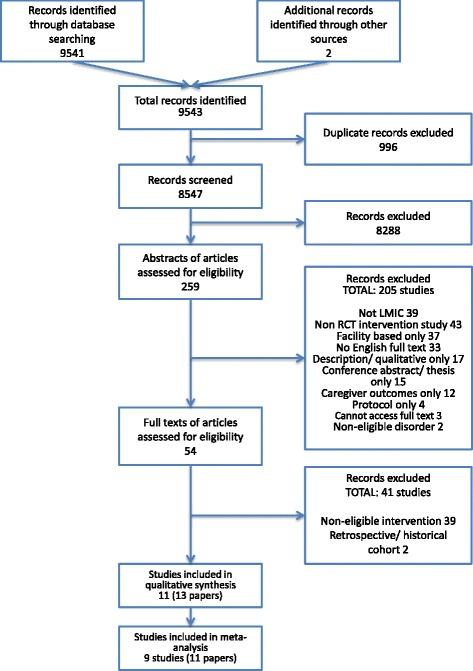
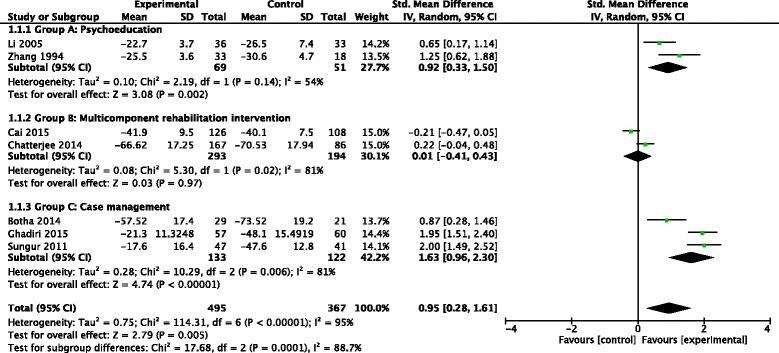
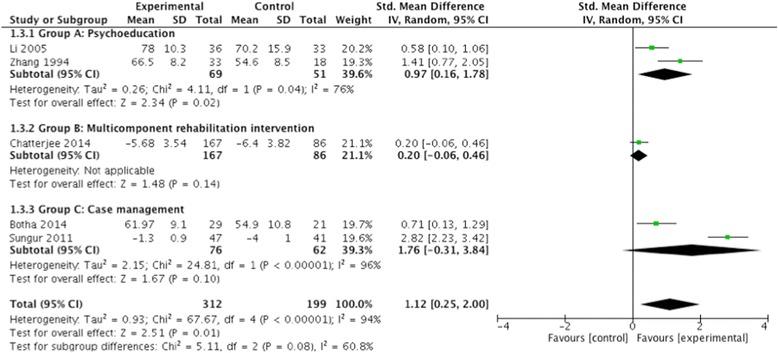
Eleven randomised controlled trials in five middle-income countries were identified, with a total of 1580 participants. The content of included interventions varied from single-faceted psychoeducational interventions, to multi-component rehabilitation-focused interventions, to case management interventions. A third of the included studies did not incorporate any community involvement in the intervention. The quality of evidence was often low. Amongst the seven studies that reported on symptom severity up to 18 months post intervention, the pooled standardised mean difference (SMD) across all intervention types was 0.95 (95% CI 0.28, 1.61; P 0.005; I = 95%; n = 862), representing a strong effect. A strong effect on symptom severity remained after excluding two studies with a high risk of bias (SMD 0.80; 95% CI 0.07, 1.53; P 0.03; I = 94%; n = 676). Community-based psychosocial interventions may also have beneficial impacts on functioning (SMD 1.12; 95% CI 0.25, 2.00; P 0.01; I = 94%; n = 511) and reducing hospital readmissions (SMD 0.68; 95% CI 0.27, 1.09; P 0.001; I = 33%; n = 167).
CONCLUSION
The limited evidence from low and middle-income countries supports the feasibility and effectiveness of community-based psychosocial interventions for schizophrenia, even in the absence of community mobilisation. Community-based psychosocial interventions should therefore be provided in these settings as an adjuvant service in addition to facility-based care for people with schizophrenia.
背景
人们普遍认为,治疗精神分裂症应将抗精神病药物与社会心理干预相结合,以满足复杂的社会、经济和健康需求。建议为中低收入国家的精神分裂症患者提供家庭治疗或支持、以社区为基础的康复以及/或自助和支持小组。在这些环境中,以社区为基础的心理社会干预的有效性尚不清楚。
方法
通过数据库检索,截至 2016 年 4 月,确定了评估精神分裂症患者以社区为基础的心理社会干预的研究。如果干预组与接受常规治疗(包括药物治疗)的对照组进行比较,则纳入随机对照试验。仅纳入中低收入国家的研究。对每种干预类型分别进行了随机效应荟萃分析。
结果
在五个中等收入国家确定了 11 项随机对照试验,共纳入 1580 名参与者。纳入干预措施的内容各不相同,从单一的心理教育干预,到多方面的以康复为重点的干预,再到病例管理干预。三分之一的纳入研究在干预中没有纳入任何社区参与。证据质量往往较低。在报告干预后 18 个月内症状严重程度的七项研究中,所有干预类型的汇总标准化均数差(SMD)为 0.95(95%CI 0.28,1.61;P<0.005;I=95%;n=862),代表了强烈的效果。在排除两项偏倚风险较高的研究后(SMD 0.80;95%CI 0.07,1.53;P=0.03;I=94%;n=676),对症状严重程度仍有强烈影响。以社区为基础的心理社会干预也可能对功能产生有益影响(SMD 1.12;95%CI 0.25,2.00;P=0.01;I=94%;n=511),并减少住院再入院(SMD 0.68;95%CI 0.27,1.09;P<0.001;I=33%;n=167)。
结论
来自中低收入国家的有限证据支持以社区为基础的心理社会干预治疗精神分裂症的可行性和有效性,即使在没有社区动员的情况下也是如此。因此,应为这些环境中的精神分裂症患者提供以社区为基础的心理社会干预,作为对设施为基础的护理的辅助服务。
 Zotero 插件