
英国的公共卫生监测彻底改变了我们对非洲侵袭性沙门氏菌 Typhimurium 流行的认识。
Public health surveillance in the UK revolutionises our understanding of the invasive Salmonella Typhimurium epidemic in Africa.
机构信息
Gastrointestinal Bacteria Reference Unit, Public Health England, 61 Colindale Avenue, London, NW9 5HT, UK.
Institute of Integrative Biology, University of Liverpool, Liverpool, UK.
出版信息
Genome Med. 2017 Oct 31;9(1):92. doi: 10.1186/s13073-017-0480-7.
BACKGROUND
The ST313 sequence type of Salmonella Typhimurium causes invasive non-typhoidal salmonellosis and was thought to be confined to sub-Saharan Africa. Two distinct phylogenetic lineages of African ST313 have been identified.
METHODS
We analysed the whole genome sequences of S. Typhimurium isolates from UK patients that were generated following the introduction of routine whole-genome sequencing (WGS) of Salmonella enterica by Public Health England in 2014.
RESULTS
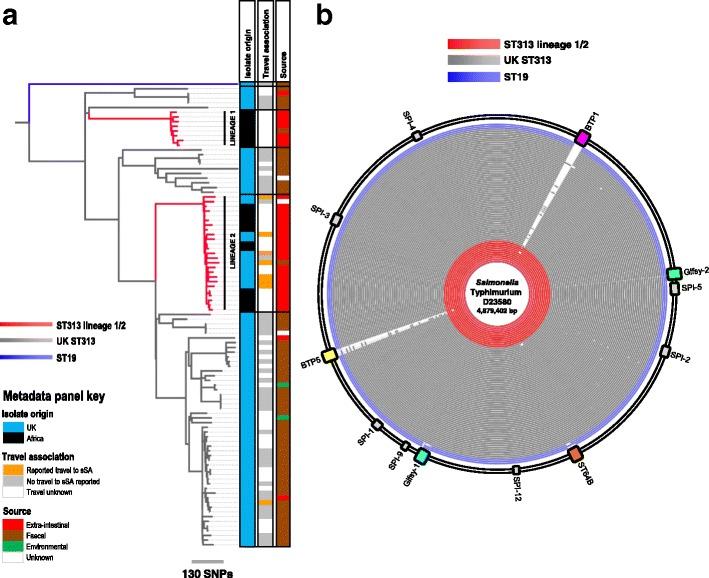
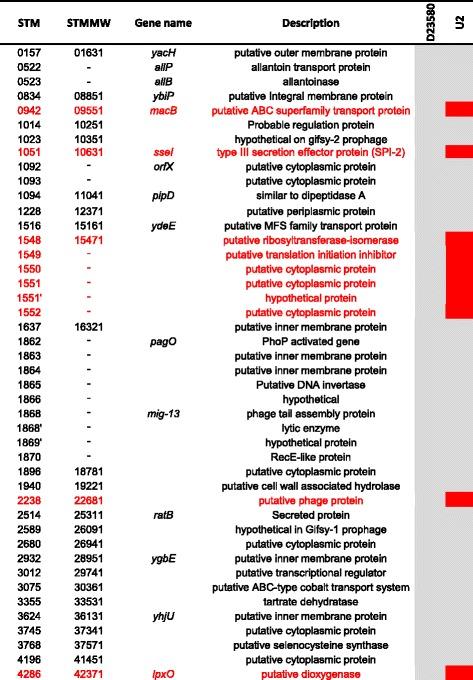
We found that 2.7% (84/3147) of S. Typhimurium from patients in England and Wales were ST313 and were associated with gastrointestinal infection. Phylogenetic analysis revealed novel diversity of ST313 that distinguished UK-linked gastrointestinal isolates from African-associated extra-intestinal isolates. The majority of genome degradation of African ST313 lineage 2 was conserved in the UK-ST313, but the African lineages carried a characteristic prophage and antibiotic resistance gene repertoire. These findings suggest that a strong selection pressure exists for certain horizontally acquired genetic elements in the African setting. One UK-isolated lineage 2 strain that probably originated in Kenya carried a chromosomally located bla , demonstrating the continual evolution of this sequence type in Africa in response to widespread antibiotic usage.
CONCLUSIONS
The discovery of ST313 isolates responsible for gastroenteritis in the UK reveals new diversity in this important sequence type. This study highlights the power of routine WGS by public health agencies to make epidemiologically significant deductions that would be missed by conventional microbiological methods. We speculate that the niche specialisation of sub-Saharan African ST313 lineages is driven in part by the acquisition of accessory genome elements.
背景
肠炎沙门氏菌 ST313 血清型可引起侵袭性非伤寒型沙门氏菌病,且以往认为其仅局限于撒哈拉以南非洲。目前已鉴定出两种不同的非洲 ST313 进化枝。
方法
我们分析了英国患者的肠炎沙门氏菌分离株的全基因组序列,这些序列是在英格兰公共卫生部于 2014 年引入沙门氏菌全基因组测序(WGS)常规检测之后产生的。
结果
我们发现,英格兰和威尔士的 3147 例肠炎沙门氏菌分离株中,有 2.7%(84/3147)为 ST313,与胃肠道感染相关。系统进化分析显示,ST313 存在新的多样性,可将与英国相关的胃肠道分离株与与非洲相关的肠外分离株区分开来。非洲 ST313 进化枝 2 的大多数基因组降解在英国 ST313 中得以保留,但非洲进化枝携带特征性的前噬菌体和抗生素耐药基因库。这些发现表明,在非洲环境中,某些水平获得的遗传元件存在强烈的选择压力。一株可能起源于肯尼亚的英国分离株 2 系携带染色体定位的 bla ,表明该序列型在非洲不断进化以应对广泛的抗生素使用。
结论
在英国发现的引起肠胃炎的 ST313 分离株揭示了这一重要血清型的新多样性。本研究强调了公共卫生机构常规 WGS 的强大功能,可通过传统微生物学方法进行有意义的流行病学推断。我们推测,撒哈拉以南非洲 ST313 进化枝的生态位特化部分是由获得辅助基因组元件驱动的。




 Zotero 插件