
超越采用:一个用于理论化和评估健康与护理技术的未采用、废弃以及扩大规模、传播和可持续性挑战的新框架。
Beyond Adoption: A New Framework for Theorizing and Evaluating Nonadoption, Abandonment, and Challenges to the Scale-Up, Spread, and Sustainability of Health and Care Technologies.
作者信息
Greenhalgh Trisha, Wherton Joseph, Papoutsi Chrysanthi, Lynch Jennifer, Hughes Gemma, A'Court Christine, Hinder Susan, Fahy Nick, Procter Rob, Shaw Sara
机构信息
Department of Primary Care Health Sciences, University of Oxford, Oxford, United Kingdom.
School of Health and Social Work, University of Hertfordshire, Hatfield, United Kingdom.
出版信息
J Med Internet Res. 2017 Nov 1;19(11):e367. doi: 10.2196/jmir.8775.
BACKGROUND
Many promising technological innovations in health and social care are characterized by nonadoption or abandonment by individuals or by failed attempts to scale up locally, spread distantly, or sustain the innovation long term at the organization or system level.
OBJECTIVE
Our objective was to produce an evidence-based, theory-informed, and pragmatic framework to help predict and evaluate the success of a technology-supported health or social care program.
METHODS
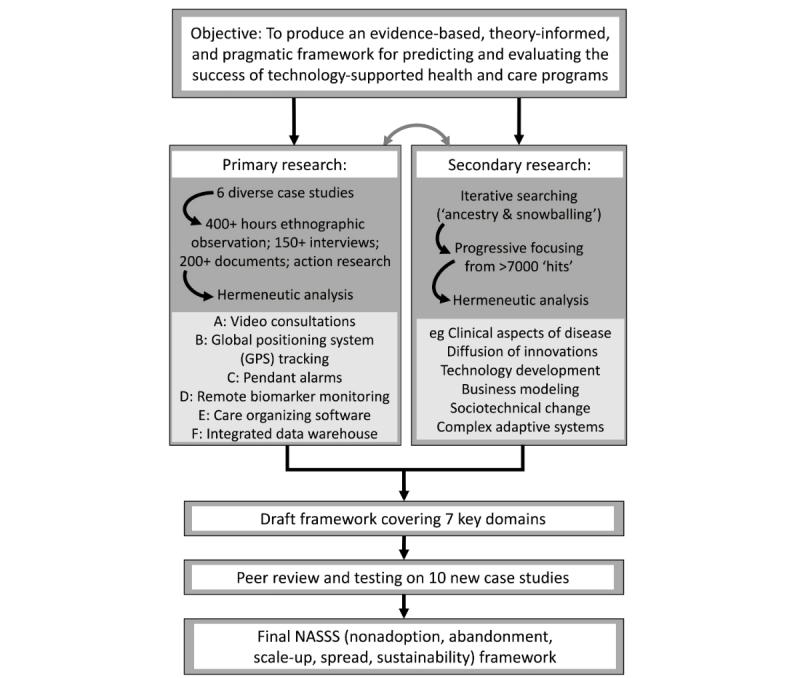
The study had 2 parallel components: (1) secondary research (hermeneutic systematic review) to identify key domains, and (2) empirical case studies of technology implementation to explore, test, and refine these domains. We studied 6 technology-supported programs-video outpatient consultations, global positioning system tracking for cognitive impairment, pendant alarm services, remote biomarker monitoring for heart failure, care organizing software, and integrated case management via data sharing-using longitudinal ethnography and action research for up to 3 years across more than 20 organizations. Data were collected at micro level (individual technology users), meso level (organizational processes and systems), and macro level (national policy and wider context). Analysis and synthesis was aided by sociotechnically informed theories of individual, organizational, and system change. The draft framework was shared with colleagues who were introducing or evaluating other technology-supported health or care programs and refined in response to feedback.
RESULTS
The literature review identified 28 previous technology implementation frameworks, of which 14 had taken a dynamic systems approach (including 2 integrative reviews of previous work). Our empirical dataset consisted of over 400 hours of ethnographic observation, 165 semistructured interviews, and 200 documents. The final nonadoption, abandonment, scale-up, spread, and sustainability (NASSS) framework included questions in 7 domains: the condition or illness, the technology, the value proposition, the adopter system (comprising professional staff, patient, and lay caregivers), the organization(s), the wider (institutional and societal) context, and the interaction and mutual adaptation between all these domains over time. Our empirical case studies raised a variety of challenges across all 7 domains, each classified as simple (straightforward, predictable, few components), complicated (multiple interacting components or issues), or complex (dynamic, unpredictable, not easily disaggregated into constituent components). Programs characterized by complicatedness proved difficult but not impossible to implement. Those characterized by complexity in multiple NASSS domains rarely, if ever, became mainstreamed. The framework showed promise when applied (both prospectively and retrospectively) to other programs.
CONCLUSIONS
Subject to further empirical testing, NASSS could be applied across a range of technological innovations in health and social care. It has several potential uses: (1) to inform the design of a new technology; (2) to identify technological solutions that (perhaps despite policy or industry enthusiasm) have a limited chance of achieving large-scale, sustained adoption; (3) to plan the implementation, scale-up, or rollout of a technology program; and (4) to explain and learn from program failures.
背景
健康和社会护理领域的许多有前景的技术创新,其特点是个人不采用或放弃,或者在地方层面扩大规模、在远距离传播或在组织或系统层面长期维持创新的尝试失败。
目的
我们的目标是制定一个基于证据、理论驱动且务实的框架,以帮助预测和评估技术支持的健康或社会护理项目的成功。
方法
该研究有两个并行部分:(1)二次研究(诠释性系统综述)以确定关键领域,(2)技术实施的实证案例研究以探索、测试和完善这些领域。我们研究了6个技术支持项目——视频门诊咨询、用于认知障碍的全球定位系统跟踪、吊坠报警服务、心力衰竭的远程生物标志物监测、护理组织软件以及通过数据共享进行的综合病例管理——在20多个组织中进行了长达3年的纵向人种志研究和行动研究。数据在微观层面(个体技术用户)、中观层面(组织流程和系统)和宏观层面(国家政策及更广泛背景)收集。分析和综合借助个体、组织和系统变革的社会技术理论进行。框架草案与正在引入或评估其他技术支持的健康或护理项目的同事分享,并根据反馈进行完善。
结果
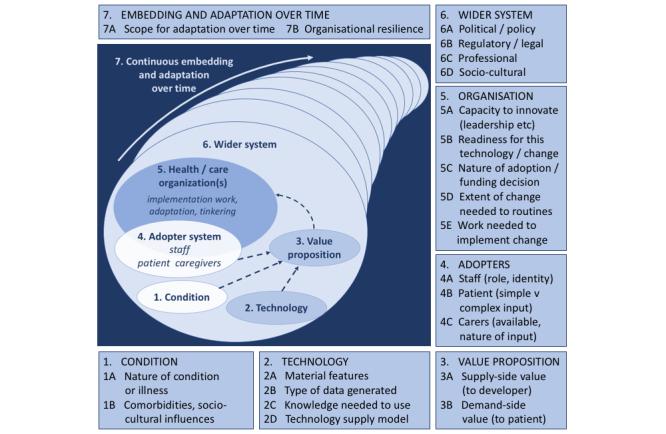
文献综述确定了之前的28个技术实施框架,其中14个采用了动态系统方法(包括对先前工作的2项综合综述)。我们的实证数据集包括超过400小时的人种志观察、165次半结构化访谈和200份文件。最终的未采用、放弃、扩大规模、传播和可持续性(NASSS)框架包括7个领域的问题:病情或疾病、技术、价值主张、采用系统(包括专业人员、患者和非专业护理人员)、组织、更广泛的(机构和社会)背景以及所有这些领域随时间的相互作用和相互适应。我们的实证案例研究在所有7个领域都提出了各种挑战,每个挑战分为简单(直接、可预测、组成部分少)、复杂(多个相互作用的组成部分或问题)或复杂(动态、不可预测、不易分解为组成部分)。以复杂性为特征的项目实施困难但并非不可能。那些在多个NASSS领域具有复杂性特征的项目很少(如果有的话)成为主流。该框架在应用于(前瞻性和回顾性)其他项目时显示出前景。
结论
经过进一步实证检验,NASSS可应用于健康和社会护理领域的一系列技术创新。它有几个潜在用途:(1)为新技术的设计提供信息;(2)识别(可能尽管有政策或行业热情)实现大规模、持续采用机会有限的技术解决方案;(3)规划技术项目的实施、扩大规模或推广;(4)解释项目失败并从中吸取教训。
 Zotero 插件