
食源性病原体空肠弯曲菌会对胆盐脱氧胆酸盐做出反应,采取应对活性氧的措施。
The food-borne pathogen Campylobacter jejuni responds to the bile salt deoxycholate with countermeasures to reactive oxygen species.
作者信息
Negretti Nicholas M, Gourley Christopher R, Clair Geremy, Adkins Joshua N, Konkel Michael E
机构信息
School of Molecular Biosciences, College of Veterinary Medicine, Washington State University, Pullman, WA, 99164-7520, USA.
Integrative Omics, Pacific Northwest National Laboratory, 902 Battelle Boulevard, Richland, Washington, 99352, USA.
出版信息
Sci Rep. 2017 Nov 13;7(1):15455. doi: 10.1038/s41598-017-15379-5.
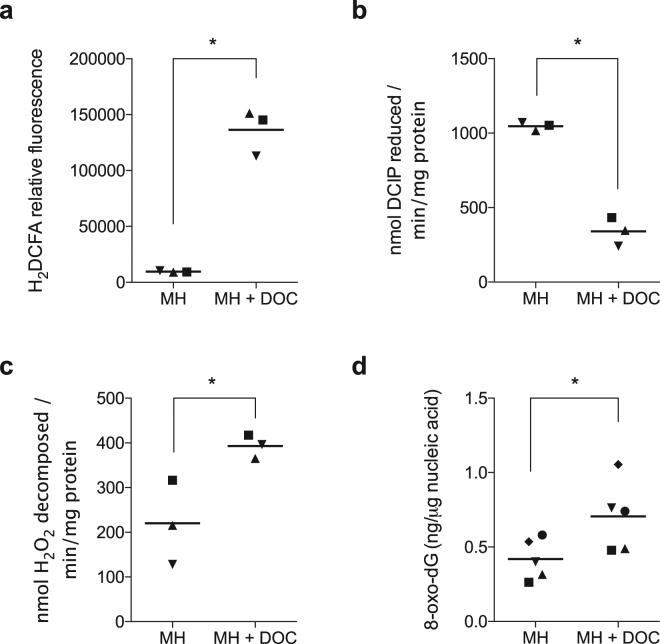
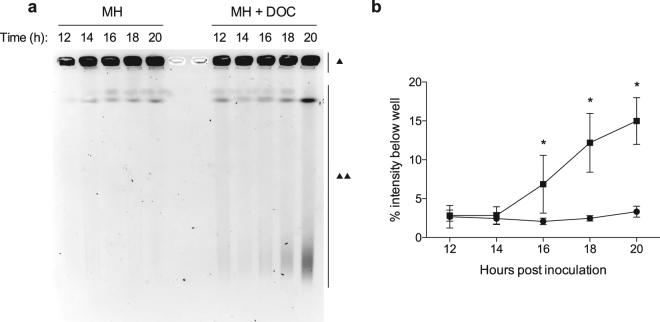
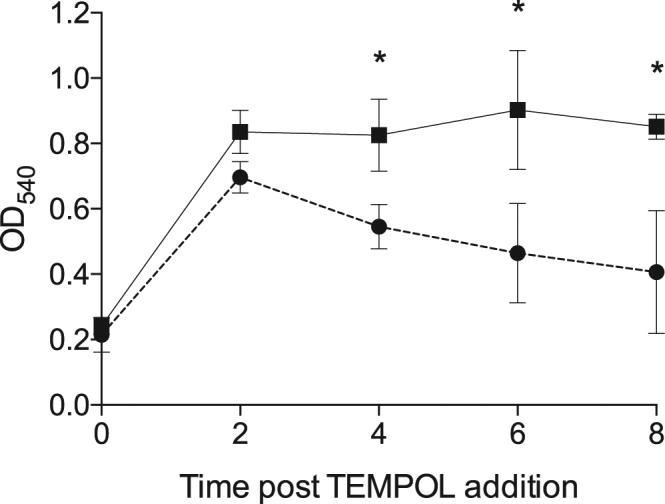
Bile plays an important role in digestion, absorption of fats, and the excretion of waste products, while concurrently providing a critical barrier against colonization by harmful bacteria. Previous studies have demonstrated that gut pathogens react to bile by adapting their protein synthesis. The ability of pathogens to respond to bile is remarkably complex and still incompletely understood. Here we show that Campylobacter jejuni, a leading bacterial cause of human diarrheal illness worldwide, responds to deoxycholate, a component of bile, by altering global gene transcription in a manner consistent with a strategy to mitigate exposure to reactive oxygen stress. More specifically, continuous growth of C. jejuni in deoxycholate was found to: 1) induce the production of reactive oxygen species (ROS); 2) decrease succinate dehydrogenase activity (complex II of the electron transport chain); 3) increase catalase activity that is involved in HO breakdown; and 4) result in DNA strand breaks. Congruently, the addition of 4-hydroxy-TEMPO (TEMPOL), a superoxide dismutase mimic that reacts with superoxide, rescued the growth of C. jejuni cultured in the presence of deoxycholate. We postulate that continuous exposure of a number of enteric pathogens to deoxycholate stimulates a conserved survival response to this stressor.
胆汁在消化、脂肪吸收以及废物排泄过程中发挥着重要作用,同时还为抵御有害细菌的定殖提供关键屏障。此前的研究表明,肠道病原体通过调整蛋白质合成来应对胆汁。病原体对胆汁作出反应的能力极为复杂,目前仍未完全明晰。在此,我们发现空肠弯曲菌作为全球人类腹泻疾病的主要细菌病因,会通过改变整体基因转录来应对胆汁成分脱氧胆酸盐,这种方式符合减轻活性氧应激暴露的策略。具体而言,研究发现空肠弯曲菌在脱氧胆酸盐中持续生长会:1)诱导活性氧(ROS)的产生;2)降低琥珀酸脱氢酶活性(电子传递链复合物II);3)增加参与过氧化氢分解的过氧化氢酶活性;4)导致DNA链断裂。同样,添加4-羟基-TEMPO(TEMPOL),一种与超氧化物反应的超氧化物歧化酶模拟物,可挽救在脱氧胆酸盐存在下培养的空肠弯曲菌的生长。我们推测,多种肠道病原体持续暴露于脱氧胆酸盐会刺激对这种应激源的保守生存反应。


 Zotero 插件