
在生物样本中进行统计学上强有力的、无标签的天然荧光团定量鉴定。
Statistically strong label-free quantitative identification of native fluorophores in a biological sample.
机构信息
ARC Centre of Excellence for Nanoscale Biophotonics, Macquarie University, North Ryde, 2109, NSW, Australia.
Quantitative Pty Ltd, ABN 17165684186, 116-118 Great Western Highway, Mt. Victoria, NSW, 2786, Australia.
出版信息
Sci Rep. 2017 Nov 17;7(1):15792. doi: 10.1038/s41598-017-15952-y.
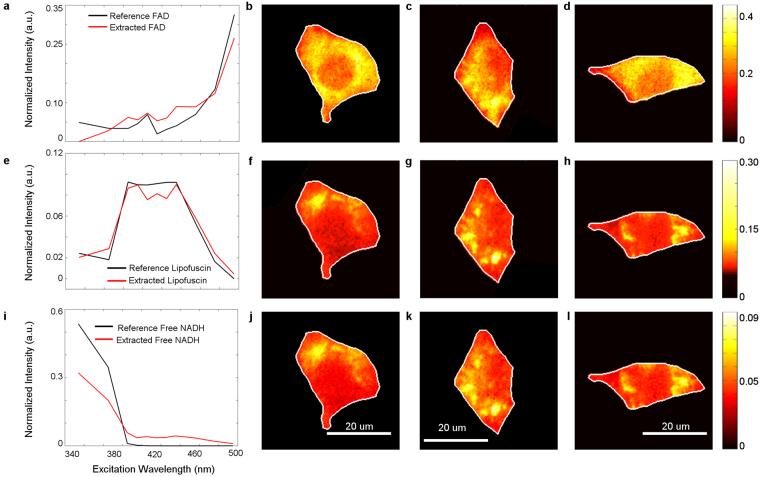
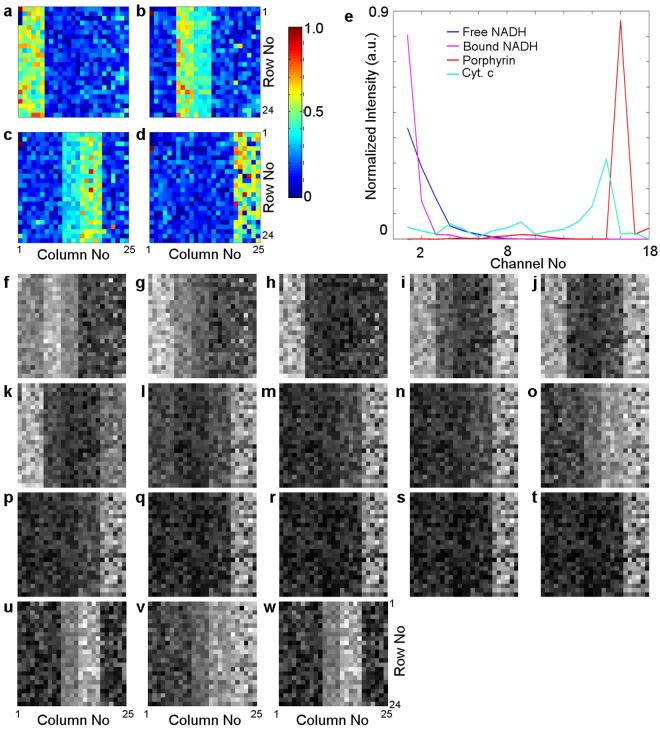
Bioimaging using endogenous cell fluorescence, without any external biomarkers makes it possible to explore cells and tissues in their original native state, also in vivo. In order to be informative, this label-free method requires careful multispectral or hyperspectral recording of autofluorescence images followed by unsupervised extraction (unmixing) of biochemical signatures. The unmixing is difficult due to the scarcity of biochemically pure regions in cells and also because autofluorescence is weak compared with signals from labelled cells, typically leading to low signal to noise ratio. Here, we solve the problem of unsupervised hyperspectral unmixing of cellular autofluorescence by introducing the Robust Dependent Component Analysis (RoDECA). This approach provides sophisticated and statistically robust quantitative biochemical analysis of cellular autofluorescence images. We validate our method on artificial images, where the addition of varying known level of noise has allowed us to quantify the accuracy of our RoDECA analysis in a way that can be applied to real biological datasets. The same unsupervised statistical minimisation is then applied to imaging of mouse retinal photoreceptor cells where we establish the identity of key endogenous fluorophores (free NADH, FAD and lipofuscin) and derive the corresponding molecular abundance maps. The pre-processing methodology of image datasets is also presented, which is essential for the spectral unmixing analysis, but mostly overlooked in the previous studies.
利用内源性细胞荧光进行生物成像,无需任何外部生物标志物,就可以在原始状态下探索细胞和组织,包括在体内。为了具有信息性,这种无标记方法需要仔细进行多光谱或高光谱记录自发荧光图像,然后进行无监督提取(解混)生物化学特征。由于细胞中生物化学纯区域稀缺,而且自发荧光与标记细胞的信号相比较弱,因此解混非常困难,通常会导致低信噪比。在这里,我们通过引入稳健相关成分分析(RoDECA)来解决细胞自发荧光的无监督高光谱解混问题。这种方法提供了细胞自发荧光图像的复杂和统计稳健的定量生化分析。我们在人工图像上验证了我们的方法,在这些图像中,添加不同已知水平的噪声使我们能够以可以应用于真实生物数据集的方式量化我们的 RoDECA 分析的准确性。然后将相同的无监督统计最小化应用于小鼠视网膜光感受器细胞的成像,我们确定了关键内源性荧光团(游离 NADH、FAD 和脂褐素)的身份,并得出相应的分子丰度图。还介绍了图像数据集的预处理方法,这对于光谱解混分析是必不可少的,但在以前的研究中大多被忽视。


 Zotero 插件