
通过循环肿瘤DNA分析胰腺癌患者的肿瘤异质性。
Profiling tumour heterogeneity through circulating tumour DNA in patients with pancreatic cancer.
作者信息
Adamo Patricia, Cowley Caroline M, Neal Christopher P, Mistry Vilas, Page Karen, Dennison Ashley R, Isherwood John, Hastings Robert, Luo JinLi, Moore David A, Howard Pringle J, Miguel Martins L, Pritchard Catrin, Manson Margaret, Shaw Jacqui A
机构信息
Department of Cancer Studies, University of Leicester, Robert Kilpatrick Clinical Sciences Building, Leicester Royal Infirmary, Leicester, UK.
Department of Hepatobiliary and Pancreatic Surgery, Leicester General Hospital, Leicester, UK.
出版信息
Oncotarget. 2017 Aug 14;8(50):87221-87233. doi: 10.18632/oncotarget.20250. eCollection 2017 Oct 20.
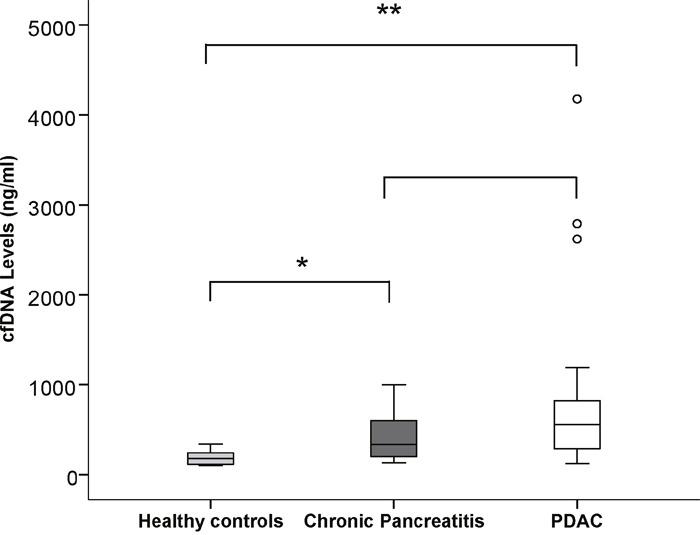
The majority of pancreatic ductal adenocarcinomas (PDAC) are diagnosed late so that surgery is rarely curative. Earlier detection could significantly increase the likelihood of successful treatment and improve survival. The aim of the study was to provide proof of principle that point mutations in key cancer genes can be identified by sequencing circulating free DNA (cfDNA) and that this could be used to detect early PDACs and potentially, premalignant lesions, to help target early effective treatment. Targeted next generation sequencing (tNGS) analysis of mutation hotspots in 50 cancer genes was conducted in 26 patients with PDAC, 14 patients with chronic pancreatitis (CP) and 12 healthy controls with status validated by digital droplet PCR. A higher median level of total cfDNA was observed in patients with PDAC (585 ng/ml) compared to either patients with CP (300 ng/ml) or healthy controls (175 ng/ml). PDAC tissue showed wide mutational heterogeneity, whereas was the most commonly mutated gene in cfDNA of patients with PDAC and was significantly associated with a poor disease specific survival (p=0.018). This study demonstrates that tNGS of cfDNA is feasible to characterise the circulating genomic profile in PDAC and that driver mutations in have prognostic value but cannot currently be used to detect early emergence of disease. Importantly, monitoring total cfDNA levels may have utility in individuals "at risk" and warrants further investigation.
大多数胰腺导管腺癌(PDAC)在晚期才被诊断出来,因此手术很少能治愈。早期检测可显著提高成功治疗的可能性并改善生存率。本研究的目的是提供原理证明,即通过对循环游离DNA(cfDNA)进行测序可以识别关键癌症基因中的点突变,并且这可用于检测早期PDAC以及潜在的癌前病变,以帮助靶向早期有效治疗。对26例PDAC患者、14例慢性胰腺炎(CP)患者和12名健康对照者进行了50个癌症基因突变热点的靶向二代测序(tNGS)分析,结果通过数字液滴PCR验证。与CP患者(300 ng/ml)或健康对照者(175 ng/ml)相比,PDAC患者的总cfDNA中位水平更高(585 ng/ml)。PDAC组织表现出广泛的突变异质性,而 是PDAC患者cfDNA中最常发生突变的基因,并且与较差的疾病特异性生存率显著相关(p = 0.018)。本研究表明,cfDNA的tNGS可用于表征PDAC中的循环基因组图谱,并且 中的驱动突变具有预后价值,但目前不能用于检测疾病的早期出现。重要的是,监测总cfDNA水平可能对“高危”个体有用,值得进一步研究。 (注:原文中“whereas was the most commonly mutated gene in cfDNA of patients with PDAC”这里的“whereas ”表述不完整,可能有信息缺失)

 Zotero 插件