
预防耐碳青霉烯类进入医疗机构的感染预防与控制措施及工具:欧洲疾病预防控制中心指南
Infection prevention and control measures and tools for the prevention of entry of carbapenem-resistant into healthcare settings: guidance from the European Centre for Disease Prevention and Control.
作者信息
Magiorakos A P, Burns K, Rodríguez Baño J, Borg M, Daikos G, Dumpis U, Lucet J C, Moro M L, Tacconelli E, Simonsen G Skov, Szilágyi E, Voss A, Weber J T
机构信息
European Centre for Disease Prevention and Control, Stockholm, Sweden.
Beaumont Hospital, Royal College of Surgeons in Ireland & Health Protection Surveillance Centre, Dublin, Ireland.
出版信息
Antimicrob Resist Infect Control. 2017 Nov 15;6:113. doi: 10.1186/s13756-017-0259-z. eCollection 2017.
BACKGROUND
Infections with carbapenem-resistant (CRE) are increasingly being reported from patients in healthcare settings. They are associated with high patient morbidity, attributable mortality and hospital costs. Patients who are "at-risk" may be carriers of these multidrug-resistant (MDR-E).The purpose of this guidance is to raise awareness and identify the "at-risk" patient when admitted to a healthcare setting and to outline effective infection prevention and control measures to halt the entry and spread of CRE.
METHODS
The guidance was created by a group of experts who were functioning independently of their organisations, during two meetings hosted by the European Centre for Disease Prevention and Control. A list of epidemiological risk factors placing patients "at-risk" for carriage with CRE was created by the experts. The conclusions of a systematic review on the prevention of spread of CRE, with the addition of expert opinion, were used to construct lists of core and supplemental infection prevention and control measures to be implemented for "at-risk" patients upon admission to healthcare settings.
RESULTS
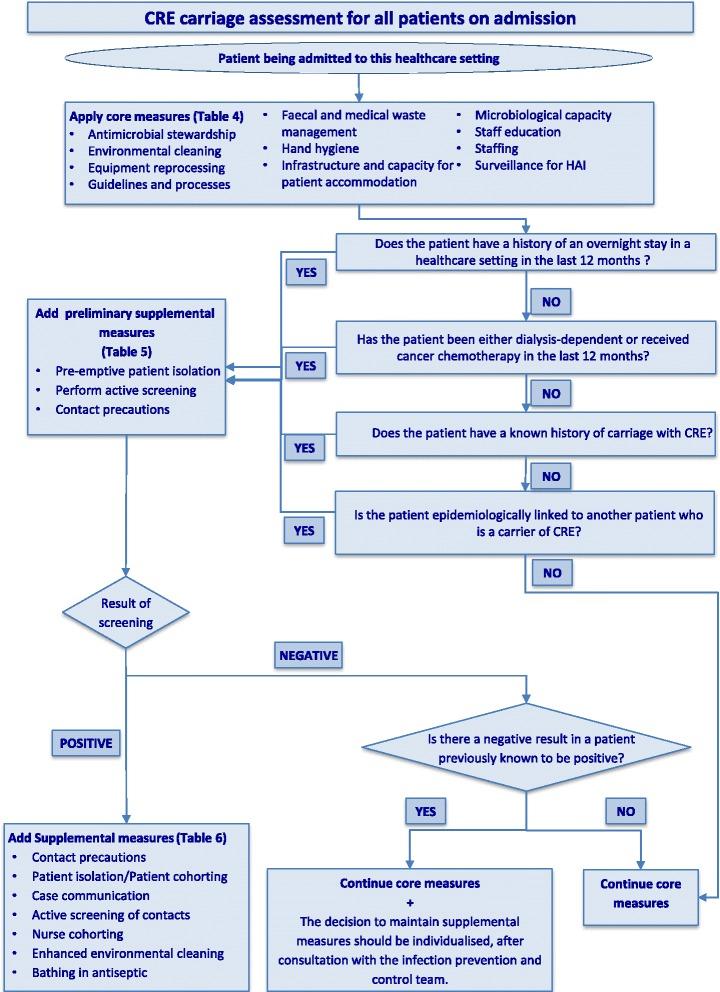
Individuals with the following profile are "at-risk" for carriage of CRE: a) a history of an overnight stay in a healthcare setting in the last 12 months, b) dialysis-dependent or cancer chemotherapy in the last 12 months, c) known previous carriage of CRE in the last 12 months and d) epidemiological linkage to a known carrier of a CRE.Core infection prevention and control measures that should be considered for all patients in healthcare settings were compiled. Preliminary supplemental measures to be implemented for "at-risk" patients on admission are: pre-emptive isolation, active screening for CRE and contact precautions. Patients who are confirmed positive for CRE will need additional supplemental measures.
CONCLUSIONS
Strengthening the microbiological capacity, surveillance and reporting of new cases of CRE in healthcare settings and countries is necessary to monitor the epidemiological situation so that, if necessary, the implemented CRE prevention strategies can be refined in a timely manner. Creating a large communication network to exchange this information would be helpful to understand the extent of the CRE reservoir and to prevent infections in healthcare settings, by applying the principles outlined here.This guidance document offers suggestions for best practices, but is in no way prescriptive for all healthcare settings and all countries. Successful implementation will result if there is local commitment and accountability. The options for intervention can be adopted or adapted to local needs, depending on the availability of financial and structural resources.
背景
医疗机构中耐碳青霉烯类肠杆菌科细菌(CRE)感染的报告日益增多。这些感染与患者的高发病率、可归因死亡率及医院成本相关。“高危”患者可能是这些多重耐药菌(MDR-E)的携带者。本指南的目的是提高认识,在患者入住医疗机构时识别出“高危”患者,并概述有效的感染预防与控制措施,以阻止CRE的传入和传播。
方法
该指南由一组独立于其所在组织的专家在欧洲疾病预防控制中心主办的两次会议期间制定。专家们列出了使患者有携带CRE“风险”的一系列流行病学危险因素。通过对预防CRE传播的系统评价结果,并结合专家意见,构建了针对“高危”患者入住医疗机构时应实施的核心和补充感染预防与控制措施清单。
结果
具有以下特征的个体有携带CRE的“风险”:a)过去12个月内在医疗机构过夜的病史;b)过去12个月内依赖透析或接受癌症化疗;c)过去12个月内已知曾携带CRE;d)与已知的CRE携带者存在流行病学关联。汇总了医疗机构中所有患者都应考虑的核心感染预防与控制措施。对“高危”患者入院时应实施的初步补充措施包括:抢先隔离、主动筛查CRE以及接触预防措施。CRE检测呈阳性的患者将需要额外的补充措施。
结论
加强医疗机构和各国对CRE新病例的微生物检测能力、监测及报告,对于监测流行病学情况很有必要,以便在必要时及时完善已实施的CRE预防策略。建立一个大型信息交流网络来交换这些信息,将有助于了解CRE储存库的范围,并通过应用此处概述的原则预防医疗机构内的感染。本指南文件提供了最佳实践建议,但绝不是对所有医疗机构和所有国家都具有规范性。如果有地方的承诺和问责制,将成功实施。干预选项可根据财政和结构资源的可用性采用或调整以满足当地需求。
 Zotero 插件