
基于图像的泪膜脂质层厚度定量分析用于评估睑板腺。
Image-based quantitative analysis of tear film lipid layer thickness for meibomian gland evaluation.
机构信息
Department of Electrical Engineering and Computer Science, Gwangju Institute of Science and Technology (GIST), 123 Cheomdan-gwagiro, Buk-gu, Gwangju, 61005, Korea.
Department of Biomedical Science and Engineering, Institute of Integrated Technology, Gwangju Institute of Science and Technology (GIST), 123 Cheomdan-gwagiro, Buk-gu, Gwangju, 61005, Korea.
出版信息
Biomed Eng Online. 2017 Nov 23;16(1):135. doi: 10.1186/s12938-017-0426-8.
BACKGROUND
Dry eye syndrome is one of the most common ocular diseases, and meibomian gland dysfunction (MGD) is the leading cause of evaporative dry eye syndrome. When the tear film lipid layer becomes thin due to obstructive or hyposecretory meibomian gland dysfunction, the excessive evaporation of the aqueous layer can occur, and this causes evaporative dry eye syndrome. Thus, measuring the lipid layer thickness (LLT) is essential for accurate diagnosis and proper treatment of evaporative dry eye syndrome.
METHODS
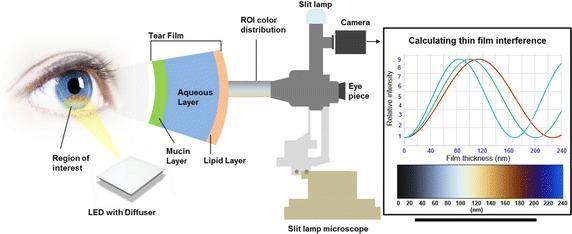
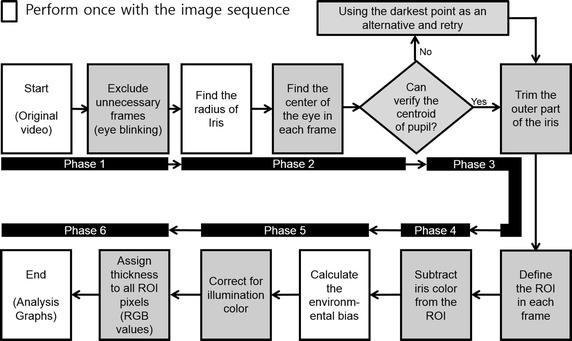
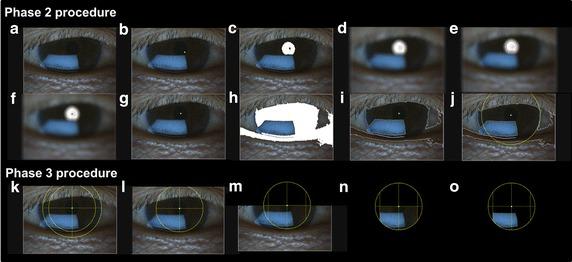
We used a white LED panel with a slit lamp microscope to obtain videos of the lipid layer interference patterns on the cornea. To quantitatively analyze the LLT from interference colors, we developed a novel algorithm that can automatically perform the following processes on an image frame: determining the radius of the iris, locating the center of the pupil, defining region of interest (ROI), tracking the ROI, compensating for the color of iris and illumination, and producing comprehensive analysis output. A group of dry eye syndrome patients with hyposecretory MGD, dry eye syndrome without MGD, hypersecretory MGD, and healthy volunteers were recruited. Their LLTs were analyzed and statistical information-mean and standard deviation, the relative frequency of LLT at each time point, and graphical LLT visualization-were produced.
RESULTS
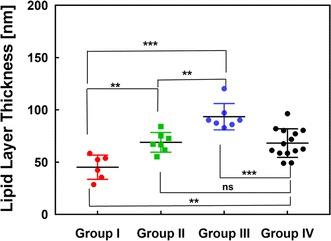
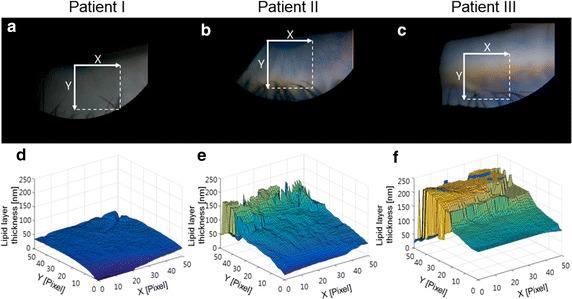
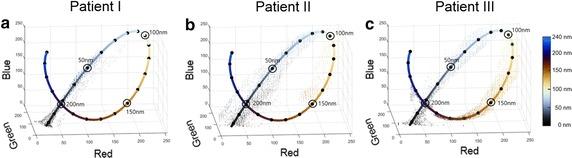
Using our algorithm, we processed the lipid layer interference pattern and automatically analyzed the LLT distribution of images from patients. The LLT of hyposecretory MGD was thinner (45.2 ± 11.6 nm) than that of dry eye syndrome without MGD (69.0 ± 9.4 nm) and healthy volunteers (68.3 ± 13.7 nm) while the LLT of hypersecretory MGD was thicker (93.5 ± 12.6 nm) than that of dry eye syndrome without MGD. Patients' LLTs were statistically analyzed over time, visualized with 3D surface plots, and displayed using 3D scatter plots of image pixel data for comprehensive assessment.
CONCLUSIONS
We developed an image-based algorithm for quantitative measurement as well as statistical analysis of the LLT despite fluctuation and eye movement. This pilot study demonstrates that the quantitative LLT analysis of patients is consistent with the functions of meibomian glands clinically evaluated by an ophthalmologist. This approach is a significant step forward in developing a fully automated instrument for evaluating dry eye syndrome and for providing proper guidance of treatment.
背景
干眼症是最常见的眼病之一,而睑板腺功能障碍(MGD)是蒸发性干眼症的主要原因。当泪膜脂质层由于阻塞性或低分泌性睑板腺功能障碍而变薄时,水层的过度蒸发会导致蒸发性干眼症。因此,测量脂质层厚度(LLT)对于准确诊断和适当治疗蒸发性干眼症至关重要。
方法
我们使用带有裂隙灯显微镜的白色 LED 面板获取角膜上脂质层干涉图案的视频。为了从干涉色定量分析 LLT,我们开发了一种新算法,可以自动执行以下图像帧处理过程:确定虹膜半径、定位瞳孔中心、定义感兴趣区域(ROI)、跟踪 ROI、补偿虹膜和照明的颜色,并生成全面的分析输出。我们招募了一组患有低分泌性 MGD 的干眼症患者、无 MGD 的干眼症患者、高分泌性 MGD 患者和健康志愿者。分析了他们的 LLT,并生成了统计信息——平均值和标准差、每个时间点的 LLT 相对频率以及 LLT 的图形可视化。
结果
使用我们的算法,我们处理了脂质层干涉图案,并自动分析了来自患者的图像的 LLT 分布。低分泌性 MGD 的 LLT 较薄(45.2±11.6nm),而无 MGD 的干眼症(69.0±9.4nm)和健康志愿者(68.3±13.7nm)的 LLT 较厚。高分泌性 MGD 的 LLT 较厚(93.5±12.6nm)。对患者的 LLT 进行了随时间的统计分析,并用 3D 表面图可视化,并使用图像像素数据的 3D 散点图进行综合评估。
结论
我们开发了一种基于图像的算法,用于定量测量 LLT,并对其进行统计分析,尽管存在波动和眼球运动。这项初步研究表明,患者的定量 LLT 分析与眼科医生临床评估的睑板腺功能一致。这种方法是朝着开发用于评估干眼症并为治疗提供适当指导的全自动仪器迈出的重要一步。

 Zotero 插件