
Vonoprazan 预防低剂量阿司匹林相关溃疡复发:随机 3 期研究。
Vonoprazan prevents low-dose aspirin-associated ulcer recurrence: randomised phase 3 study.
机构信息
Endoscopy Center, Tokyo Medical University Hospital, Tokyo, Japan.
Takeda Development Center, Takeda Pharmaceutical Company Ltd, Osaka, Japan.
出版信息
Gut. 2018 Jun;67(6):1033-1041. doi: 10.1136/gutjnl-2017-314852. Epub 2017 Dec 1.
OBJECTIVE
Compare efficacy and safety of vonoprazan and lansoprazole for secondary prevention of low-dose aspirin (LDA)-associated peptic ulcers in a 24-week study and long-term extension therapy in separate study.
DESIGN
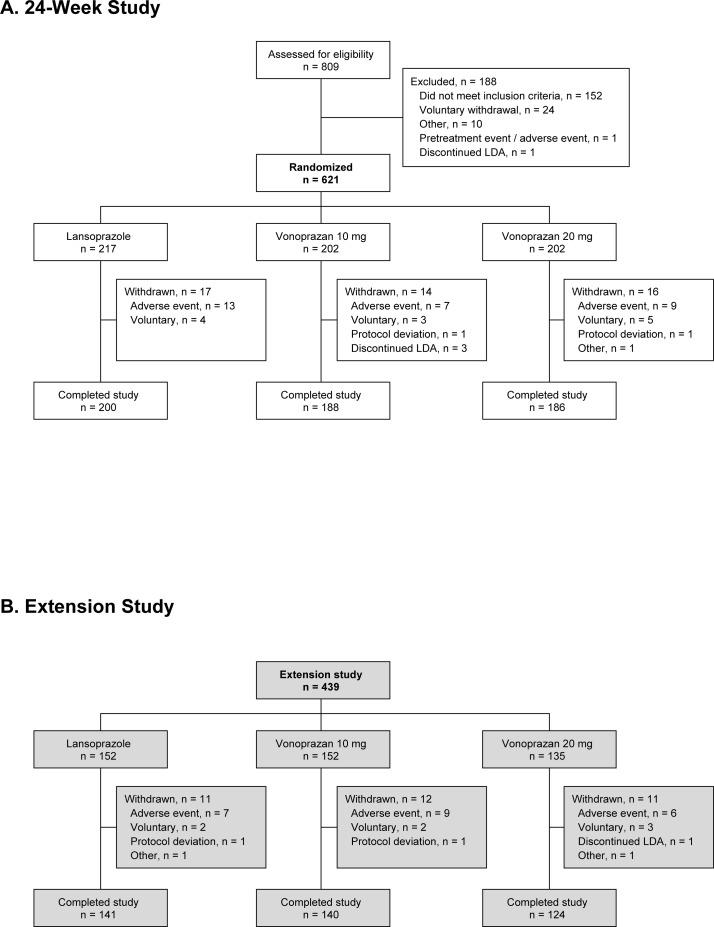
Double-blind, randomised, non-inferiority study; single-blind extension study at 104 Japanese sites, including 621 patients (439 in extension) with a history of peptic ulcers who required long-term LDA therapy. Randomised (1:1:1, computer generated) patients received lansoprazole 15 mg (n=217), vonoprazan 10 mg (n=202) or vonoprazan 20 mg (n=202) once daily for 24 weeks (double blind) and ≤2 years (extension). The following measurements were made: 24-week (primary outcome; double blind) and 12-week peptic ulcer recurrence rate, 24-week GI bleeding rate, cumulative incidences of peptic ulcer recurrence and GI bleeding, treatment-emergent adverse events, laboratory results, serum gastrin and pepsinogen I/II concentrations.
RESULTS
The 24-week peptic ulcer recurrence rate was 2.8%, 0.5% and 1.5% in the lansoprazole 15 mg, vonoprazan 10 mg and vonoprazan 20 mg groups, respectively. Vonoprazan was non-inferior (Farrington and Manning test: margin 8.7%, significance level 2.5%) to lansoprazole. In the post hoc analyses of the extension study, peptic ulcer recurrence rates were significantly lower with vonoprazan 10 mg (log-rank test, P=0.039), but not vonoprazan 20 mg (P=0.260), compared with lansoprazole 15 mg. GI bleeding rates were higher with lansoprazole compared with two doses of vonoprazan in both 24-week study and extension study.
CONCLUSION
Vonoprazan (10 and 20 mg) was as effective as lansoprazole (15 mg) in preventing peptic ulcer recurrence during LDA therapy, had a similar long-term safety profile and was well tolerated.
TRIAL REGISTRATION NUMBERS
NCT01452763; NCT01456247.
目的
在一项为期 24 周的研究中比较沃诺拉赞和兰索拉唑在预防低剂量阿司匹林(LDA)相关消化性溃疡复发方面的疗效和安全性,并在单独的研究中进行长期扩展治疗。
设计
双盲、随机、非劣效性研究;在 104 个日本地点进行的单盲扩展研究,包括 621 例(扩展研究中 439 例)有消化性溃疡病史且需要长期 LDA 治疗的患者。患者按 1:1:1(计算机生成)随机分配,接受兰索拉唑 15mg(n=217)、沃诺拉赞 10mg(n=202)或沃诺拉赞 20mg(n=202),每日 1 次,治疗 24 周(双盲)和最长 2 年(扩展)。主要测量指标为:24 周(主要结局;双盲)和 12 周消化性溃疡复发率、24 周胃肠道出血率、消化性溃疡复发和胃肠道出血的累积发生率、治疗期间发生的不良事件、实验室结果、血清胃泌素和胃蛋白酶原 I/II 浓度。
结果
兰索拉唑 15mg、沃诺拉赞 10mg 和沃诺拉赞 20mg 组 24 周消化性溃疡复发率分别为 2.8%、0.5%和 1.5%。沃诺拉赞与兰索拉唑相当(法林顿和曼宁检验:差值 8.7%,显著性水平 2.5%)。在扩展研究的事后分析中,与兰索拉唑 15mg 相比,沃诺拉赞 10mg 显著降低了消化性溃疡复发率(对数秩检验,P=0.039),但沃诺拉赞 20mg 差异无统计学意义(P=0.260)。在 24 周研究和扩展研究中,与兰索拉唑相比,两种剂量的沃诺拉赞胃肠道出血率均较高。
结论
沃诺拉赞(10mg 和 20mg)在预防 LDA 治疗期间消化性溃疡复发方面与兰索拉唑(15mg)同样有效,长期安全性相似,且耐受良好。
试验注册号
NCT01452763;NCT01456247。


 Zotero 插件