
从16S rRNA宏基因组数据预测肠道微生物群的功能概况,能更有力地评估日本2型糖尿病患者肠道菌群失调情况。
Prediction of functional profiles of gut microbiota from 16S rRNA metagenomic data provides a more robust evaluation of gut dysbiosis occurring in Japanese type 2 diabetic patients.
作者信息
Inoue Ryo, Ohue-Kitano Ryuji, Tsukahara Takamitsu, Tanaka Masashi, Masuda Shinya, Inoue Takayuki, Yamakage Hajime, Kusakabe Toru, Hasegawa Koji, Shimatsu Akira, Satoh-Asahara Noriko
机构信息
Laboratory of Animal Science, Kyoto Prefectural University, 1-5 Shimogamo Hangi-cho, Sakyo-ku, Kyoto 606-8522, Japan.
Department of Endocrinology, Metabolism, and Hypertension, National Hospital Organization Kyoto Medical Center, 1-1 Fukakusa Mukaihata-cho, Fushimi-ku, Kyoto 612-8555, Japan.
出版信息
J Clin Biochem Nutr. 2017 Nov;61(3):217-221. doi: 10.3164/jcbn.17-44. Epub 2017 Oct 11.
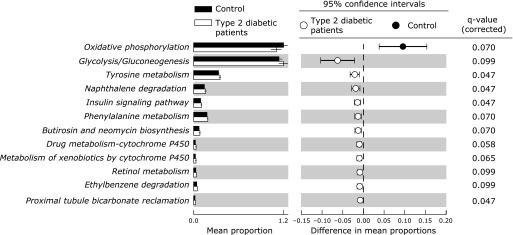
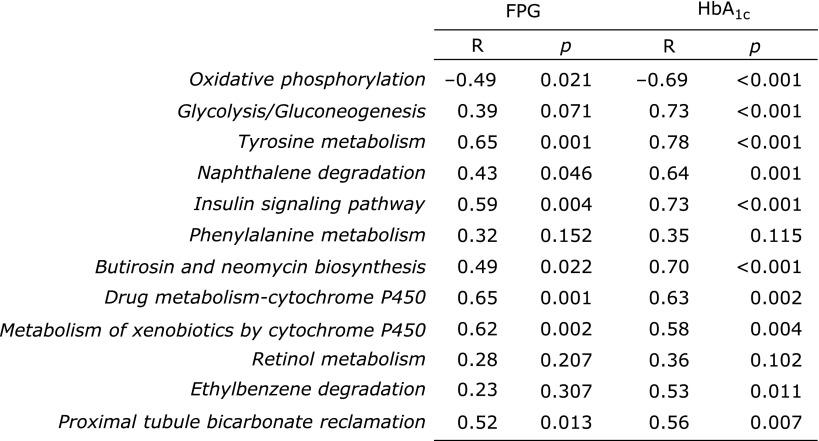
We assessed whether gut microbial functional profiles predicted from 16S rRNA metagenomics differed in Japanese type 2 diabetic patients. A total of 22 Japanese subjects were recruited from our outpatient clinic in an observational study. Fecal samples were obtained from 12 control and 10 type 2 diabetic subjects. 16S rRNA metagenomic data were generated and functional profiles predicted using "Phylogenetic Investigation of Communities by Reconstruction of Unobserved States" software. We measured the parameters of glucose metabolism, gut bacterial taxonomy and functional profile, and examined the associations in a cross-sectional manner. Eleven of 288 "Kyoto Encyclopedia of Genes and Genomes" pathways were significantly enriched in diabetic patients compared with control subjects (<0.05, q<0.1). The relative abundance of almost all pathways, including the and , showed strong, positive correlations with hemoglobin A (HbA) and fasting plasma glucose (FPG) levels. Bacterial taxonomic analysis showed that genus significantly differed between groups and had negative correlations with HbA and FPG levels. Our findings suggest a novel pathophysiological relationship between gut microbial communities and diabetes, further highlighting the significance and utility of combining prediction of functional profiles with ordinal bacterial taxonomic analysis (UMIN Clinical Trails Registry number: UMIN000026592).
我们评估了通过16S rRNA宏基因组学预测的肠道微生物功能谱在日本2型糖尿病患者中是否存在差异。在一项观察性研究中,我们从门诊诊所招募了22名日本受试者。从12名对照受试者和10名2型糖尿病受试者中获取粪便样本。生成了16S rRNA宏基因组数据,并使用“通过未观察状态的重建对群落进行系统发育研究”软件预测功能谱。我们测量了葡萄糖代谢、肠道细菌分类学和功能谱的参数,并以横断面方式检查了它们之间的关联。与对照受试者相比,288条“京都基因与基因组百科全书”通路中的11条在糖尿病患者中显著富集(<0.05,q<0.1)。几乎所有通路的相对丰度,包括[此处原文缺失具体通路名称]和[此处原文缺失具体通路名称],都与糖化血红蛋白(HbA)和空腹血糖(FPG)水平呈强正相关。细菌分类学分析表明,[此处原文缺失具体菌属名称]属在两组之间存在显著差异,并且与HbA和FPG水平呈负相关。我们的研究结果表明肠道微生物群落与糖尿病之间存在一种新的病理生理关系,进一步突出了将功能谱预测与有序细菌分类学分析相结合的意义和实用性(UMIN临床试验注册编号:UMIN000026592)。

 Zotero 插件