
作为研究脊髓形成、发育、功能和再生的模式生物。
as a Model Organism for the Study of Spinal Cord Formation, Development, Function and Regeneration.
机构信息
Department of Physiology & Membrane Biology and Institute for Pediatric Regenerative Medicine, Shriners Hospital for Children, University of California Davis School of Medicine, Sacramento, CA, United States.
出版信息
Front Neural Circuits. 2017 Nov 23;11:90. doi: 10.3389/fncir.2017.00090. eCollection 2017.
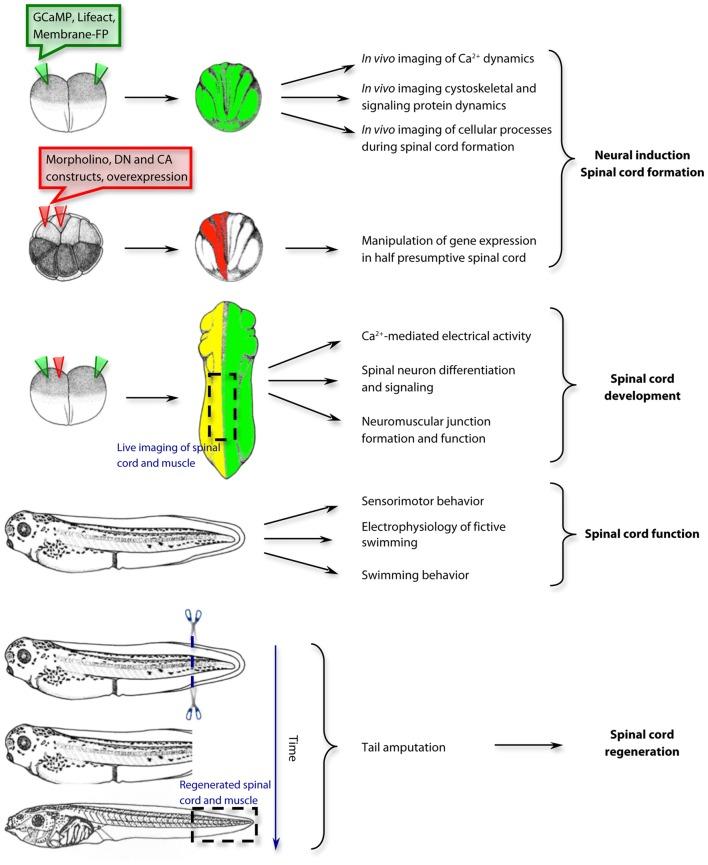
The spinal cord is the first central nervous system structure to develop during vertebrate embryogenesis, underscoring its importance to the organism. Because of its early formation, accessibility to the developing spinal cord in amniotes is challenging, often invasive and the experimental approaches amenable to model systems like mammals are limited. In contrast, amphibians, in general and the African-clawed frog , in particular, offer model systems in which the formation of the spinal cord, the differentiation of spinal neurons and glia and the establishment of spinal neuron and neuromuscular synapses can be easily investigated with minimal perturbations to the whole organism. The significant advances on gene editing and microscopy along with the recent completion of the genome sequencing have reinvigorated the use of this classic model species to elucidate the mechanisms of spinal cord formation, development, function and regeneration.
脊髓是脊椎动物胚胎发生过程中最早发育的中枢神经系统结构,这凸显了其对生物体的重要性。由于其早期形成,羊膜动物的发育中脊髓的可及性具有挑战性,通常是侵入性的,并且适用于哺乳动物等模型系统的实验方法有限。相比之下,一般来说,两栖动物,特别是非洲爪蟾,提供了模型系统,其中脊髓的形成、脊髓神经元和神经胶质的分化以及脊髓神经元和神经肌肉突触的建立可以很容易地在对整个生物体的最小干扰下进行研究。基因编辑和显微镜技术的显著进步,以及最近完成的基因组测序,重新激发了使用这种经典模式物种来阐明脊髓形成、发育、功能和再生机制的兴趣。
 Zotero 插件