
用于评估非小细胞肺癌中涉及免疫检查点抑制剂治疗策略的程序性死亡受体配体1免疫组织化学检测:一项比较研究
PD-L1 immunohistochemical assays for assessment of therapeutic strategies involving immune checkpoint inhibitors in non-small cell lung cancer: a comparative study.
作者信息
Kim Hyojin, Kwon Hyun Jung, Park Soo Young, Park Eunhyang, Chung Jin-Haeng
机构信息
Department of Pathology, Seoul National University Bundang Hospital, Seongnam, Republic of Korea.
Department of Pathology, Seoul National University College of Medicine, Seoul, Republic of Korea.
出版信息
Oncotarget. 2017 Oct 6;8(58):98524-98532. doi: 10.18632/oncotarget.21567. eCollection 2017 Nov 17.
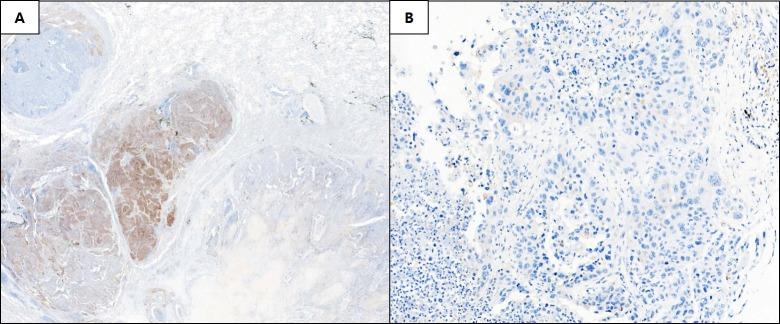
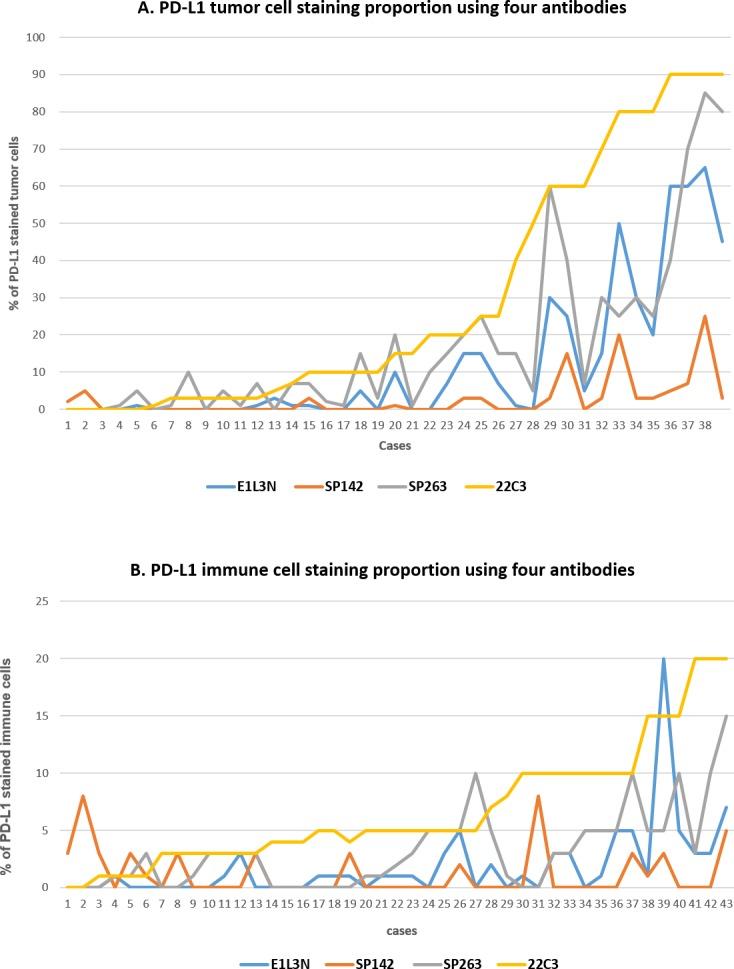
Although immune checkpoints inhibitors have exhibited promising activity in clinical trials in non-small cell lung cancer (NSCLC) patients, the current programmed cell death-ligand 1 (PD-L1) assays are inconsistent in terms of the staining analysis and scoring system used. To verify the interchangeability of the available PD-L1 assays, we performed immunohistochemistry using three antibody clones used in clinical trials (22C3, SP263, and SP142) and the E1L3N clone as a laboratory developed test for 97 resected NSCLC specimens. Matched tissue microarray specimens were also stained. Staining with 22C3 yielded a greater proportion of stained tumor cells, whereas SP142 staining consistently labelled fewer tumor cells. However, when various cut-off criteria were applied, the positivity rates for PD-L1 were similar, with high concordance, under assay-specific cut-offs. Moreover, seven cases of discordant PD-L1 expression between the resected specimen and matched tissue microarray specimens were observed. In conclusion, despite of inter-assay variability of the PD-L1 status in NSCLC, the positivity rate appears to be similar under assay-specific criteria. Hence, an appropriate clinically defined algorithm or cut-off should be separately applied for each assay. Moreover, multiple biopsy specimens from different tumor areas should be obtained to reduce false results due to intratumoral heterogeneity in PD-L1 expression.
尽管免疫检查点抑制剂在非小细胞肺癌(NSCLC)患者的临床试验中已展现出有前景的活性,但目前的程序性细胞死亡配体1(PD-L1)检测在所用的染色分析和评分系统方面并不一致。为验证现有PD-L1检测的互换性,我们使用了临床试验中使用的三种抗体克隆(22C3、SP263和SP142)以及E1L3N克隆对97例切除的NSCLC标本进行免疫组织化学检测,E1L3N克隆作为实验室研发的检测方法。匹配的组织微阵列标本也进行了染色。用22C3染色产生的染色肿瘤细胞比例更高,而SP142染色始终标记较少的肿瘤细胞。然而,当应用各种截断标准时,在特定检测的截断值下,PD-L1的阳性率相似,具有高度一致性。此外,观察到7例切除标本与匹配的组织微阵列标本之间PD-L1表达不一致的情况。总之,尽管NSCLC中PD-L1状态存在检测间的变异性,但在特定检测标准下阳性率似乎相似。因此,应针对每种检测分别应用适当的临床定义算法或截断值。此外,应从不同肿瘤区域获取多个活检标本,以减少因PD-L1表达的肿瘤内异质性导致的假结果。

 Zotero 插件