
使用同胞减法法通过全基因组测序鉴定因果突变。
Use of a Sibling Subtraction Method for Identifying Causal Mutations in by Whole-Genome Sequencing.
作者信息
Joseph Braveen B, Blouin Nicolas A, Fay David S
机构信息
Department of Molecular Biology, College of Agriculture and Natural Resources, University of Wyoming, Laramie, Wyoming 82071.
Idea Networks for Biomedical Research Excellence (INBRE) Bioinformatics Core, University of Wyoming, Laramie, Wyoming 82071.
出版信息
G3 (Bethesda). 2018 Feb 2;8(2):669-678. doi: 10.1534/g3.117.300135.
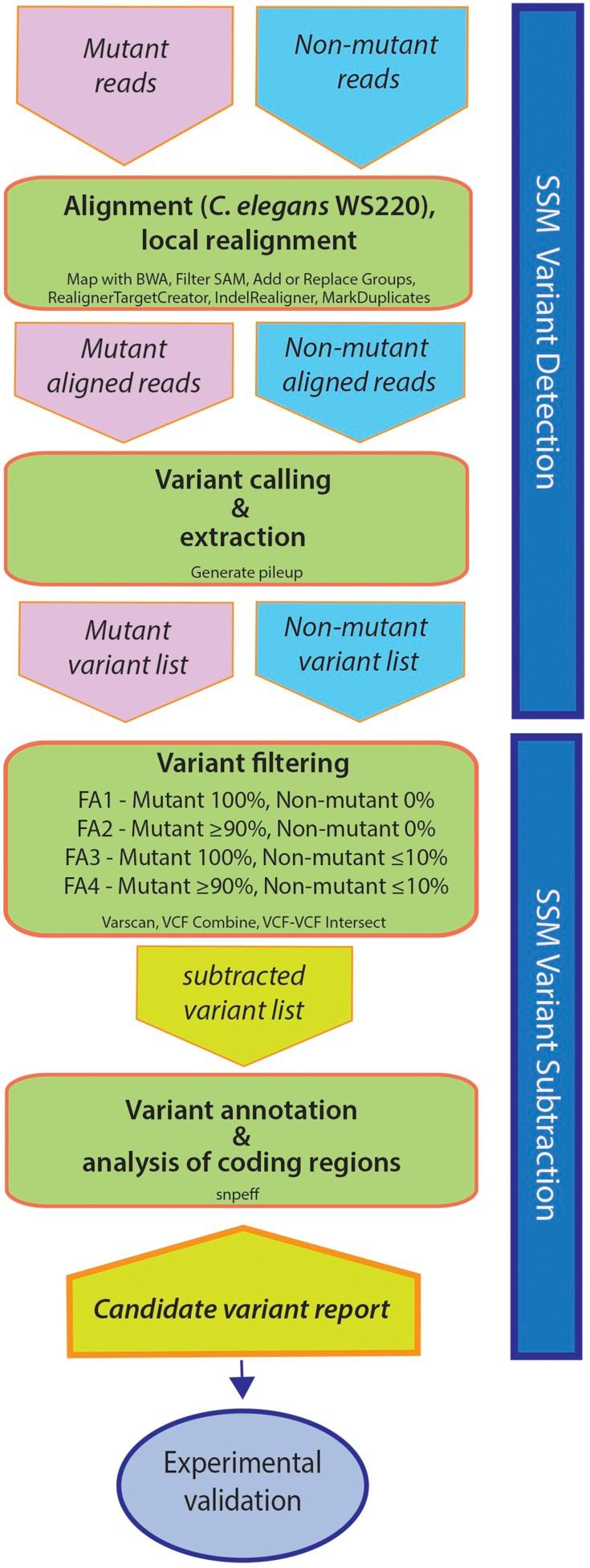
Whole-genome sequencing (WGS) is an indispensable tool for identifying causal mutations obtained from genetic screens. To reduce the number of causal mutation candidates typically uncovered by WGS, researchers have developed several strategies. One involves crossing N2-background mutants to the polymorphic Hawaiian (HA) strain, which can be used to simultaneously identify mutant strain variants and obtain high-density mapping information. This approach, however, is not well suited for uncovering mutations in complex genetic backgrounds, and HA polymorphisms can alter phenotypes. Other approaches make use of DNA variants present in the initial background or introduced by mutagenesis. This information is used to implicate genomic regions with high densities of DNA lesions that persist after backcrossing, but these methods can provide lower resolution than HA mapping. To identify suppressor mutations using WGS, we developed an approach termed the sibling subtraction method (SSM). This method works by eliminating variants present in both mutants and their nonmutant siblings, thus greatly reducing the number of candidates. We used this method with two members of the NimA-related kinase family, and Combining weak aphenotypic alleles of and leads to penetrant molting defects and larval arrest. We isolated ∼50 suppressors of ; synthetic lethality using F1 clonal screening methods and a -based counterselection strategy. When applied to five of the suppressors, SSM led to only one to four suppressor candidates per strain. Thus SSM is a powerful approach for identifying causal mutations in any genetic background and provides an alternative to current methods.
全基因组测序(WGS)是鉴定从遗传筛选中获得的致病突变的不可或缺的工具。为了减少WGS通常发现的致病突变候选基因的数量,研究人员已经开发了几种策略。一种方法是将N2背景突变体与多态性夏威夷(HA)菌株杂交,该菌株可用于同时鉴定突变体菌株变体并获得高密度图谱信息。然而,这种方法不太适合揭示复杂遗传背景中的突变,并且HA多态性可能会改变表型。其他方法利用初始背景中存在的或由诱变引入的DNA变体。这些信息用于暗示回交后仍存在的高密度DNA损伤的基因组区域,但这些方法提供的分辨率可能低于HA图谱。为了使用WGS鉴定抑制突变,我们开发了一种称为同胞减法法(SSM)的方法。该方法通过消除突变体及其非突变同胞中都存在的变体来起作用,从而大大减少了候选基因的数量。我们将这种方法应用于NimA相关激酶家族的两个成员,并且将 和 的弱表型等位基因组合会导致明显的蜕皮缺陷和幼虫停滞。我们使用F1克隆筛选方法和基于 的反选择策略分离出约50个 的抑制子。当将SSM应用于其中五个抑制子时,每个菌株仅产生一到四个抑制子候选基因。因此,SSM是在任何遗传背景下鉴定致病突变的有力方法,并为当前方法提供了一种替代方案。


 Zotero 插件