
关于电子烟室内公共使用、零售销售及价格的州法律——美国各州、关岛、波多黎各和美属维尔京群岛,2017年9月30日
State Laws Regarding Indoor Public Use, Retail Sales, and Prices of Electronic Cigarettes - U.S. States, Guam, Puerto Rico, and U.S. Virgin Islands, September 30, 2017.
作者信息
Marynak Kristy, Kenemer Brandon, King Brian A, Tynan Michael A, MacNeil Allison, Reimels Elizabeth
机构信息
Office on Smoking and Health, National Center for Chronic Disease Prevention and Health Promotion, CDC.
出版信息
MMWR Morb Mortal Wkly Rep. 2017 Dec 15;66(49):1341-1346. doi: 10.15585/mmwr.mm6649a1.
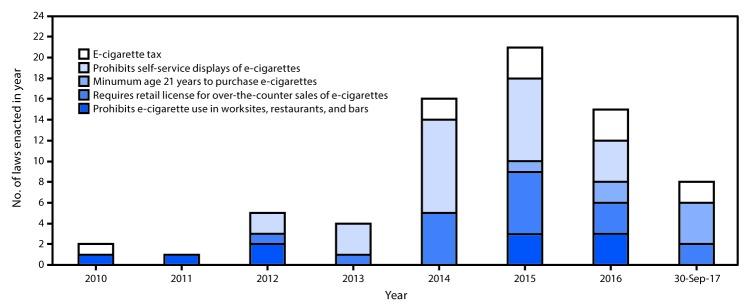
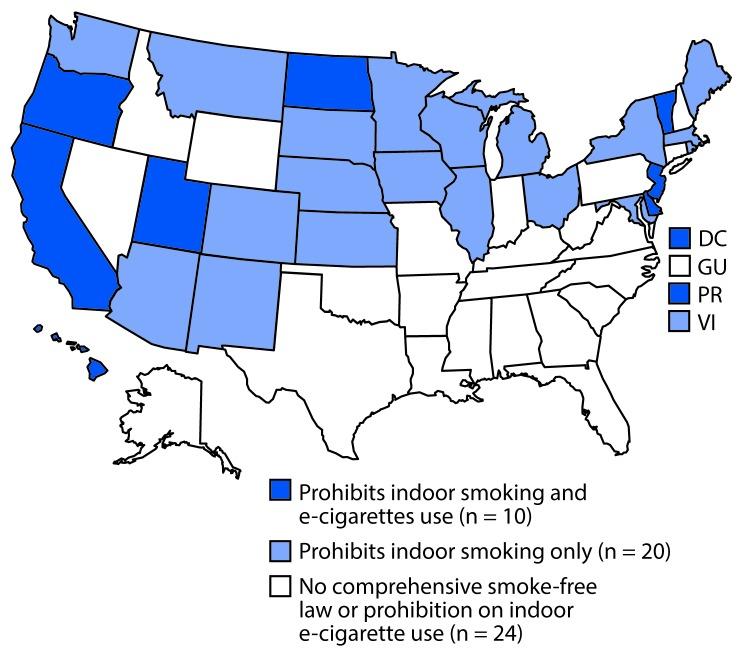
Electronic cigarettes (e-cigarettes) are the most frequently used tobacco product among U.S. youths, and past 30-day e-cigarette use is more prevalent among high school students than among adults (1,2). E-cigarettes typically deliver nicotine, and the U.S. Surgeon General has concluded that nicotine exposure during adolescence can cause addiction and can harm the developing adolescent brain (2). Through authority granted by the Family Smoking Prevention and Tobacco Control Act, the Food and Drug Administration (FDA) prohibits e-cigarette sales to minors, free samples, and vending machine sales, except in adult-only facilities (3). States, localities, territories, and tribes maintain broad authority to adopt additional or more stringent requirements regarding tobacco product use, sales, marketing, and other topics (2,4). To understand the current e-cigarette policy landscape in the United States, CDC assessed state and territorial laws that 1) prohibit e-cigarette use and conventional tobacco smoking indoors in restaurants, bars, and worksites; 2) require a retail license to sell e-cigarettes; 3) prohibit e-cigarette self-service displays (e.g., requirement that products be kept behind the counter or in a locked box); 4) establish 21 years as the minimum age of purchase for all tobacco products, including e-cigarettes (tobacco-21); and 5) apply an excise tax to e-cigarettes. As of September 30, 2017, eight states, the District of Columbia (DC), and Puerto Rico prohibited indoor e-cigarette use and smoking in indoor areas of restaurants, bars, and worksites; 16 states, DC, and the U.S. Virgin Islands required a retail license to sell e-cigarettes; 26 states prohibited e-cigarette self-service displays; five states, DC, and Guam had tobacco-21 laws; and eight states, DC, Puerto Rico, and the U.S. Virgin Islands taxed e-cigarettes. Sixteen states had none of the assessed laws. A comprehensive approach that combines state-level strategies to reduce youths' initiation of e-cigarettes and population exposure to e-cigarette aerosol, coupled with federal regulation, could help reduce health risks posed by e-cigarettes among youths (2,5).
电子烟是美国青少年中使用最为频繁的烟草制品,过去30天内使用电子烟的情况在高中生中比在成年人中更为普遍(1,2)。电子烟通常会释放尼古丁,美国卫生局局长已得出结论,青少年时期接触尼古丁会导致成瘾,并会损害青少年正在发育的大脑(2)。通过《家庭吸烟预防与烟草控制法案》授予的权力,美国食品药品监督管理局(FDA)禁止向未成年人销售电子烟、提供免费样品以及通过自动售货机销售电子烟,但在仅限成年人进入的场所除外(3)。各州、地方、领地和部落拥有广泛权力,可就烟草制品的使用、销售、营销及其他相关主题制定额外或更严格的要求(2,4)。为了解美国当前的电子烟政策状况,美国疾病控制与预防中心(CDC)评估了州和领地法律,这些法律包括:1)禁止在餐馆、酒吧和工作场所的室内区域使用电子烟及吸食传统烟草;2)要求销售电子烟需持有零售许可证;3)禁止电子烟自助展示(例如,要求产品存放在柜台后或上锁的盒子里);4)规定包括电子烟在内的所有烟草制品的最低购买年龄为21岁(烟草21岁政策);5)对电子烟征收消费税。截至2017年9月30日,八个州、哥伦比亚特区(DC)和波多黎各禁止在餐馆、酒吧和工作场所的室内区域使用电子烟及吸烟;16个州、DC和美属维尔京群岛要求销售电子烟需持有零售许可证;26个州禁止电子烟自助展示;五个州、DC和关岛实施了烟草21岁政策;八个州、DC、波多黎各和美属维尔京群岛对电子烟征税。16个州没有上述任何一项被评估的法律。将州层面减少青少年开始使用电子烟及减少人群接触电子烟烟雾的策略与联邦监管相结合的综合方法,有助于降低电子烟对青少年健康造成的风险(2,5)。
 Zotero 插件