
KH型剪接调节蛋白参与食管鳞状细胞癌的进展。
KH-type splicing regulatory protein is involved in esophageal squamous cell carcinoma progression.
作者信息
Fujita Yuji, Masuda Kiyoshi, Hamada Junichi, Shoda Katsutoshi, Naruto Takuya, Hamada Satoshi, Miyakami Yuko, Kohmoto Tomohiro, Watanabe Miki, Takahashi Rizu, Tange Shoichiro, Saito Masako, Kudo Yasusei, Fujiwara Hitoshi, Ichikawa Daisuke, Tangoku Akira, Otsuji Eigo, Imoto Issei
机构信息
Department of Human Genetics, Graduate School of Biomedical Sciences, Tokushima University, Tokushima, Japan.
Division of Digestive Surgery, Department of Surgery, Kyoto Prefectural University of Medicine, Kyoto, Japan.
出版信息
Oncotarget. 2017 Sep 15;8(60):101130-101145. doi: 10.18632/oncotarget.20926. eCollection 2017 Nov 24.
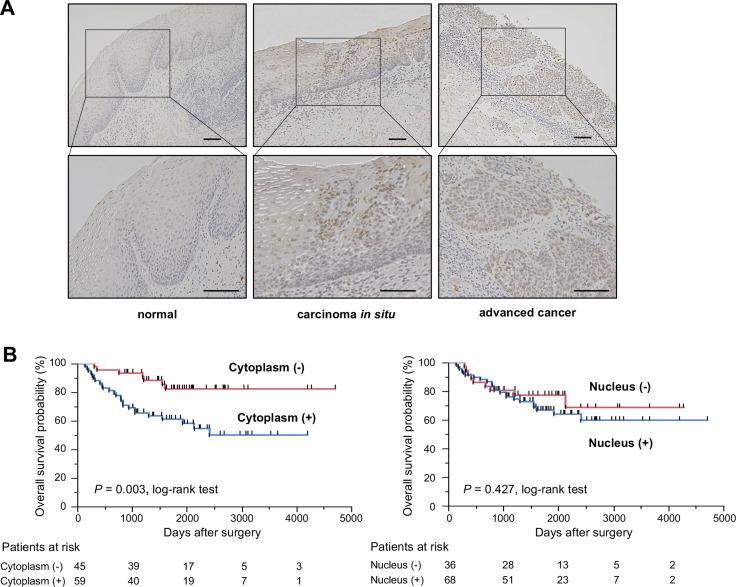
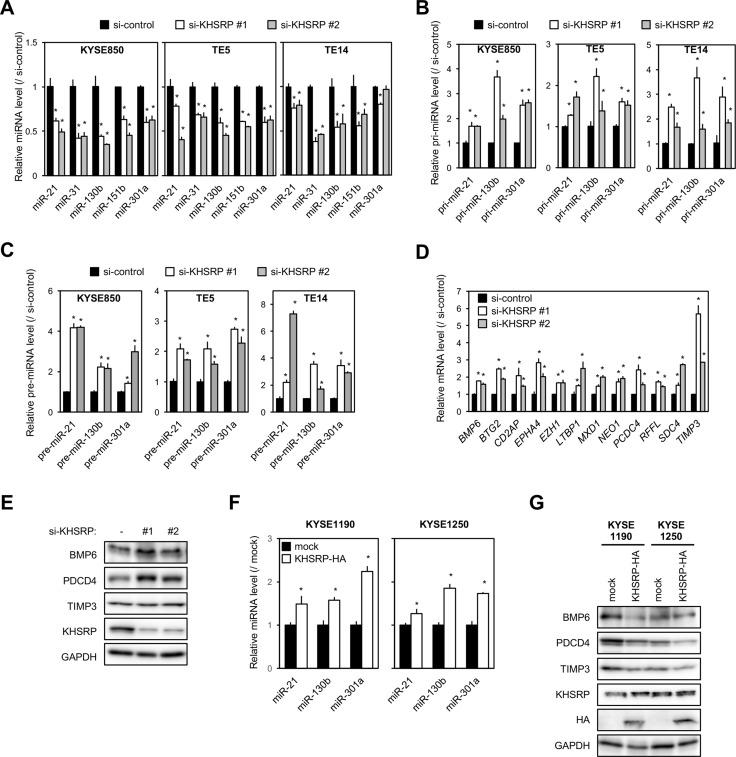
KH-type splicing regulatory protein (KHSRP) is a multifunctional RNA-binding protein, which is involved in several post-transcriptional aspects of RNA metabolism, including microRNA (miRNA) biogenesis. It affects distinct cell functions in different tissues and can have an impact on various pathological conditions. In the present study, we investigated the oncogenic functions of KHSRP and their underlying mechanisms in the pathogenesis of esophageal squamous cell carcinoma (ESCC). KHSRP expression levels were elevated in ESCC tumors when compared with those in non-tumorous tissues by immunohistochemistry, and cytoplasmic KHSRP overexpression was found to be an independent prognosticator for worse overall survival in a cohort of 104 patients with ESCC. KHSRP knockdown inhibited growth, migration, and invasion of ESCC cells. KHSRP knockdown also inhibited the maturation of cancer-associated miRNAs, such as miR-21, miR-130b, and miR-301, and induced the expression of their target mRNAs, such as and resulting in the inhibition of epithelial-to-mesenchymal transition. Our findings uncover a novel oncogenic function of KHSRP in esophageal tumorigenesis and implicate its use as a marker for prognostic evaluation and as a putative therapeutic target in ESCC.
KH型剪接调节蛋白(KHSRP)是一种多功能RNA结合蛋白,参与RNA代谢的多个转录后过程,包括微小RNA(miRNA)的生物合成。它在不同组织中影响不同的细胞功能,并可对各种病理状况产生影响。在本研究中,我们调查了KHSRP在食管鳞状细胞癌(ESCC)发病机制中的致癌功能及其潜在机制。通过免疫组织化学分析,与非肿瘤组织相比,ESCC肿瘤中KHSRP表达水平升高,并且在104例ESCC患者队列中发现细胞质KHSRP过表达是总体生存率较差的独立预后指标。KHSRP敲低抑制了ESCC细胞的生长、迁移和侵袭。KHSRP敲低还抑制了癌症相关miRNA(如miR-21、miR-130b和miR-301)的成熟,并诱导了它们靶mRNA(如 和 )的表达,从而抑制上皮-间质转化。我们的研究结果揭示了KHSRP在食管肿瘤发生中的一种新的致癌功能,并表明其可作为预后评估的标志物以及ESCC的潜在治疗靶点。



 Zotero 插件