
自体造血细胞移植后早期复发仍然是多发性骨髓瘤的一个不良预后因素,但随着时间的推移,结局已经有所改善。
Early relapse after autologous hematopoietic cell transplantation remains a poor prognostic factor in multiple myeloma but outcomes have improved over time.
机构信息
Mayo Clinic Rochester, Rochester, MN, USA.
CIBMTR (Center for International Blood and Marrow Transplant Research), Department of Medicine, Medical College of Wisconsin, Milwaukee, WI, USA.
出版信息
Leukemia. 2018 Apr;32(4):986-995. doi: 10.1038/leu.2017.331. Epub 2017 Nov 16.
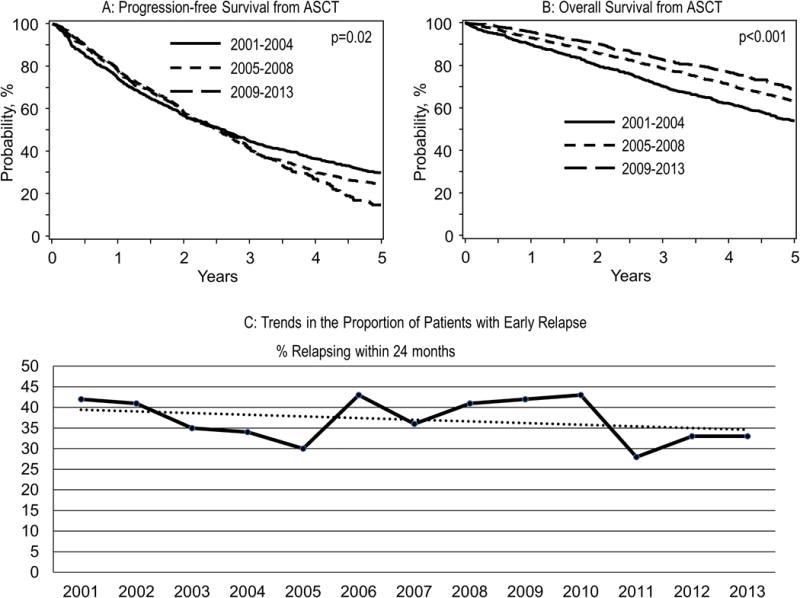
Duration of initial disease response remains a strong prognostic factor in multiple myeloma (MM) particularly for upfront autologous hematopoietic cell transplant (AHCT) recipients. We hypothesized that new drug classes and combinations employed prior to AHCT as well as after post-AHCT relapse may have changed the natural history of MM in this population. We analyzed the Center for International Blood and Marrow Transplant Research database to track overall survival (OS) of MM patients receiving single AHCT within 12 months after diagnosis (N=3256) and relapsing early post-AHCT (<24 months), and to identify factors predicting for early vs late relapses (24-48 months post-AHCT). Over three periods (2001-2004, 2005-2008, 2009-2013), patient characteristics were balanced except for lower proportion of Stage III, higher likelihood of one induction therapy with novel triplets and higher rates of planned post-AHCT maintenance over time. The proportion of patients relapsing early was stable over time at 35-38%. Factors reducing risk of early relapse included lower stage, chemosensitivity, transplant after 2008 and post-AHCT maintenance. Shorter post-relapse OS was associated with early relapse, IgA MM, Karnofsky <90, stage III, >1 line of induction and lack of maintenance. Post-AHCT early relapse remains a poor prognostic factor, even though outcomes have improved over time.
初始疾病缓解持续时间仍然是多发性骨髓瘤(MM)的一个强有力的预后因素,尤其是对于 upfront 自体造血细胞移植(AHCT)的受者。我们假设,在 AHCT 之前和 AHCT 后复发时使用的新药类别和组合可能已经改变了该人群中 MM 的自然史。我们分析了国际血液和骨髓移植研究中心数据库,以追踪在诊断后 12 个月内接受单次 AHCT 的 MM 患者的总生存率(OS)(N=3256)和早期 AHCT 后复发(<24 个月),并确定预测早期与晚期复发(AHCT 后 24-48 个月)的因素。在三个时期(2001-2004 年、2005-2008 年和 2009-2013 年)中,除了 III 期患者的比例较低、更有可能使用新型三联药物进行一次诱导治疗以及随着时间的推移计划进行 AHCT 后维持治疗的比例较高外,患者特征得到了平衡。早期复发的患者比例在 35-38%之间保持稳定。降低早期复发风险的因素包括较低的分期、化疗敏感性、2008 年后的移植和 AHCT 后维持治疗。与早期复发相关的是较短的缓解后 OS,IgA MM、Karnofsky<90、III 期、>1 线诱导治疗和缺乏维持治疗。即使随着时间的推移,预后有所改善,但 AHCT 后早期复发仍然是一个不良预后因素。

 Zotero 插件