
regorafenib和sorafenib在肝细胞癌临床前模型中的抗肿瘤作用。
Antitumor effects of regorafenib and sorafenib in preclinical models of hepatocellular carcinoma.
作者信息
Kissel Maria, Berndt Sandra, Fiebig Lukas, Kling Simon, Ji Qunsheng, Gu Qingyang, Lang Tina, Hafner Frank-Thorsten, Teufel Michael, Zopf Dieter
机构信息
Drug Discovery, Bayer AG, Wuppertal, Germany.
Drug Discovery, Bayer AG, Berlin, Germany.
出版信息
Oncotarget. 2017 Nov 6;8(63):107096-107108. doi: 10.18632/oncotarget.22334. eCollection 2017 Dec 5.
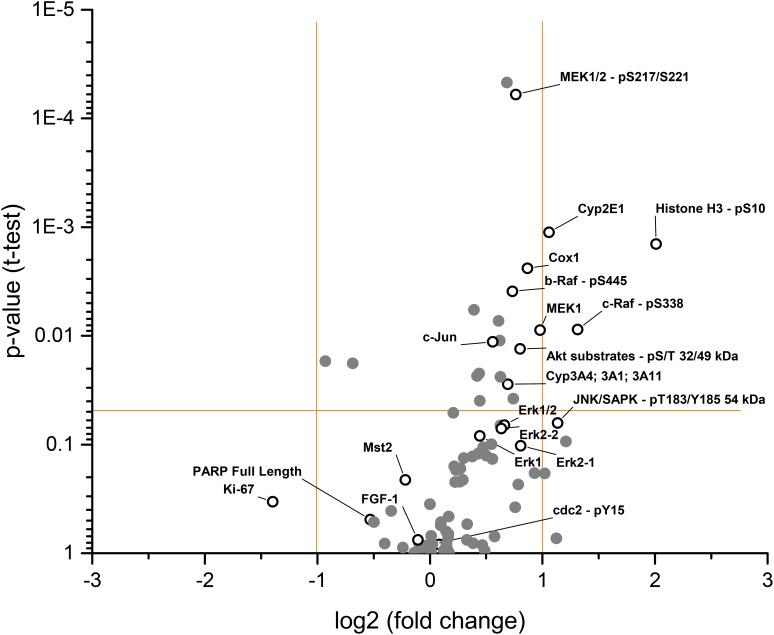
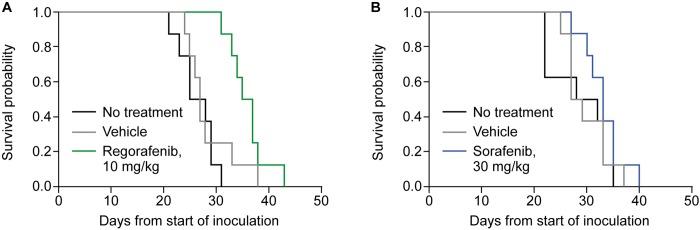
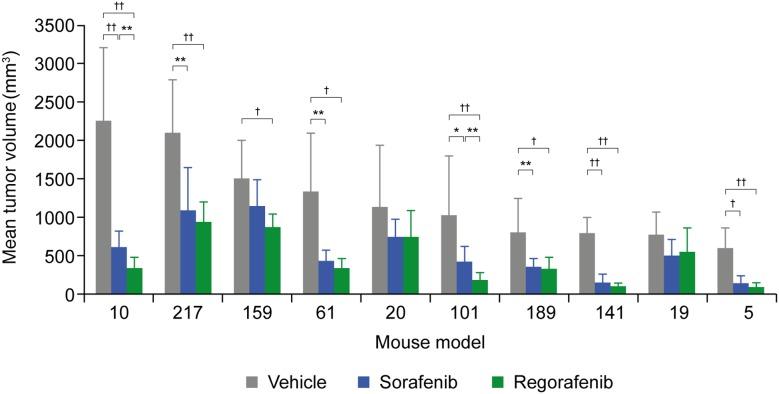
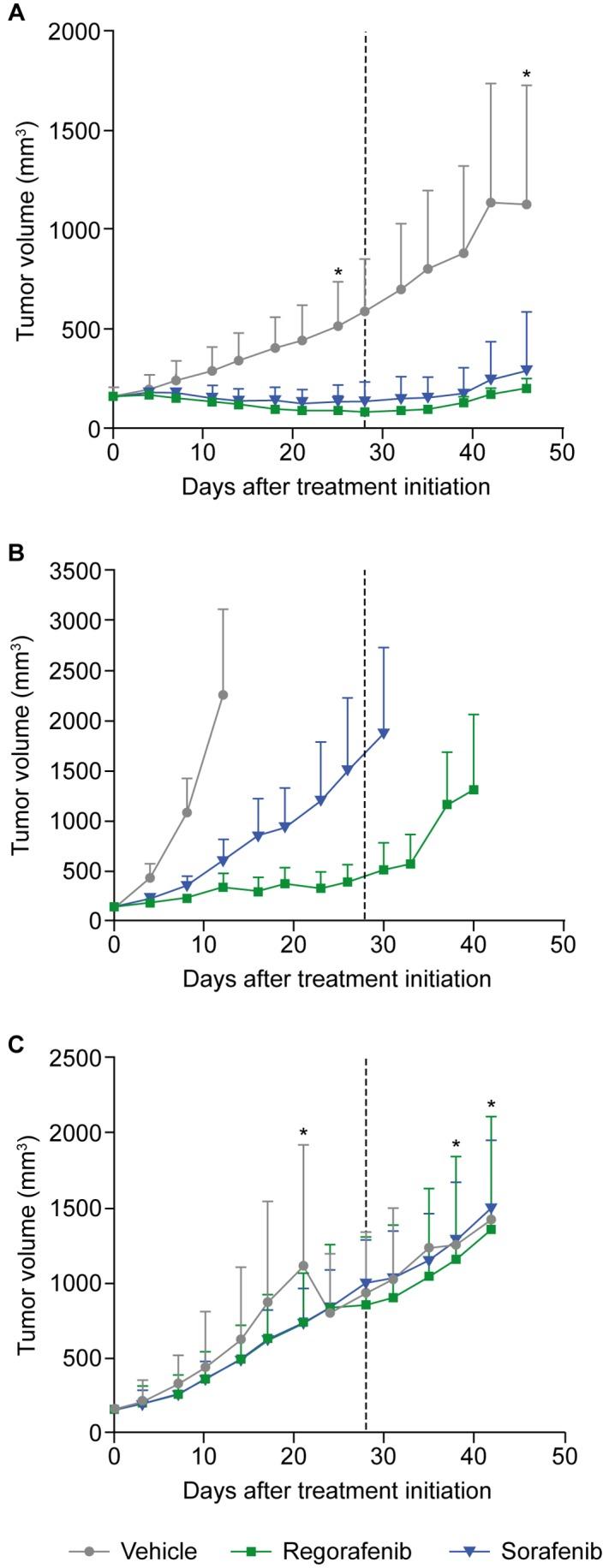
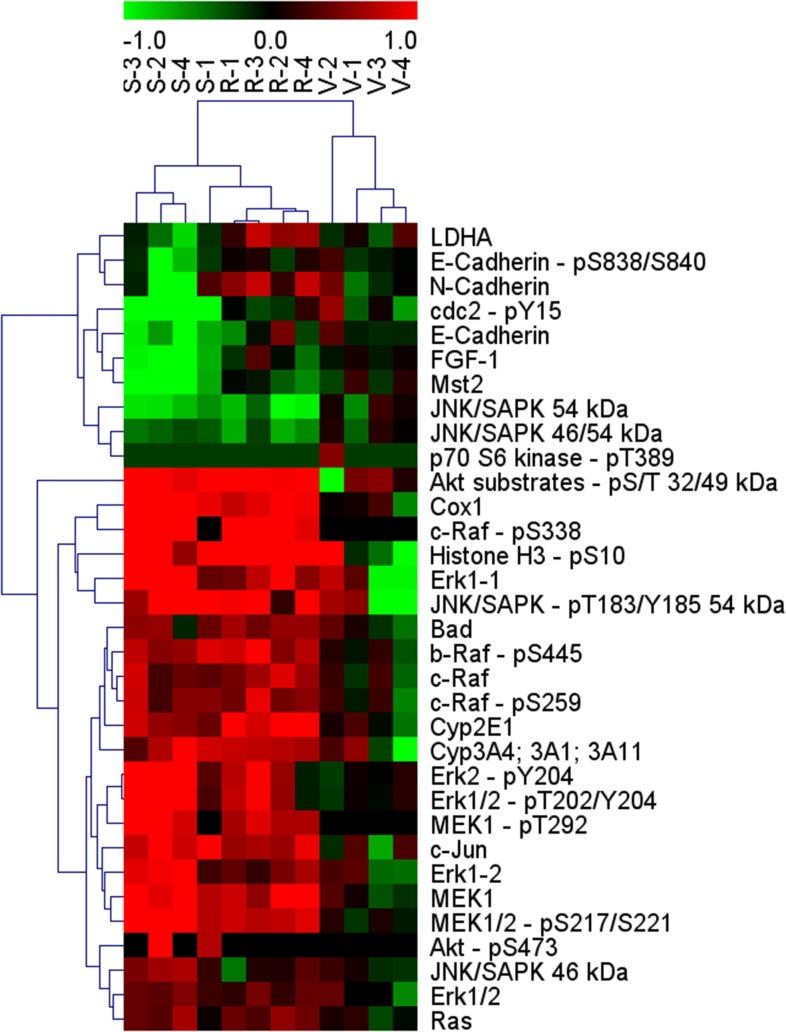
The purpose of this study was to investigate the antitumor activity of regorafenib and sorafenib in preclinical models of HCC and to assess their mechanism of action by associated changes in protein expression in a HCC-PDX mouse model. Both drugs were administered orally once daily at 10 mg/kg (regorafenib) or 30 mg/kg (sorafenib), which recapitulate the human exposure at the maximally tolerated dose in mice. In a H129 hepatoma model, survival times differed significantly between regorafenib versus vehicle (p=0.0269; median survival times 36 vs 27 days), but not between sorafenib versus vehicle (p=0.1961; 33 vs 28 days). Effects on tumor growth were assessed in 10 patient-derived HCC xenograft (HCC-PDX) models. Significant tumor growth inhibition was observed in 8/10 models with regorafenib and 7/10 with sorafenib; in four models, superior response was observed with regorafenib versus sorafenib which was deemed not to be due to lower sorafenib exposure. Bead-based multiplex western blot analysis was performed with total protein lysates from drug- and vehicle-treated HCC-PDX xenografts. Protein expression was substantially different in regorafenib- and sorafenib-treated samples compared with vehicle. The pattern of upregulated proteins was similar with both drugs and indicates an activated RAF/MEK/ERK pathway, but more proteins were downregulated with sorafenib versus regorafenib. Overall, both regorafenib and sorafenib were effective in mouse models of HCC, although several cases showed better regorafenib activity which may explain the observed efficacy of regorafenib in sorafenib-refractory patients.
本研究的目的是在肝癌临床前模型中研究瑞戈非尼和索拉非尼的抗肿瘤活性,并通过肝癌人源肿瘤异种移植(HCC-PDX)小鼠模型中蛋白质表达的相关变化来评估其作用机制。两种药物均以10mg/kg(瑞戈非尼)或30mg/kg(索拉非尼)的剂量每日口服一次,这模拟了小鼠最大耐受剂量下的人体暴露情况。在H129肝癌模型中,瑞戈非尼组与溶剂对照组的生存时间有显著差异(p=0.0269;中位生存时间分别为36天和27天),但索拉非尼组与溶剂对照组之间无显著差异(p=0.1961;分别为33天和28天)。在10个患者来源的肝癌异种移植(HCC-PDX)模型中评估了对肿瘤生长的影响。在10个模型中有8个使用瑞戈非尼、7个使用索拉非尼观察到显著的肿瘤生长抑制;在4个模型中,瑞戈非尼的反应优于索拉非尼,这被认为不是由于索拉非尼暴露量较低所致。对药物和溶剂处理的HCC-PDX异种移植瘤的总蛋白裂解物进行基于磁珠的多重蛋白质印迹分析。与溶剂处理组相比,瑞戈非尼和索拉非尼处理的样本中蛋白质表达有很大差异。两种药物上调的蛋白质模式相似,表明RAF/MEK/ERK通路被激活,但与瑞戈非尼相比,索拉非尼下调的蛋白质更多。总体而言,瑞戈非尼和索拉非尼在肝癌小鼠模型中均有效,尽管有几例显示瑞戈非尼活性更好,这可能解释了瑞戈非尼在索拉非尼难治性患者中观察到的疗效。
 Zotero 插件