
视觉搜索中的假性忽视:模拟神经回路中的行为证据和连接约束。
Pseudoneglect in Visual Search: Behavioral Evidence and Connectional Constraints in Simulated Neural Circuitry.
机构信息
Department of Humanistic Studies, University of Naples Federico II, 80133 Naples, Italy.
Institut National de la Santé et de la Recherche Médicale Unité 1127, Centre National de la Recherche Scientifique Unité Mixte de Recherche (UMR) 7225, Sorbonne Universités, Université Pierre-et-Marie-Curie Univ Paris 06 UMR S 1127, Institut du Cerveau et de la Moelle Épinière ICM, 75013 Paris, France.
出版信息
eNeuro. 2017 Dec 28;4(6). doi: 10.1523/ENEURO.0154-17.2017. eCollection 2017 Nov-Dec.
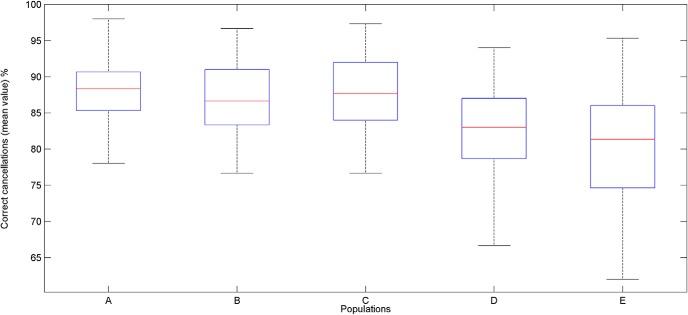
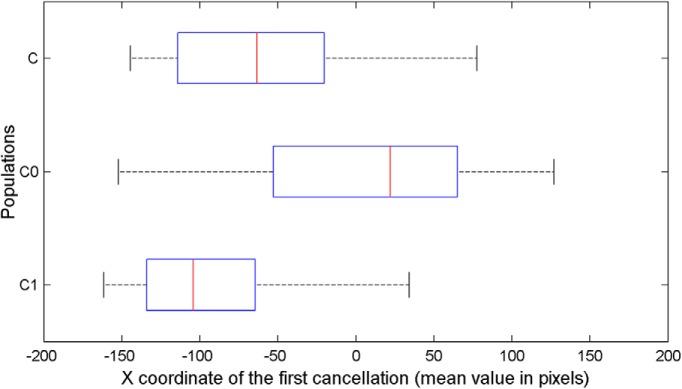
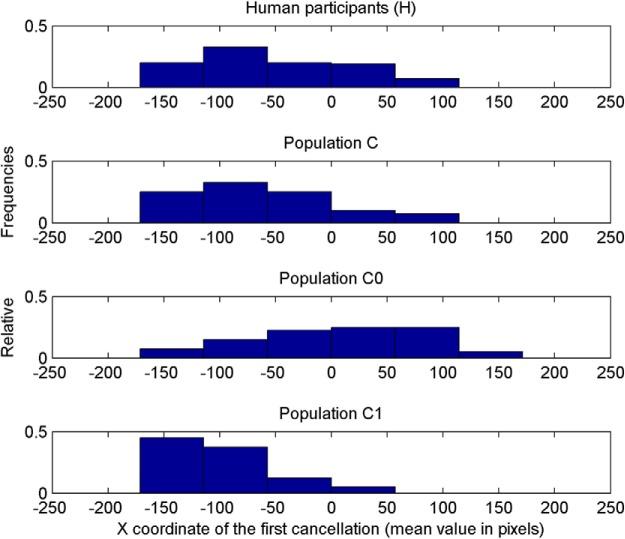
Most people tend to bisect horizontal lines slightly to the left of their true center (pseudoneglect) and start visual search from left-sided items. This physiological leftward spatial bias may depend on hemispheric asymmetries in the organization of attentional networks, but the precise mechanisms are unknown. Here, we modeled relevant aspects of the ventral and dorsal attentional networks (VAN and DAN) of the human brain. First, we demonstrated pseudoneglect in visual search in 101 right-handed psychology students. Participants consistently tended to start the task from a left-sided item, thus showing pseudoneglect. Second, we trained populations of simulated neurorobots to perform a similar task, by using a genetic algorithm. The neurorobots' behavior was controlled by artificial neural networks, which simulated the human VAN and DAN in the two brain hemispheres. Neurorobots differed in the connectional constraints that were applied to the anatomy and function of the attention networks. Results indicated that (1) neurorobots provided with a biologically plausible hemispheric asymmetry of the VAN-DAN connections, as well as with interhemispheric inhibition, displayed the best match with human data; however; (2) anatomical asymmetry per se was not sufficient to generate pseudoneglect; in addition, the VAN must have an excitatory influence on the ipsilateral DAN; and (3) neurorobots provided with bilateral competence in the VAN but without interhemispheric inhibition failed to display pseudoneglect. These findings provide a proof of concept of the causal link between connectional asymmetries and pseudoneglect and specify important biological constraints that result in physiological asymmetries of human behavior.
大多数人倾向于将水平线略微偏左于其真实中心(假性忽视),并从左侧的项目开始视觉搜索。这种生理上的左侧空间偏向可能取决于注意力网络组织中的半球不对称,但确切的机制尚不清楚。在这里,我们模拟了人类大脑腹侧和背侧注意力网络(VAN 和 DAN)的相关方面。首先,我们在 101 名右利手心理学学生的视觉搜索中证明了假性忽视。参与者始终倾向于从左侧的项目开始任务,因此表现出假性忽视。其次,我们通过遗传算法训练了模拟神经机器人来执行类似的任务。神经机器人的行为由人工神经网络控制,该网络模拟了人类大脑左右半球的 VAN 和 DAN。神经机器人在注意力网络的解剖结构和功能上的连接约束方面存在差异。结果表明:(1)提供了具有生物学意义的 VAN-DAN 连接半球不对称性以及半球间抑制的神经机器人,与人类数据的匹配最好;然而;(2)解剖学上的不对称性本身不足以产生假性忽视;此外,VAN 必须对同侧 DAN 具有兴奋性影响;(3)提供双侧 VAN 能力但没有半球间抑制的神经机器人未能表现出假性忽视。这些发现提供了连接不对称性和假性忽视之间因果关系的概念证明,并确定了导致人类行为生理不对称的重要生物学约束。





 Zotero 插件