
接受依鲁替尼治疗的患者心房颤动的累积发病率、危险因素及管理
Cumulative incidence, risk factors, and management of atrial fibrillation in patients receiving ibrutinib.
作者信息
Wiczer Tracy E, Levine Lauren B, Brumbaugh Jessica, Coggins Jessica, Zhao Qiuhong, Ruppert Amy S, Rogers Kerry, McCoy Anli, Mousa Luay, Guha Avirup, Heerema Nyla A, Maddocks Kami, Christian Beth, Andritsos Leslie A, Jaglowski Samantha, Devine Steven, Baiocchi Robert, Woyach Jennifer, Jones Jeffrey, Grever Michael, Blum Kristie A, Byrd John C, Awan Farrukh T
机构信息
Department of Pharmacy and.
Division of Hematology, The James Cancer Hospital and Solove Research Institute at The Ohio State University, Columbus, OH.
出版信息
Blood Adv. 2017 Sep 8;1(20):1739-1748. doi: 10.1182/bloodadvances.2017009720. eCollection 2017 Sep 12.
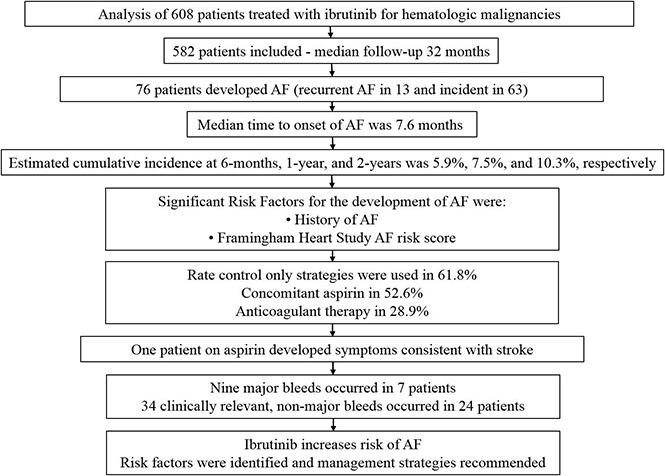
Atrial fibrillation (AF) has been reported in up to 16% of patients taking ibrutinib. Data regarding the management of AF in this patient population are limited, and stroke prevention poses a challenge because of increased risk of bleeding with ibrutinib treatment. Our study sought to describe the incidence of AF in adult patients treated with ibrutinib for a hematologic malignancy, assess management strategies, evaluate stroke and bleeding outcomes, and identify risk factors for occurrence. Of 582 patients treated with ibrutinib, 76 developed AF. With a median follow-up of 32 months, the estimated cumulative incidence at 6 months, 1 year, and 2 years was 5.9% (95% confidence interval [CI]: 4.2-8.0), 7.5% (95% CI: 5.5-9.9), and 10.3% (95% CI: 8.0-13.0), respectively. Median time to onset of AF was 7.6 months. History of AF and Framingham Heart Study (FHS) AF risk score were found to be significant risk factors for development of AF. Most patients were treated with rate control-only strategies (61.8%), and concomitant aspirin or anticoagulant therapy with ibrutinib was used in 52.6% and 28.9% of patients, respectively. One patient on aspirin developed symptoms consistent with stroke. Nine major bleeds were noted in 7 patients, and 34 clinically relevant nonmajor bleeds were noted in 24 patients. Twenty-one bleeds (4 major bleeds) occurred in 18 patients on aspirin, and 10 bleeds (all clinically relevant nonmajor bleeds) occurred in 6 patients with anticoagulant therapy. These results provide risk factor assessment, impact of management strategies, and outcomes of patients with AF on ibrutinib and serve as basis for formal guidelines.
据报道,接受依鲁替尼治疗的患者中,高达16%会出现心房颤动(AF)。关于该患者群体中房颤管理的数据有限,由于依鲁替尼治疗会增加出血风险,因此预防中风颇具挑战。我们的研究旨在描述接受依鲁替尼治疗血液系统恶性肿瘤的成年患者中房颤的发生率,评估管理策略,评估中风和出血结局,并确定发生的风险因素。在582例接受依鲁替尼治疗的患者中,76例发生了房颤。中位随访32个月,6个月、1年和2年时的估计累积发生率分别为5.9%(95%置信区间[CI]:4.2 - 8.0)、7.5%(95% CI:5.5 - 9.9)和10.3%(95% CI:8.0 - 13.0)。房颤发作的中位时间为7.6个月。房颤病史和弗雷明汉心脏研究(FHS)房颤风险评分被发现是房颤发生的重要风险因素。大多数患者仅接受心率控制策略治疗(61.8%),分别有52.6%和28.9%的患者在接受依鲁替尼治疗时同时使用了阿司匹林或抗凝治疗。1例服用阿司匹林的患者出现了与中风相符的症状。7例患者出现9次大出血,24例患者出现34次临床相关非大出血。18例服用阿司匹林的患者发生21次出血(4次大出血),6例接受抗凝治疗的患者发生10次出血(均为临床相关非大出血)。这些结果提供了风险因素评估、管理策略的影响以及房颤患者接受依鲁替尼治疗的结局,并作为正式指南的基础。
 Zotero 插件