
急性心肌梗死患者的全动脉血管重建术——可行性与结果
Total arterial revascularization in patients with acute myocardial infarction - feasibility and outcomes.
作者信息
Grieshaber Philippe, Oster Lukas, Schneider Tobias, Johnson Victoria, Orhan Coskun, Roth Peter, Niemann Bernd, Böning Andreas
机构信息
Department of Adult and Pediatric Cardiovascular Surgery, University Hospital Giessen, Rudolf-Buchheim-Str. 7, DE-35392, Giessen, Germany.
Department of Anaesthesiology, Sana Hospital Berlin-Lichtenberg, Berlin, Germany.
出版信息
J Cardiothorac Surg. 2018 Jan 5;13(1):2. doi: 10.1186/s13019-017-0691-4.
BACKGROUND
In acute situations such as acute myocardial infarction (AMI) with indication for coronary artery bypass grafting (CABG), total arterial revascularization (TAR) is often rejected in favour of saphenous vein (SV) grafting, which is assumed to allow for quicker vessel harvesting, a simpler anastomosis technique, and thus quicker revascularization and fewer bleeding complications. The aim of this study was to evaluate whether reluctance to apply TAR in AMI is still justified from a technical point of view in the current era and whether superiority of TAR results is also evident in emergency patients with AMI undergoing CABG.
METHODS
In this retrospective analysis of 434 consecutive patients undergoing CABG for AMI with either TAR or with a combination of one internal mammary artery and SV grafts between 2008 and 2014, procedural data, short-term and mid-term outcome were compared. Propensity score matching of the groups was performed.
RESULTS
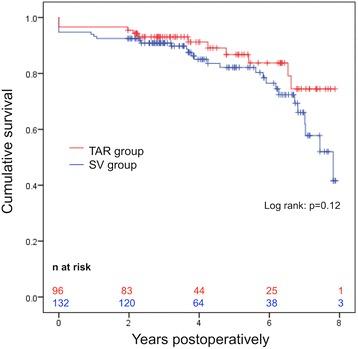
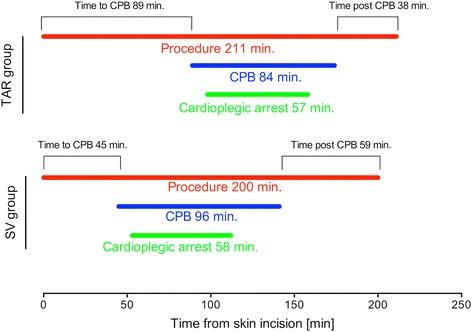
After propensity score matching, 250 patients were included in the analysis (TAR group: n = 98; SV group n = 152). The procedural time (TAR group: 211 min vs. SV group: 200 min, p = 0.46) did not differ between the groups. Erythrocyte transfusion rates were higher in the SV group (76% vs. 57%; p < 0.001). Rates of re-exploration for bleeding did not differ. Thirty-day mortality rates were comparable (TAR group: 3.4% vs. SV group: 4.5%, p = 0.68). Kaplan-Meier analysis until 7 years postoperatively revealed a tendency for improved survival after TAR (75% vs. 62%; log-rank p = 0.12).
CONCLUSION
TAR neither impairs rapid revascularization nor reduces its safety in patients with AMI. It may result in improved long-term outcome and should be preferred in the clinical setting of AMI.
背景
在急性心肌梗死(AMI)等需要进行冠状动脉旁路移植术(CABG)的急性情况下,全动脉血运重建(TAR)常被摒弃,而倾向于采用大隐静脉(SV)移植,因为人们认为SV移植能更快地获取血管,吻合技术更简单,从而实现更快的血运重建且减少出血并发症。本研究的目的是评估在当前时代,从技术角度来看,在AMI中不愿应用TAR是否仍然合理,以及TAR在接受CABG的AMI急诊患者中是否也具有明显的优势。
方法
对2008年至2014年间连续434例因AMI接受CABG的患者进行回顾性分析,这些患者接受了TAR或一侧胸廓内动脉与SV移植相结合的手术,比较了手术数据、短期和中期结果。对两组进行倾向评分匹配。
结果
倾向评分匹配后,250例患者纳入分析(TAR组:n = 98;SV组:n = 152)。两组之间的手术时间(TAR组:211分钟 vs. SV组:200分钟,p = 0.46)无差异。SV组的红细胞输注率更高(76% vs. 57%;p < 0.001)。因出血再次手术的发生率无差异。30天死亡率相当(TAR组:3.4% vs. SV组:4.5%,p = 0.68)。术后7年的Kaplan-Meier分析显示,TAR术后生存有改善趋势(75% vs. 62%;对数秩检验p = 0.12)。
结论
TAR既不损害AMI患者的快速血运重建,也不降低其安全性。它可能会改善长期预后,在AMI的临床情况下应优先选择。

 Zotero 插件