
在一家临床诊断实验室,对630名连续转诊进行检测的患者进行了一项27基因遗传性癌症检测板的评估。
Evaluation of a 27-gene inherited cancer panel across 630 consecutive patients referred for testing in a clinical diagnostic laboratory.
作者信息
Gardner Sabrina A, Weymouth Katelyn S, Kelly Wei S, Bogdanova Ekaterina, Chen Wenjie, Lupu Daniel, Suhl Joshua, Zeng Qiandong, Geigenmüller Ute, Boles Debbie, Okamoto Patricia M, McDowell Geraldine, Hayden Melissa A, Nagan Narasimhan
机构信息
Integrated Genetics, Laboratory Corporation of America® Holdings, Research Triangle Park, NC and 3400 Computer Drive, Westborough, MA 01581 USA.
出版信息
Hered Cancer Clin Pract. 2018 Jan 4;16:1. doi: 10.1186/s13053-017-0083-8. eCollection 2018.
BACKGROUND
Extensive clinical and genetic heterogeneity of inherited cancers has allowed multi-gene panel testing to become an efficient means for identification of patients with an inherited predisposition to a broad spectrum of syndromic and nonsyndromic forms of cancer. This study reports our experience with a 27-gene inherited cancer panel on a cohort of 630 consecutive individuals referred for testing at our laboratory with the following objectives: 1. Determine the rates for positive cases and those with variants of uncertain clinical significance (VUS) relative to data published in the recent literature, 2. Examine heterogeneity among the constituent genes on the panel, and 3. Review test uptake in the cohort relative to other reports describing outcomes for expanded panel testing.
METHODS
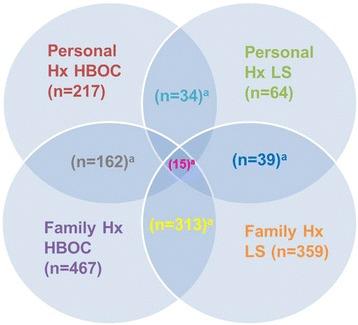
Clinical and genomic data were reviewed on 630 individuals tested on a panel of 27 genes selected on the basis of high (≥ 40%) or moderate to low (≤ 40%) lifetime risk of hereditary cancer. These patients were not enriched for adherence to the National Comprehensive Cancer Network (NCCN) criteria for Hereditary Breast and Ovarian Cancer (HBOC) or Lynch Syndrome (LS) and constitute a referral laboratory cohort.
RESULTS
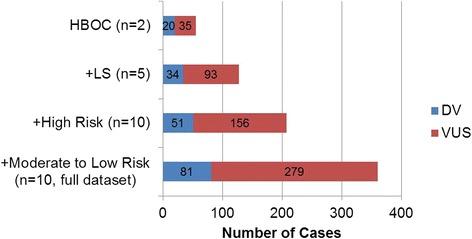
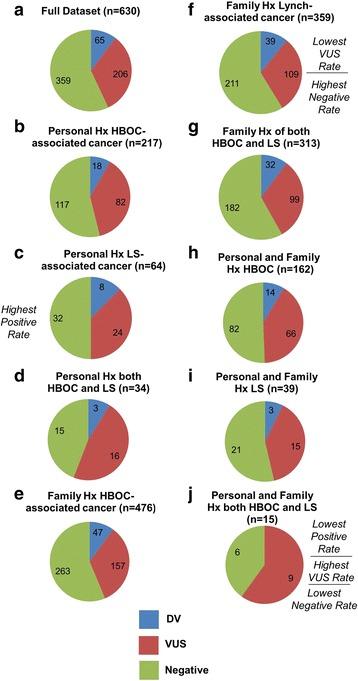
Sixty-five individuals with variants classified as pathogenic or likely pathogenic across 14 genes were identified for an overall positive rate of 10.3%. Although a family history of cancer constituted a major reason for referral, accounting for 84% of our cohort, excluding patients with a known familial variant did not have a significant impact on the observed positive rate (9% vs 10.3%). More than half (58%) of the pathogenic or likely pathogenic variants were observed in high or moderate to low risk genes on the panel, while only 42% occurred in classic HBOC or LS-associated genes.
CONCLUSION
These results provide the actual percentage of family or personal history of cancer that can be attributed to pathogenic or likely pathogenic variants in one or more of the genes on our panel and corroborate the utility of multi-gene panels over sequential testing to identify individuals with an inherited predisposition to cancer.
背景
遗传性癌症广泛的临床和基因异质性使得多基因检测成为识别具有广泛综合征性和非综合征性癌症遗传易感性患者的有效手段。本研究报告了我们在一组630名连续个体中使用27基因遗传性癌症检测面板的经验,这些个体被转介到我们实验室进行检测,目的如下:1. 相对于近期文献中公布的数据,确定阳性病例和具有临床意义未明变异(VUS)的病例的比例;2. 检查检测面板中各组成基因之间的异质性;3. 相对于其他描述扩展检测面板结果的报告,回顾该队列中的检测接受情况。
方法
回顾了630名个体的临床和基因组数据,这些个体接受了基于遗传性癌症高(≥40%)或中低(≤40%)终身风险选择的27个基因的检测面板检测。这些患者并未因遵循国家综合癌症网络(NCCN)遗传性乳腺癌和卵巢癌(HBOC)或林奇综合征(LS)标准而被富集,构成了一个转诊实验室队列。
结果
在14个基因中鉴定出65名具有分类为致病或可能致病变异的个体,总体阳性率为10.3%。尽管癌症家族史是转诊的主要原因,占我们队列的84%,但排除已知家族变异的患者对观察到的阳性率没有显著影响(9%对10.3%)。超过一半(58%)的致病或可能致病变异出现在检测面板中的高风险或中低风险基因中,而只有42%出现在经典的HBOC或LS相关基因中。
结论
这些结果提供了可归因于我们检测面板中一个或多个基因的致病或可能致病变异的癌症家族史或个人史的实际百分比,并证实了多基因检测面板相对于序贯检测在识别具有癌症遗传易感性个体方面的效用。

 Zotero 插件