
塞古地区 2012-2015 年非拟除虫菊酯类室内滞留喷洒对疟疾发病率影响的观察性分析
An observational analysis of the impact of indoor residual spraying with non-pyrethroid insecticides on the incidence of malaria in Ségou Region, Mali: 2012-2015.
机构信息
PATH, Washington, DC, USA.
PMI, Bamako, Mali.
出版信息
Malar J. 2018 Jan 10;17(1):19. doi: 10.1186/s12936-017-2168-2.
BACKGROUND
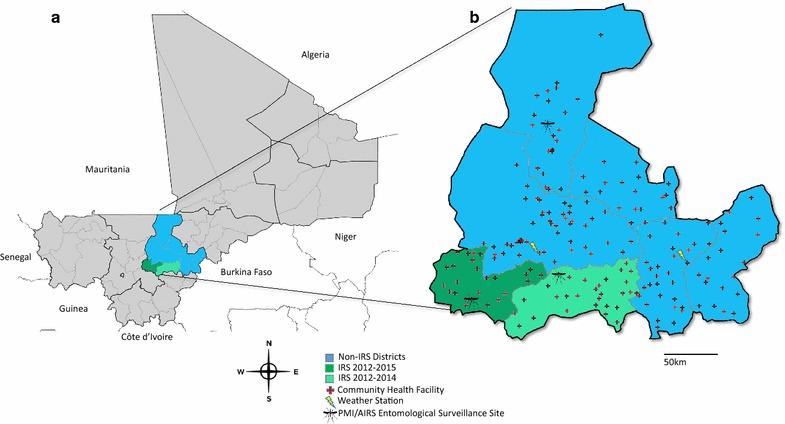
Ségou Region in Central Mali is an area of high malaria burden with seasonal transmission, high access to and use of long-lasting insecticidal nets (LLINs), and resistance to pyrethroids and DDT well documented in Anopheles gambiae s.l. (the principal vector of malaria in Mali). Ségou has recently received indoor residual spraying (IRS) supported by Mali's collaboration with the US President's Malaria Initiative/Africa Indoor Residual Spraying programme. From 2012 to 2015, two different non-pyrethroid insecticides: bendiocarb in 2012 and 2013 and pirimiphos-methyl in 2014 and 2015, were used for IRS in two districts. This report summarizes the results of observational analyses carried out to assess the impact of these IRS campaigns on malaria incidence rates reported through local and district health systems before and after spraying.
METHODS
A series of retrospective time series analyses were performed on 1,382,202 rapid diagnostic test-confirmed cases of malaria reported by district routine health systems in Ségou Region from January 2012 to January 2016. Malaria testing, treatment, surveillance and reporting activities remained consistent across districts and years during the study period, as did LLIN access and use estimates as well as An. gambiae s.l. insecticide resistance patterns. Districts were stratified by IRS implementation status and all-age monthly incidence rates were calculated and compared across strata from 2012 to 2014. In 2015 a regional but variable scale-up of seasonal malaria chemoprevention complicated the region-wide analysis; however IRS operations were suspended in Bla District that year so a difference in differences approach was used to compare 2014 to 2015 changes in malaria incidence at the health facility level in children under 5-years-old from Bla relative to changes observed in Barouéli, where IRS operations were consistent.
RESULTS
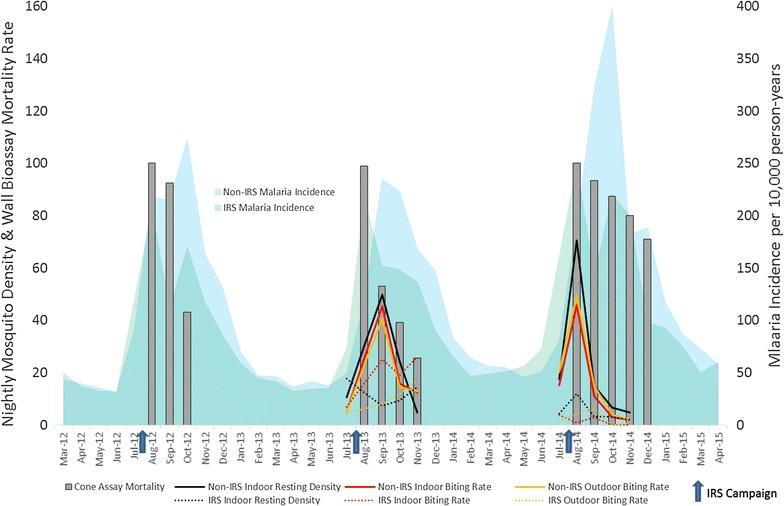
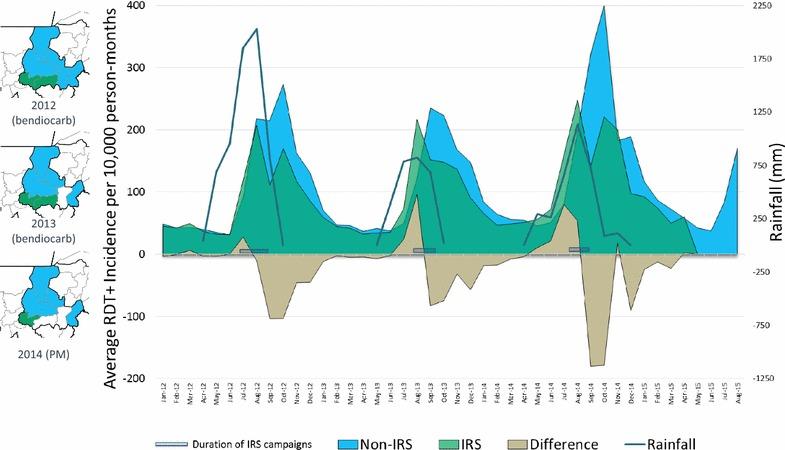
During 2012-2014, rapid reductions in malaria incidence were observed during the 6 months following each IRS campaign, though most of the reduction in cases (70% of the total) was concentrated in the first 2 months after each campaign was completed. Compared to non-IRS districts, in which normal seasonal patterns of malaria incidence were observed, an estimated 286,745 total fewer cases of all-age malaria were observed in IRS districts. The total cost of IRS in Ségou was around 9.68 million USD, or roughly 33.75 USD per case averted. Further analysis suggests that the timing of the 2012-2014 IRS campaigns (spraying in July and August) was well positioned to maximize public health impact. Suspension of IRS in Bla District after the 2014 campaign resulted in a 70% increase in under-5-years-old malaria incidence rates from 2014 to 2015, significantly greater (p = 0.0003) than the change reported from Barouéli District, where incidence rates remained the same.
CONCLUSIONS
From 2012 to 2015, the annual IRS campaigns in Ségou are associated with several hundred thousand fewer cases of malaria. This work supports the growing evidence that shows that IRS with non-pyrethroid insecticides is a wise public health investment in areas with documented pyrethroid resistance, high rates of LLIN coverage, and where house structures and population densities are appropriate. Additionally, this work highlights the utility of quality-assured and validated routine surveillance and well defined observational analyses to rapidly assess the impact of malaria control interventions in operational settings, helping to empower evidence-based decision making and to further grow the evidence base needed to better understand when and where to utilize new vector control tools as they become available.
背景
马里中部的塞古地区疟疾负担沉重,具有季节性传播的特点,长效驱虫蚊帐(LLINs)的可及性和使用率高,并且在安蚊 gambiae s.l.(马里的主要疟疾传播媒介)中对拟除虫菊酯和滴滴涕的抗药性得到了充分记录。塞古最近在马里与美国总统疟疾倡议/非洲室内残留喷洒计划合作的支持下接受了室内残留喷洒(IRS)。从 2012 年到 2015 年,两种不同的非拟除虫菊酯杀虫剂:2012 年和 2013 年使用苯氧威,2014 年和 2015 年使用吡虫啉,用于两个区的 IRS。本报告总结了在喷洒前后通过当地和地区卫生系统报告的疟疾发病率进行的观察性分析的结果,以评估这些 IRS 运动对疟疾发病率的影响。
方法
对 2012 年 1 月至 2016 年 1 月塞古地区常规卫生系统报告的 1382202 例快速诊断检测确诊的疟疾病例进行了一系列回顾性时间序列分析。在研究期间,疟疾检测、治疗、监测和报告活动在各地区保持一致,LLIN 的可及性和使用率以及安蚊 gambiae s.l. 的杀虫剂耐药模式也保持一致。按 IRS 实施情况对地区进行分层,并计算了所有年龄组的每月发病率,并在 2012 年至 2014 年期间对各分层的发病率进行了比较。2015 年,季节性疟疾化学预防的区域范围扩大,使全区域分析变得复杂;然而,当年 Bla 区暂停了 IRS 作业,因此采用差异与差异方法比较 Bla 区五岁以下儿童的卫生设施级别在 2014 年至 2015 年期间疟疾发病率的变化,与 Barouéli 区观察到的变化相比,Barouéli 区的 IRS 作业保持不变。
结果
在 2012-2014 年期间,每次 IRS 运动后 6 个月内,疟疾发病率迅速下降,尽管大多数病例减少(占总数的 70%)集中在每次运动结束后的头 2 个月内。与未进行 IRS 的地区相比,在 IRS 地区观察到的全年龄段疟疾总病例数减少了 286745 例。塞古的 IRS 总成本约为 968 万美元,或每例避免的病例约为 33.75 美元。进一步的分析表明,2012-2014 年 IRS 运动的时间安排(7 月和 8 月喷洒)非常有利于最大限度地提高公共卫生的影响。2014 年 IRS 运动后,Bla 区暂停 IRS 导致 2014 年至 2015 年五岁以下儿童疟疾发病率增加 70%,与 Barouéli 区的变化相比,差异显著(p=0.0003),后者的发病率保持不变。
结论
从 2012 年到 2015 年,塞古的年度 IRS 运动与数十万例疟疾病例减少有关。这项工作支持越来越多的证据表明,在有记录的拟除虫菊酯耐药、高覆盖率的长效驱虫蚊帐和适合房屋结构和人口密度的地区,使用非拟除虫菊酯杀虫剂的 IRS 是明智的公共卫生投资。此外,这项工作强调了使用经过质量保证和验证的常规监测和明确的观察性分析来快速评估疟疾控制干预措施的影响的实用性,有助于为基于证据的决策提供支持,并进一步扩大为更好地了解何时何地利用新的病媒控制工具所需的证据基础,因为这些工具正在变得可用。


 Zotero 插件