
南非学龄儿童严重创伤性脑损伤后的学业和行为结果
Academic and Behavioral Outcomes in School-Age South African Children Following Severe Traumatic Brain Injury.
作者信息
Dollman Aimee K, Figaji Anthony A, Schrieff-Elson Leigh E
机构信息
Applied Cognitive Science and Experimental Neuropsychology Team, Department of Psychology, University of Cape Town, Cape Town, South Africa.
Division of Neurosurgery, Department of Surgery, School of Child and Adolescent Health, University of Cape Town, Red Cross War Memorial Children's Hospital, Cape Town, South Africa.
出版信息
Front Neuroanat. 2017 Dec 13;11:121. doi: 10.3389/fnana.2017.00121. eCollection 2017.
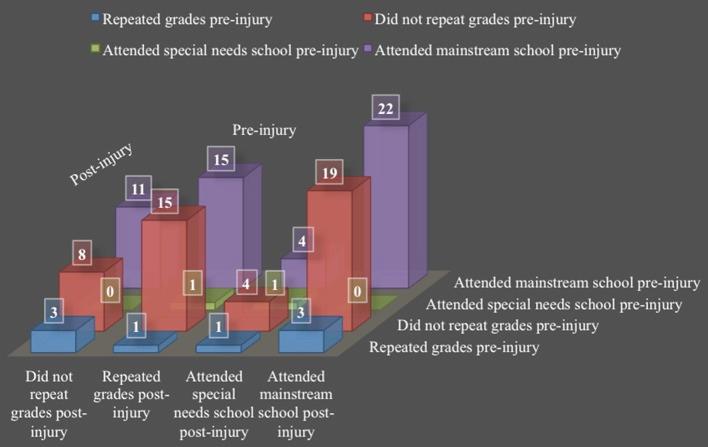
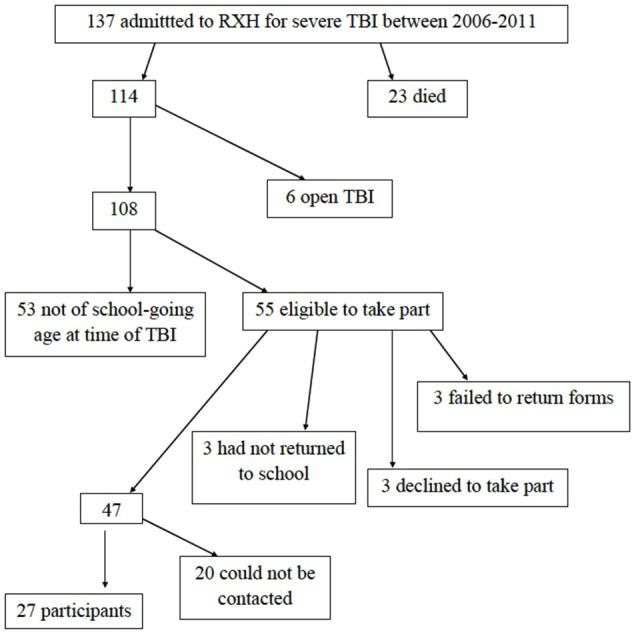
Children who have sustained severe traumatic brain injuries (TBIs) demonstrate a range of post-injury neurocognitive and behavioral sequelae, which may have adverse effects on their academic and behavioral outcomes and interfere with school re-entry, educational progress, and quality of life. These post-TBI sequelae are exacerbated within the context of a resource-poor country like South Africa (SA) where the education system is in a somewhat precarious state especially for those from disadvantaged backgrounds. To describe behavioral and academic outcomes of a group of school-aged SA children following severe TBI. The sample included 27 school-age children who were admitted to the Red Cross War Memorial Children's Hospital (RXH), SA, between 2006 and 2011 for closed severe TBI and who received intracranial monitoring. We collected behavioral data using the Child Behavior Checklist (CBCL) and the Behavior Rating Inventory of Executive Function (BRIEF) and academic information sourced from the BRIEF, CBCL, medical folders, and caregivers. Analyses include descriptive statistics and bivariate correlation matrices. The descriptive results show that (1) more than half of the participants experienced clinically-significant behavioral problems across the CBCL scales, (2) the working memory BRIEF subscale appeared to be the most problematic subdomain, (3) two thirds of the sample were receiving some form of, or were in the process of being placed in, special needs education, (4) there was a three-fold increase in the use of special education services from pre- to post-injury, and (5) more than half ( = 16) of the sample repeated at least one grade after returning to school post-injury. Correlation analyses results suggest that children with increased externalizing behavioral problems and executive dysfunction are more likely to repeat a grade post-injury; and that children with executive dysfunction post-TBI are more likely to require some form of special educational services. While there is a vast amount of literature on pediatric TBI (pTBI) academic and behavioral outcomes, little literature exists on the pTBI population from the developing world and SA specifically. This is important to address given unique challenges that face the country and its educational system, and its implications for the management and care of children post-TBI.
遭受严重创伤性脑损伤(TBI)的儿童会出现一系列伤后神经认知和行为后遗症,这可能会对他们的学业和行为结果产生不利影响,并干扰重返校园、教育进展和生活质量。在像南非(SA)这样资源匮乏的国家,这些创伤性脑损伤后遗症会更加严重,因为该国的教育系统处于某种不稳定状态,尤其是对于那些来自弱势背景的人。为了描述一组南非学龄儿童在严重创伤性脑损伤后的行为和学业结果。样本包括27名学龄儿童,他们在2006年至2011年间因闭合性严重创伤性脑损伤入住南非红十字战争纪念儿童医院(RXH)并接受颅内监测。我们使用儿童行为检查表(CBCL)和执行功能行为评定量表(BRIEF)收集行为数据,并从BRIEF、CBCL、医疗文件夹和照顾者那里获取学业信息。分析包括描述性统计和双变量相关矩阵。描述性结果表明:(1)超过一半的参与者在CBCL量表上经历了具有临床意义的行为问题;(2)工作记忆BRIEF子量表似乎是问题最大的子领域;(3)三分之二的样本正在接受某种形式的特殊需求教育,或者正在被安排接受特殊需求教育;(4)从受伤前到受伤后,特殊教育服务的使用增加了两倍;(5)超过一半(n = 16)的样本在受伤后返校至少留级一次。相关分析结果表明,具有外化行为问题增加和执行功能障碍的儿童在受伤后更有可能留级;创伤性脑损伤后有执行功能障碍的儿童更有可能需要某种形式的特殊教育服务。虽然有大量关于小儿创伤性脑损伤(pTBI)学业和行为结果的文献,但关于发展中国家尤其是南非的小儿创伤性脑损伤人群的文献却很少。鉴于该国及其教育系统面临的独特挑战以及对创伤性脑损伤后儿童管理和护理的影响,解决这个问题很重要。
 Zotero 插件