
K22 对套式病毒目成员的抗病毒活性。
Antiviral activity of K22 against members of the order Nidovirales.
机构信息
Institute for Virology and Immunology IVI, Mittelhäusern and Bern, Switzerland; Graduate School for Cellular and Biomedical Sciences, University of Bern, Switzerland; Department of Infectious Diseases and Pathobiology, University of Bern, Switzerland.
Molecular Virology Laboratory, Department of Medical Microbiology, Leiden University Medical Center, Leiden, The Netherlands.
出版信息
Virus Res. 2018 Feb 15;246:28-34. doi: 10.1016/j.virusres.2018.01.002. Epub 2018 Jan 11.
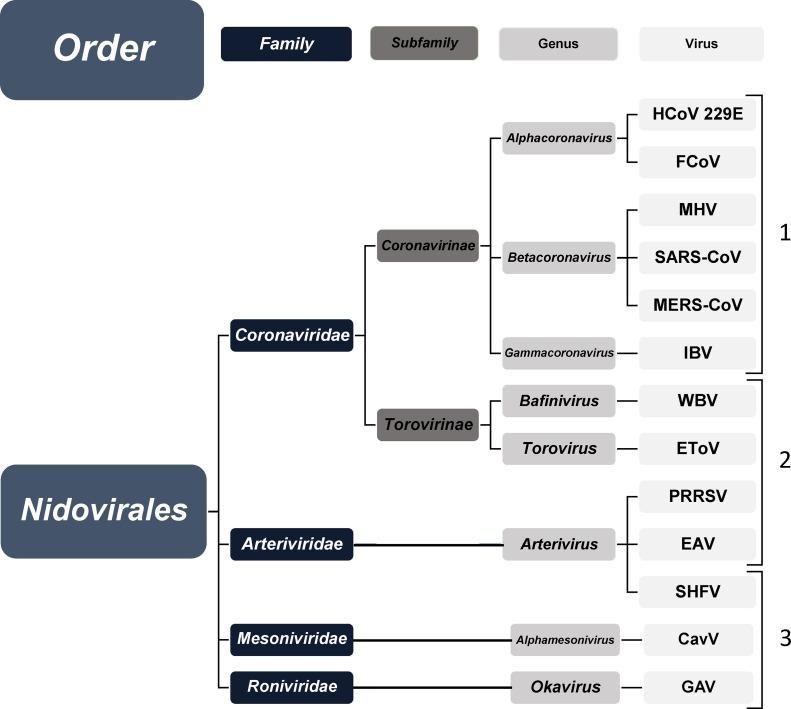
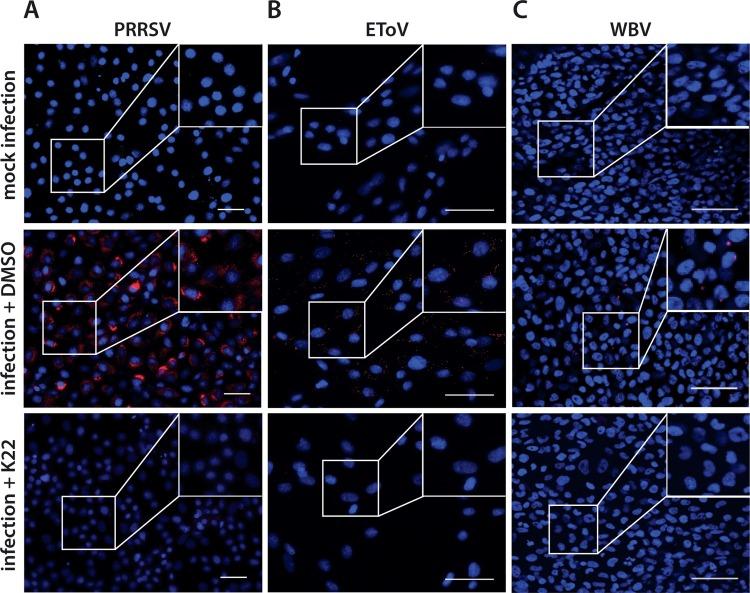
Recently, a novel antiviral compound (K22) that inhibits replication of a broad range of animal and human coronaviruses was reported to interfere with viral RNA synthesis by impairing double-membrane vesicle (DMV) formation (Lundin et al., 2014). Here we assessed potential antiviral activities of K22 against a range of viruses representing two (sub)families of the order Nidovirales, the Arteriviridae (porcine reproductive and respiratory syndrome virus [PRRSV], equine arteritis virus [EAV] and simian hemorrhagic fever virus [SHFV]), and the Torovirinae (equine torovirus [EToV] and White Bream virus [WBV]). Possible effects of K22 on nidovirus replication were studied in suitable cell lines. K22 concentrations significantly decreasing infectious titres of the viruses included in this study ranged from 25 to 50 μM. Reduction of double-stranded RNA intermediates of viral replication in nidovirus-infected cells treated with K22 confirmed the anti-viral potential of K22. Collectively, the data show that K22 has antiviral activity against diverse lineages of nidoviruses, suggesting that the inhibitor targets a critical and conserved step during nidovirus replication.
最近,有报道称一种新型抗病毒化合物(K22)可抑制广泛的动物和人类冠状病毒的复制,其通过损害双膜囊泡(DMV)的形成来干扰病毒 RNA 的合成(Lundin 等人,2014 年)。在这里,我们评估了 K22 对一系列病毒的潜在抗病毒活性,这些病毒代表了正粘病毒目(Nidovirales)的两个(亚)科,动脉炎病毒科(猪繁殖与呼吸综合征病毒 [PRRSV]、马动脉炎病毒 [EAV] 和猴出血热病毒 [SHFV])和冠状病毒科(马冠状病毒 [EToV] 和白鲷病毒 [WBV])。在合适的细胞系中研究了 K22 对 nidovirus 复制的可能影响。K22 浓度显著降低了本研究中包含的病毒的感染滴度,范围为 25 至 50 μM。用 K22 处理感染 nidovirus 的细胞中的双链 RNA 中间体的减少证实了 K22 的抗病毒潜力。总的来说,这些数据表明 K22 对各种 nidovirus 谱系具有抗病毒活性,表明该抑制剂针对 nidovirus 复制过程中的一个关键且保守的步骤。

 Zotero 插件