
褪黑素对创伤性脑损伤后睡眠障碍的疗效:一项随机对照试验。
Efficacy of melatonin for sleep disturbance following traumatic brain injury: a randomised controlled trial.
作者信息
Grima Natalie A, Rajaratnam Shantha M W, Mansfield Darren, Sletten Tracey L, Spitz Gershon, Ponsford Jennie L
机构信息
Beth Israel Deaconess Medical Center, 330 Brookline Avenue, Boston, 02215, MA, USA.
School of Psychological Sciences, Monash University, 18 Innovation Walk, Clayton Campus, Wellington Road, Melbourne, Victoria, 3800, Australia.
出版信息
BMC Med. 2018 Jan 19;16(1):8. doi: 10.1186/s12916-017-0995-1.
BACKGROUND
The study aimed to determine the efficacy of melatonin supplementation for sleep disturbances in patients with traumatic brain injury (TBI).
METHODS
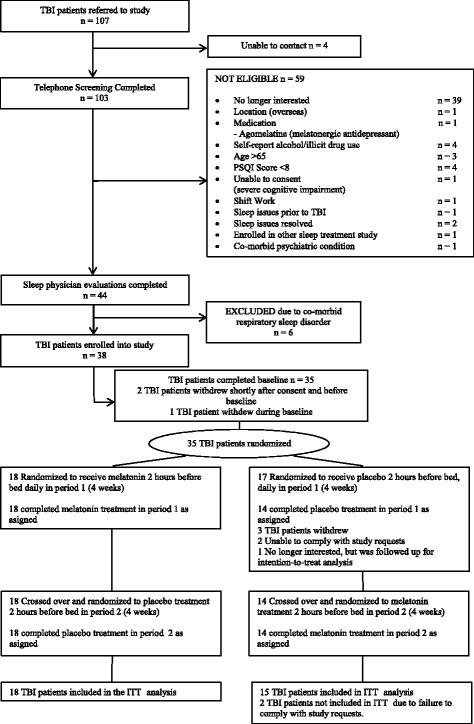
This is a randomised double-blind placebo-controlled two-period two-treatment (melatonin and placebo) crossover study. Outpatients were recruited from Epworth and Austin Hospitals Melbourne, Australia. They had mild to severe TBI (n = 33) reporting sleep disturbances post-injury (mean age 37 years, standard deviation 11 years; 67% men). They were given prolonged-release melatonin formulation (2 mg; Circadin®) and placebo capsules for 4 weeks each in a counterbalanced fashion separated by a 48-hour washout period. Treatment was taken nightly 2 hours before bedtime. Serious adverse events and side-effects were monitored.
RESULTS
Melatonin supplementation significantly reduced global Pittsburgh Sleep Quality Index scores relative to placebo, indicating improved sleep quality [melatonin 7.68 vs. placebo 9.47, original score units; difference -1.79; 95% confidence interval (CI), -2.70 to -0.88; p ≤ 0.0001]. Melatonin had no effect on sleep onset latency (melatonin 1.37 vs. placebo 1.42, log units; difference -0.05; 95% CI, -0.14 to 0.03; p = 0.23). With respect to the secondary outcomes, melatonin supplementation increased sleep efficiency on actigraphy, and vitality and mental health on the SF-36 v1 questionnaire (p ≤ 0.05 for each). Melatonin decreased anxiety on the Hospital Anxiety Depression Scale and fatigue on the Fatigue Severity Scale (p ≤ 0.05 for both), but had no significant effect on daytime sleepiness on the Epworth Sleepiness Scale (p = 0.15). No serious adverse events were reported.
CONCLUSIONS
Melatonin supplementation over a 4-week period is effective and safe in improving subjective sleep quality as well as some aspects of objective sleep quality in patients with TBI.
TRIAL REGISTRATION
Identifier: 12611000734965; Prospectively registered on 13 July 2011.
背景
本研究旨在确定补充褪黑素对创伤性脑损伤(TBI)患者睡眠障碍的疗效。
方法
这是一项随机双盲安慰剂对照的两阶段双治疗(褪黑素和安慰剂)交叉研究。门诊患者从澳大利亚墨尔本的Epworth医院和奥斯汀医院招募。他们患有轻度至重度TBI(n = 33),报告受伤后有睡眠障碍(平均年龄37岁,标准差11岁;67%为男性)。他们以平衡的方式分别服用缓释褪黑素制剂(2毫克;Circadin®)和安慰剂胶囊4周,中间有48小时的洗脱期。治疗在每晚睡前2小时服用。监测严重不良事件和副作用。
结果
与安慰剂相比,补充褪黑素显著降低了匹兹堡睡眠质量指数的总体得分,表明睡眠质量有所改善[褪黑素7.68 vs.安慰剂9.47,原始得分单位;差值-1.79;95%置信区间(CI),-2.70至-0.88;p≤0.0001]。褪黑素对入睡潜伏期没有影响(褪黑素1.37 vs.安慰剂1.42,对数单位;差值-0.05;95%CI,-0.14至0.03;p = 0.23)。关于次要结果,补充褪黑素提高了活动记录仪记录的睡眠效率,以及SF-36 v1问卷中的活力和心理健康得分(每项p≤0.05)。褪黑素降低了医院焦虑抑郁量表上的焦虑和疲劳严重程度量表上的疲劳(两者p≤0.05),但对爱泼沃斯嗜睡量表上的日间嗜睡没有显著影响(p = 0.15)。未报告严重不良事件。
结论
在TBI患者中,为期4周的褪黑素补充在改善主观睡眠质量以及客观睡眠质量的某些方面是有效且安全的。
试验注册
标识符:12611000734965;于2011年7月13日进行前瞻性注册。
 Zotero 插件