
开发一种阿尔茨海默病的随机数学模型,以帮助改进潜在治疗方法的临床试验设计。
The development of a stochastic mathematical model of Alzheimer's disease to help improve the design of clinical trials of potential treatments.
作者信息
Hadjichrysanthou Christoforos, Ower Alison K, de Wolf Frank, Anderson Roy M
机构信息
Department of Infectious Disease Epidemiology, School of Public Health, Imperial College London, London, United Kingdom.
Janssen Prevention Center, Leiden, The Netherlands.
出版信息
PLoS One. 2018 Jan 29;13(1):e0190615. doi: 10.1371/journal.pone.0190615. eCollection 2018.
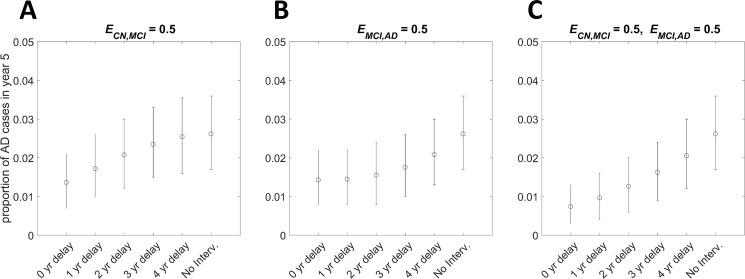
Alzheimer's disease (AD) is a neurodegenerative disorder characterised by a slow progressive deterioration of cognitive capacity. Drugs are urgently needed for the treatment of AD and unfortunately almost all clinical trials of AD drug candidates have failed or been discontinued to date. Mathematical, computational and statistical tools can be employed in the construction of clinical trial simulators to assist in the improvement of trial design and enhance the chances of success of potential new therapies. Based on the analysis of a set of clinical data provided by the Alzheimer's Disease Neuroimaging Initiative (ADNI) we developed a simple stochastic mathematical model to simulate the development and progression of Alzheimer's in a longitudinal cohort study. We show how this modelling framework could be used to assess the effect and the chances of success of hypothetical treatments that are administered at different stages and delay disease development. We demonstrate that the detection of the true efficacy of an AD treatment can be very challenging, even if the treatment is highly effective. An important reason behind the inability to detect signals of efficacy in a clinical trial in this therapy area could be the high between- and within-individual variability in the measurement of diagnostic markers and endpoints, which consequently results in the misdiagnosis of an individual's disease state.
阿尔茨海默病(AD)是一种神经退行性疾病,其特征是认知能力缓慢进行性衰退。治疗AD急需药物,遗憾的是,迄今为止,几乎所有AD候选药物的临床试验都已失败或终止。数学、计算和统计工具可用于构建临床试验模拟器,以协助改进试验设计,并提高潜在新疗法成功的几率。基于对阿尔茨海默病神经成像计划(ADNI)提供的一组临床数据的分析,我们开发了一个简单的随机数学模型,以模拟纵向队列研究中阿尔茨海默病的发展和进展。我们展示了如何使用这个建模框架来评估在不同阶段给予的假设治疗的效果和成功几率,并延缓疾病发展。我们证明,即使治疗非常有效,检测AD治疗的真正疗效也可能极具挑战性。在该治疗领域的临床试验中无法检测到疗效信号的一个重要原因可能是诊断标志物和终点测量中个体间和个体内的高变异性,这进而导致个体疾病状态的误诊。


 Zotero 插件