
应用 GRADE-CERQual 对定性证据综合研究结果进行评估——第 2 部分:如何对信心进行全面的 CERQual 评估并创建定性研究结果总结表。
Applying GRADE-CERQual to qualitative evidence synthesis findings-paper 2: how to make an overall CERQual assessment of confidence and create a Summary of Qualitative Findings table.
机构信息
Norwegian Institute of Public Health, Oslo, Norway.
Health Systems Research Unit, South African Medical Research Council, Cape Town, South Africa.
出版信息
Implement Sci. 2018 Jan 25;13(Suppl 1):10. doi: 10.1186/s13012-017-0689-2.
BACKGROUND
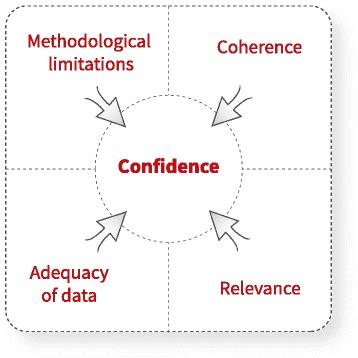
The GRADE-CERQual (Confidence in Evidence from Reviews of Qualitative research) approach has been developed by the GRADE (Grading of Recommendations Assessment, Development and Evaluation) Working Group. The approach has been developed to support the use of findings from qualitative evidence syntheses in decision making, including guideline development and policy formulation. CERQual includes four components for assessing how much confidence to place in findings from reviews of qualitative research (also referred to as qualitative evidence syntheses): (1) methodological limitations, (2) coherence, (3) adequacy of data and (4) relevance. This paper is part of a series providing guidance on how to apply CERQual and focuses on making an overall assessment of confidence in a review finding and creating a CERQual Evidence Profile and a CERQual Summary of Qualitative Findings table.
METHODS
We developed this guidance by examining the methods used by other GRADE approaches, gathering feedback from relevant research communities and developing consensus through project group meetings. We then piloted the guidance on several qualitative evidence syntheses before agreeing on the approach.
RESULTS
Confidence in the evidence is an assessment of the extent to which a review finding is a reasonable representation of the phenomenon of interest. Creating a summary of each review finding and deciding whether or not CERQual should be used are important steps prior to assessing confidence. Confidence should be assessed for each review finding individually, based on the judgements made for each of the four CERQual components. Four levels are used to describe the overall assessment of confidence: high, moderate, low or very low. The overall CERQual assessment for each review finding should be explained in a CERQual Evidence Profile and Summary of Qualitative Findings table.
CONCLUSIONS
Structuring and summarising review findings, assessing confidence in those findings using CERQual and creating a CERQual Evidence Profile and Summary of Qualitative Findings table should be essential components of undertaking qualitative evidence syntheses. This paper describes the end point of a CERQual assessment and should be read in conjunction with the other papers in the series that provide information on assessing individual CERQual components.
背景
GRADE-CERQual(对定性研究证据综述的信心评估)方法由 GRADE(推荐评估、制定和评价)工作组开发。该方法旨在支持在决策中使用定性证据综合研究的结果,包括指南制定和政策制定。CERQual 包括四个评估维度,用以评估对定性研究综述结果的信心程度(也称为定性证据综合研究):(1)方法学局限性;(2)一致性;(3)数据充分性;(4)相关性。本文是一系列关于如何应用 CERQual 的指南中的一部分,重点是对综述结果的整体信心进行评估,并创建 CERQual 证据概况和 CERQual 定性研究结果摘要表。
方法
我们通过检查其他 GRADE 方法使用的方法、从相关研究社区收集反馈以及通过项目组会议达成共识来制定本指南。然后,我们在达成一致之前对几个定性证据综合研究进行了指南试点。
结果
证据的可信度是对综述结果是否合理反映研究兴趣现象的评估。创建每个综述结果的摘要,并决定是否使用 CERQual,是在评估信心之前的重要步骤。应该根据每个 CERQual 维度的判断,对每个综述结果进行单独的信心评估。使用四个级别来描述整体信心评估:高、中、低或极低。每个综述结果的整体 CERQual 评估应在 CERQual 证据概况和定性研究结果摘要表中进行解释。
结论
对综述结果进行结构和总结、使用 CERQual 评估信心以及创建 CERQual 证据概况和定性研究结果摘要表,应成为进行定性证据综合研究的必要组成部分。本文描述了 CERQual 评估的终点,应与该系列中的其他论文一起阅读,这些论文提供了评估单个 CERQual 维度的信息。

 Zotero 插件