
哺乳动物呼吸复合物 I 失活状态的结构。
Structure of the Deactive State of Mammalian Respiratory Complex I.
机构信息
MRC Mitochondrial Biology Unit, University of Cambridge, Wellcome Trust/MRC Building, Cambridge Biomedical Campus, Hills Road, Cambridge CB2 0XY, UK.
MRC Laboratory of Molecular Biology, Francis Crick Avenue, Cambridge CB2 0QH, UK.
出版信息
Structure. 2018 Feb 6;26(2):312-319.e3. doi: 10.1016/j.str.2017.12.014. Epub 2018 Jan 26.
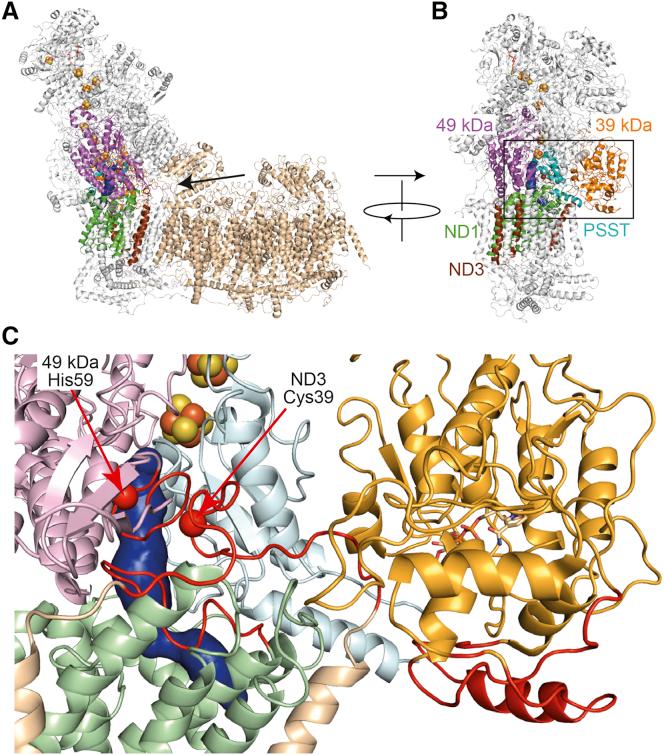
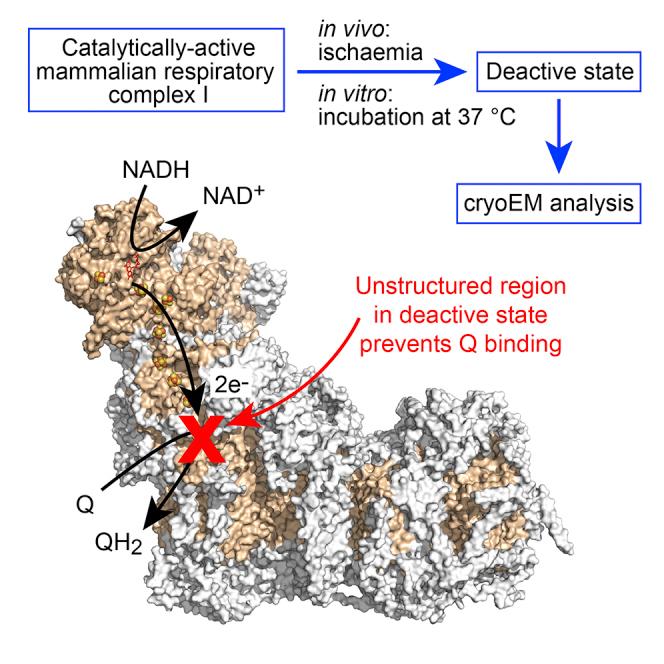
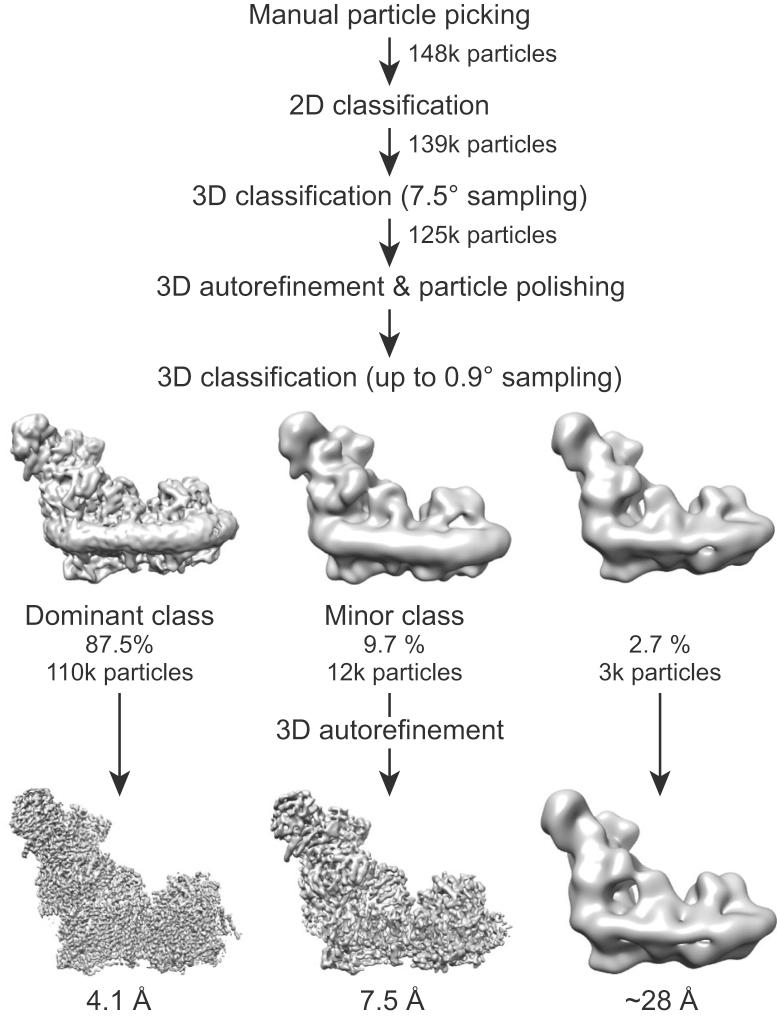
Complex I (NADH:ubiquinone oxidoreductase) is central to energy metabolism in mammalian mitochondria. It couples NADH oxidation by ubiquinone to proton transport across the energy-conserving inner membrane, catalyzing respiration and driving ATP synthesis. In the absence of substrates, active complex I gradually enters a pronounced resting or deactive state. The active-deactive transition occurs during ischemia and is crucial for controlling how respiration recovers upon reperfusion. Here, we set a highly active preparation of Bos taurus complex I into the biochemically defined deactive state, and used single-particle electron cryomicroscopy to determine its structure to 4.1 Å resolution. We show that the deactive state arises when critical structural elements that form the ubiquinone-binding site become disordered, and we propose reactivation is induced when substrate binding to the NADH-reduced enzyme templates their reordering. Our structure both rationalizes biochemical data on the deactive state and offers new insights into its physiological and cellular roles.
复合体 I(NADH:泛醌氧化还原酶)是哺乳动物线粒体能量代谢的核心。它通过将泛醌氧化的 NADH 与质子跨能量保存的内膜运输相偶联,催化呼吸作用并驱动 ATP 合成。在没有底物的情况下,活性复合体 I 逐渐进入明显的静止或失活状态。在缺血期间发生的这种活性-失活转变对于控制再灌注时呼吸作用的恢复至关重要。在这里,我们将牛复合体 I 的高度活跃制剂置于生化定义的失活状态,并使用单颗粒电子 cryomicroscopy 确定其结构至 4.1Å 分辨率。我们表明,当形成泛醌结合位点的关键结构元素变得无序时,失活状态就会出现,并且当底物结合到 NADH 还原酶上时,模板会诱导其重新有序排列,从而引发再激活。我们的结构既合理化了关于失活状态的生化数据,又为其生理和细胞作用提供了新的见解。

 Zotero 插件