
海绵窦受累不是影响鼻窦腺样囊性癌原发肿瘤部位治疗效果的危险因素。
Cavernous sinus involvement is not a risk factor for the primary tumor site treatment outcome of Sinonasal adenoid cystic carcinoma.
机构信息
Department of Otolaryngology - Head and Neck Surgery, Chang Gung Memorial Hospital, Keelung, Taiwan.
College of Medicine, Chang Gung University, Taoyuan, Taiwan.
出版信息
J Otolaryngol Head Neck Surg. 2018 Feb 5;47(1):12. doi: 10.1186/s40463-018-0257-z.
BACKGROUND
Sinonasal adenoid cystic carcinoma is a rare malignancy of the head and neck. Cavernous sinus invasion from sinonasal adenoid cystic carcinoma and its related management have rarely been investigated. This study evaluated the relationship between treatment outcome and cavernous sinus involvement in addition to other parameters.
METHODS
A retrospective case series study was conducted at a tertiary referral center. The medical records of 47 patients diagnosed with primary sinonasal adenoid cystic carcinoma between 1984 and 2015 were retrospectively reviewed. The survival impact of the primary treatment modalities and the anatomic sites of tumor involvement were analyzed.
RESULTS
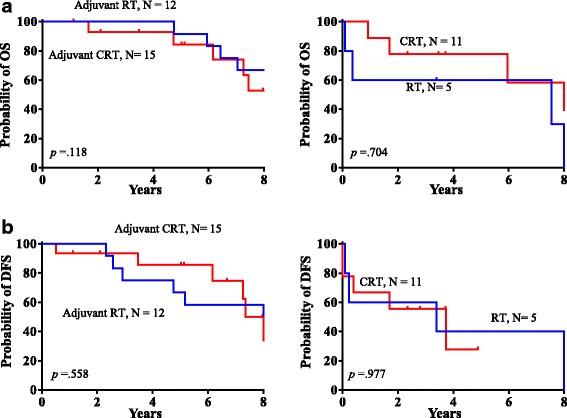
Cavernous sinus invasion was observed in 8 patients (17%), of whom 7 had ACC tumors originating from the maxillary sinus. The results of univariate analysis revealed that tumor stage, primary surgery, and the absence of skull-base and infratemporal fossa invasion were associated with better overall survival (P = 0.033, P = 0.012, P = 0.011, and P = 0.040, respectively) and better disease-free survival (P = 0.019, P = 0.001, P = 0.017, and P = 0.029, respectively). Multivariate analysis identified primary surgery as the only independent prognostic factor for disease-free survival (P = 0.026). Cavernous sinus invasion by sinonasal adenoid cystic carcinoma was not associated with worse overall survival or disease-free survival (P = 0.200 and P = 0.198, respectively).
CONCLUSIONS
Because maxillary adenoid cystic carcinoma is associated with a higher rate of cavernous sinus invasion, such cases warrant caution during preoperative planning. Primary surgery as the initial therapy provides better locoregional control and survival for patients with sinonasal adenoid cystic carcinoma. Cavernous sinus invasion did not significantly impact survival; thus, it should not be regarded as a contraindication for curative treatment.
背景
鼻腔鼻窦腺样囊性癌是一种罕见的头颈部恶性肿瘤。鼻腔鼻窦腺样囊性癌侵犯海绵窦及其相关治疗方法鲜有研究。本研究评估了治疗结果与海绵窦受累之间的关系以及其他参数。
方法
在一家三级转诊中心进行了一项回顾性病例系列研究。回顾性分析了 1984 年至 2015 年间诊断为原发性鼻腔鼻窦腺样囊性癌的 47 例患者的病历。分析了主要治疗方式和肿瘤累及解剖部位对生存的影响。
结果
8 例(17%)患者出现海绵窦侵犯,其中 7 例起源于上颌窦的 ACC 肿瘤。单因素分析结果显示,肿瘤分期、原发手术以及无颅底和颞下窝侵犯与总生存率(P=0.033、P=0.012、P=0.011 和 P=0.040)和无病生存率(P=0.019、P=0.001、P=0.017 和 P=0.029)改善相关。多因素分析显示,原发手术是无病生存率的唯一独立预后因素(P=0.026)。鼻腔鼻窦腺样囊性癌侵犯海绵窦与总生存率或无病生存率无显著相关性(P=0.200 和 P=0.198)。
结论
由于上颌部腺样囊性癌与较高的海绵窦侵犯率相关,因此术前规划时应谨慎。作为初始治疗方法的原发手术可为鼻腔鼻窦腺样囊性癌患者提供更好的局部区域控制和生存。海绵窦侵犯并未显著影响生存,因此不应将其视为根治性治疗的禁忌证。

 Zotero 插件