
美国肺癌筛查的人口影响:基于微观模拟模型的预测。
Population impact of lung cancer screening in the United States: Projections from a microsimulation model.
机构信息
Institute for Technology Assessment, Massachusetts General Hospital, Boston, Massachusetts, United States of America.
Harvard Medical School, Boston, Massachusetts, United States of America.
出版信息
PLoS Med. 2018 Feb 7;15(2):e1002506. doi: 10.1371/journal.pmed.1002506. eCollection 2018 Feb.
BACKGROUND
Previous simulation studies estimating the impacts of lung cancer screening have ignored the changes in smoking prevalence over time in the United States. Our primary rationale was to perform, to our knowledge, the first simulation study that estimates the health outcomes of lung cancer screening with explicit modeling of smoking trends for the whole US population.
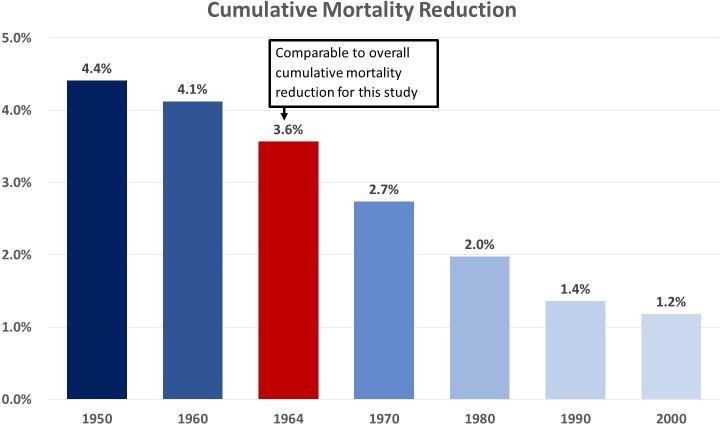
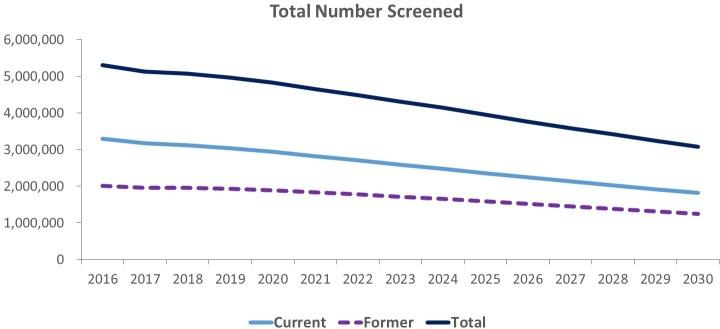
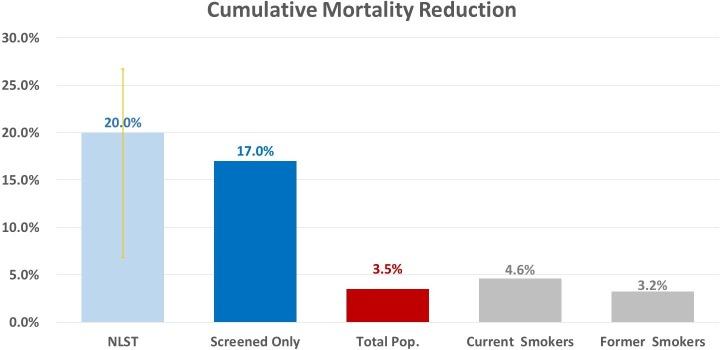
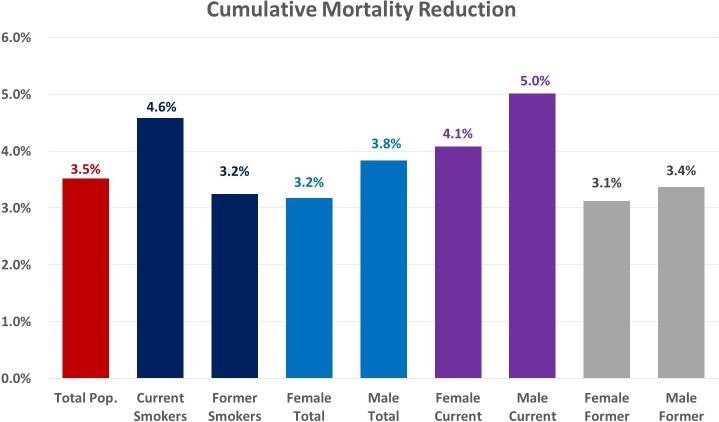
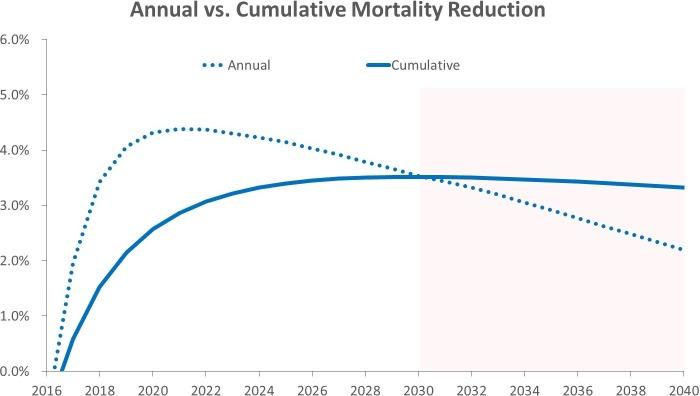
METHODS/FINDINGS: Utilizing a well-validated microsimulation model, we estimated the benefits and harms of an annual low-dose computed tomography screening scenario with a realistic screening adherence rate versus a no-screening scenario for the US population from 2016-2030. The Centers for Medicare and Medicaid Services (CMS) eligibility criteria were applied: age 55-77 years at time of screening, history of at least 30 pack-years of smoking, and current smoker or former smoker with fewer than 15 years since quitting. In the screened population, cumulative mortality reduction was projected to reach 16.98% (95% CI 16.90%-17.07%). Cumulative mortality reduction was estimated to be 3.52% (95% CI 3.50%-3.53%) for the overall study population, with annual mortality reduction peaking at 4.38% (95% CI 4.36%-4.41%) in 2021 and falling to 3.53% (95% CI 3.50%-3.56%) by 2030. Lung cancer screening would save a projected 148,484 life-years (95% CI 147,429-149,540) across the total population through 2030. There were estimated to be 9,054 (95% CI 9,011-9,098) overdiagnosed cases among the 252,429 (95% CI 251,208-253,649) screen-detected lung cancer diagnoses, yielding an overdiagnosis rate of 3.59%. The limitations of our study are that we do not explicitly model race or socioeconomic status and our model was calibrated to data from studies performed in academic centers, both of which may impact the generalizability of our results. We also exclusively model the effects of the CMS guidelines for lung cancer screening and not any other screening strategies.
CONCLUSIONS
The mortality reduction and life-years gained estimated by this study are lower than those of single birth cohort studies. Single cohort studies neglect the changing dynamics of smoking behavior across generations, whereas this study reflects the trend of decreasing smoking prevalence since the 1960s. Maximum benefit could be derived from lung cancer screening through 2021; in later years, mortality reduction due to screening will decline. If a comprehensive screening program is not implemented in the near future, the opportunity to achieve these benefits will have passed.
背景
先前的模拟研究估计了肺癌筛查的影响,但忽略了美国吸烟流行率随时间的变化。我们的主要依据是进行首次模拟研究,明确建模美国整个人群的吸烟趋势,以估计肺癌筛查的健康结果。
方法/发现:我们利用一个经过充分验证的微观模拟模型,估计了 2016-2030 年美国人群中,每年进行低剂量计算机断层扫描筛查的获益和危害,以及不筛查的情况。我们应用了医疗保险和医疗补助服务中心(CMS)的资格标准:筛查时年龄在 55-77 岁之间,有至少 30 包年的吸烟史,且目前为吸烟者或过去吸烟者,戒烟时间少于 15 年。在筛查人群中,预计累计死亡率降低 16.98%(95%CI 16.90%-17.07%)。对于整个研究人群,预计累计死亡率降低 3.52%(95%CI 3.50%-3.53%),2021 年年度死亡率降低峰值为 4.38%(95%CI 4.36%-4.41%),到 2030 年降至 3.53%(95%CI 3.50%-3.56%)。通过 2030 年,肺癌筛查预计将在整个人群中节省 148484 个预期寿命年(95%CI 147429-149540)。在 252429 例(95%CI 251208-253649)筛查发现的肺癌诊断中,预计有 9054 例(95%CI 9011-9098)为过度诊断病例,过度诊断率为 3.59%。我们研究的局限性在于,我们没有明确建模种族或社会经济地位,而且我们的模型是根据在学术中心进行的研究数据进行校准的,这两者都可能影响我们结果的普遍性。我们还仅对 CMS 肺癌筛查指南的影响进行建模,而不是对任何其他筛查策略进行建模。
结论
本研究估计的死亡率降低和预期寿命增加低于单一生育队列研究。单一生育队列研究忽略了代际之间吸烟行为的变化动态,而本研究反映了自 20 世纪 60 年代以来吸烟率下降的趋势。通过 2021 年,肺癌筛查可获得最大收益;在随后的几年中,由于筛查而导致的死亡率降低将会下降。如果在不久的将来不实施全面的筛查计划,那么将错失实现这些获益的机会。
 Zotero 插件