
右美托咪定对小儿白内障手术中使用地氟醚时苏醒期躁动的影响。
Effect of dexmedetomidine on emergence agitation using desflurane in pediatric cataract surgery.
作者信息
Jain Shikha, Sethi Sameer, Ghai Babita, Ram Jagat
机构信息
Department of Anaesthesia, All India Institute of Medical Sciences, Bhopal, Madhya Pradesh, India.
Department of Anaesthesia, Postgraduate Institute of Medical Education and Research, Chandigarh, India.
出版信息
Saudi J Anaesth. 2018 Jan-Mar;12(1):28-34. doi: 10.4103/sja.SJA_235_17.
BACKGROUND
In this study, we compared effectiveness of two doses of dexmedetomidine (0.15 μg/kg and 0.3 μg/kg) in preventing desflurane-induced emergence agitation (EA) in pediatric patients undergoing elective cataract surgery.
METHODS
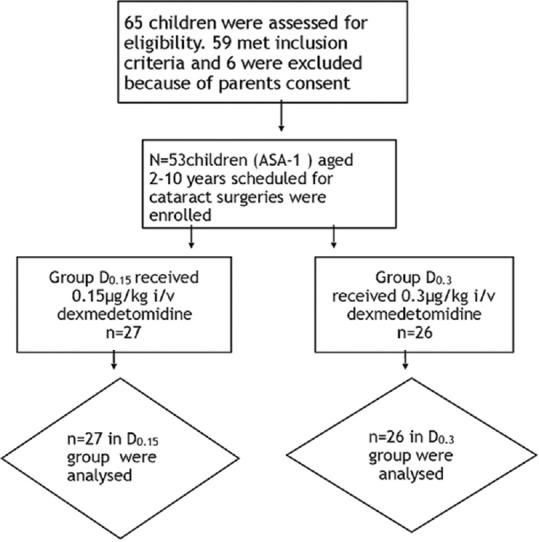
It is a prospective double-blinded randomized study conducted on 65 American Society of Anesthesiologists 1 children (2-10 years) who underwent elective cataract surgery at our institute. They were randomized into two equal groups, who received either dexmedetomidine 0.15 μg/kg (Group D) or dexmedetomidine 0.30 μg/kg (Group D) intravenously after induction of anesthesia. An observer blinded to groups recorded heart rate (HR), arterial blood pressure, oxygen saturation, end-tidal carbon dioxide, and respiratory rate (RR) at regular intervals and evaluated preoperative anxiety, state of agitation, and postoperative pain using validated scores.
RESULTS
Both groups (Group D, = 27 vs. Group D, = 26) were demographically identical. In intraoperative period, the difference in HRs was significantly lower in Group D. from 5 min till 15 min of the surgery ( < 0.05), but thereafter, from 20 min till end of surgery, the rates were comparable in both the groups, whereas RR and blood pressure fluctuations were comparable throughout. Postoperative pain scores and postoperative agitation score were significantly lower in Group D than D at all time intervals ( < 0.05).
CONCLUSIONS
In our study, 0.3 μg/kg intravenous dexmedetomidine was found to be superior to 0.15 μg/kg group in effectively reducing EA and postoperative pain, without producing adverse effects such as hypotension or bradycardia.
背景
在本研究中,我们比较了两种剂量的右美托咪定(0.15μg/kg和0.3μg/kg)在预防接受择期白内障手术的儿科患者中地氟烷诱导的苏醒期躁动(EA)方面的有效性。
方法
这是一项前瞻性双盲随机研究,对65名美国麻醉医师协会1级儿童(2至10岁)进行,这些儿童在我们研究所接受择期白内障手术。他们被随机分为两组,在麻醉诱导后分别静脉注射0.15μg/kg右美托咪定(D组)或0.30μg/kg右美托咪定(D组)。一名对分组不知情的观察者定期记录心率(HR)、动脉血压、血氧饱和度、呼气末二氧化碳和呼吸频率(RR),并使用经过验证的评分评估术前焦虑、躁动状态和术后疼痛。
结果
两组(D组,n = 27 vs. D组,n = 26)在人口统计学上相同。在术中,D组的HR差异在手术5分钟至15分钟时显著较低(P < 0.05),但此后,从20分钟至手术结束,两组的心率相当,而RR和血压波动在整个过程中相当。术后疼痛评分和术后躁动评分在所有时间间隔内D组均显著低于D组(P < 0.05)。
结论
在我们的研究中,发现静脉注射0.3μg/kg右美托咪定在有效减少EA和术后疼痛方面优于0.15μg/kg组,且未产生低血压或心动过缓等不良反应。



 Zotero 插件