
从减轻神经元线粒体膜氧化应激和电生理功能障碍角度探讨右美托咪定改善术后认知功能障碍的机制
An investigation of the mechanism of dexmedetomidine in improving postoperative cognitive dysfunction from the perspectives of alleviating neuronal mitochondrial membrane oxidative stress and electrophysiological dysfunction.
作者信息
Chen Jie, Shen Na, Duan Xiaohui, Guo Yaning
机构信息
Department of Anesthesiology, Affiliated Hospital of Hebei University of Engineering, Handan, Hebei 056029, P.R. China.
Department of ENT, Tianjin 4th Center Hospital, Tianjin 300140, P.R. China.
出版信息
Exp Ther Med. 2018 Feb;15(2):2037-2043. doi: 10.3892/etm.2017.5589. Epub 2017 Dec 4.
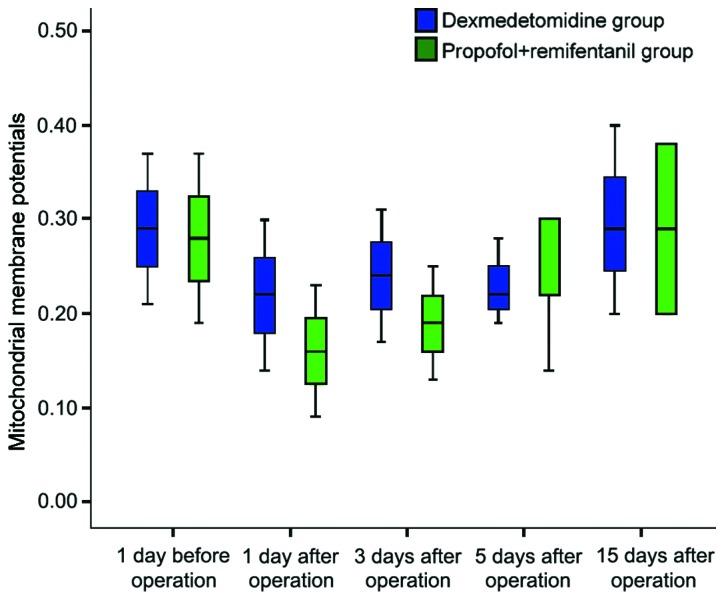
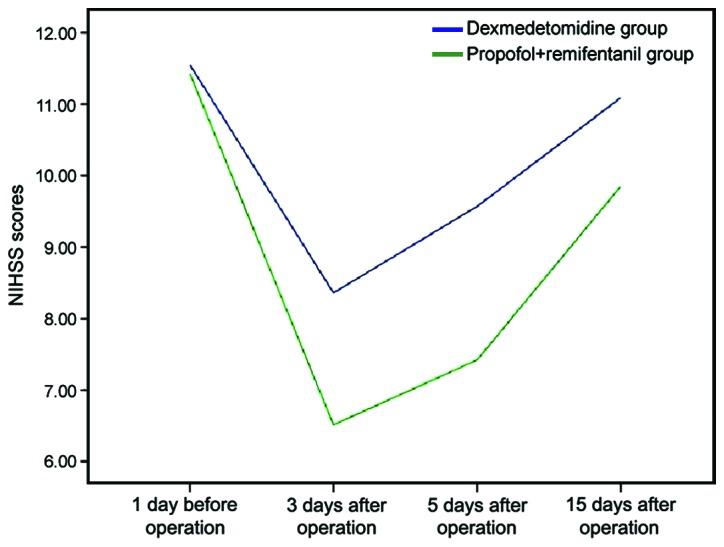
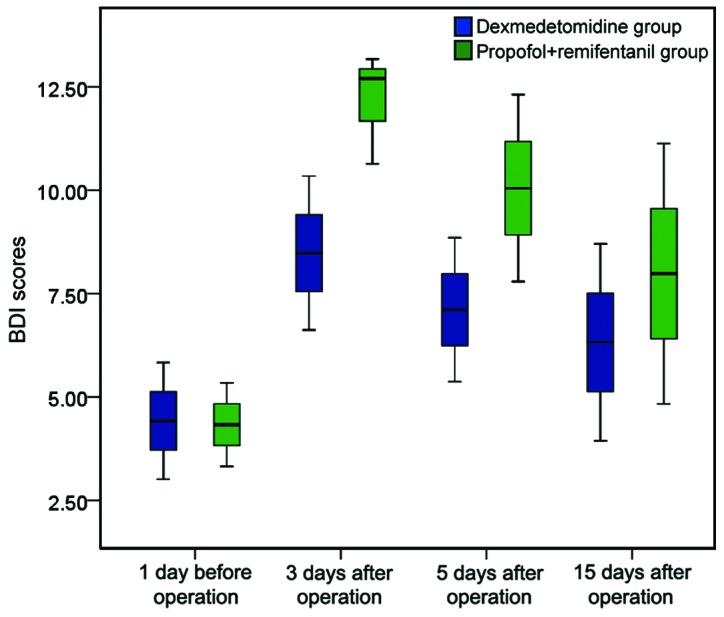
The aim of this study was to investigate the mechanism of dexmedetomidine in improving postoperative cognitive dysfunction from the perspectives of alleviating neuronal mitochondrial membrane oxidative stress and electrophysiological dysfunction. A total of 120 patients undergoing elective surgery under general anesthesia from June 2013 to May, 2016 were selected as the subjects of the study and randomly divided into the propofol + remifentanil and dexmedetomidine groups. The Rey Auditory Verbal Learning Test (AVLT) and Beck Depression Inventory (BDI) were performed at day 1 before operation and at day 1, 3, 5 and 15 after operation. The mitochondrial membrane potential was detected using a flow cytometer after staining and labeling for mitochondria in leukocytes via JC-1 fluorescence staining using a fluorescence probe at day 1 before operation and at day 1, 3, 5 and 15 after operation. The activities of mitochondrial respiratory chain complexes at day 1 before and after operation were detected via enzyme-linked immunosorbent assay (ELISA). The results showed that there were no statistically significant differences in the comparisons of general conditions (age, body weight, sex ratio, body mass index, anesthesia time, operation time, and length of stay in the ICU and hospital) for the dexmedetomidine and propofol + remifentanil groups (P>0.05). At day 3 and 5 after operation, the National Institutes of Health Stroke Scale (NIHSS) scores and AVLT scores in the two groups were decreased in different degrees, but the decrease range in the dexmedetomidine group was smaller than that in the propofol + remifentanil group, and the differences were statistically significant (P<0.05). At day 3, 5 and 15 after operation, the BDI scores of the two groups were increased in different degrees, but the increase range in the dexmedetomidine group was smaller than that in the propofol + remifentanil group, and the differences were statistically significant (P<0.05). At day 1, 3 and 5 after operation, the mitochondrial membrane potentials of the two groups were decreased in different degrees, but the decrease range in the dexmedetomidine group was smaller than that in the propofol + remifentanil group, and the differences were statistically significant (P<0.05). The mitochondrial membrane potentials of the two groups returned to the preoperative levels at day 15 after operation. The activities of mitochondrial respiratory chain complex I-IV in the propofol + remifentanil group at day 1 after operation were significantly decreased compared with those before operation, and the differences were statistically significant (P<0.05). The decrease in activities of mitochondrial respiratory chain complex I-IV in the propofol + remifentanil group at day 1 after operation was more significant than that in the dexmedetomidine group, and the difference was statistically significant (P<0.05). The results suggest that dexmedetomidine can relieve neuronal damage that may be caused by mitochondrial membrane oxidative stress, alleviate the damage to mitochondrial related enzyme system activity, and reduce the damage to the activities of mitochondrial respiratory chain enzyme complex I, II, III and IV, ultimately improving the postoperative cognitive dysfunction of patients.
本研究旨在从减轻神经元线粒体膜氧化应激和电生理功能障碍的角度,探讨右美托咪定改善术后认知功能障碍的机制。选取2013年6月至2016年5月在全身麻醉下接受择期手术的120例患者作为研究对象,随机分为丙泊酚+瑞芬太尼组和右美托咪定组。在术前1天、术后1天、3天、5天和15天进行 Rey 听觉词语学习测验(AVLT)和贝克抑郁量表(BDI)评估。在术前1天、术后1天、3天、5天和15天,使用荧光探针通过JC-1荧光染色对白细胞中的线粒体进行染色和标记后,用流式细胞仪检测线粒体膜电位。通过酶联免疫吸附测定(ELISA)检测术前1天和术后1天线粒体呼吸链复合物的活性。结果显示,右美托咪定组和丙泊酚+瑞芬太尼组在一般情况(年龄、体重、性别比、体重指数、麻醉时间、手术时间、ICU住院时间和住院时间)比较上无统计学差异(P>0.05)。术后3天和5天,两组的美国国立卫生研究院卒中量表(NIHSS)评分和AVLT评分均有不同程度下降,但右美托咪定组下降幅度小于丙泊酚+瑞芬太尼组,差异有统计学意义(P<0.05)。术后3天、5天和15天,两组的BDI评分均有不同程度升高,但右美托咪定组升高幅度小于丙泊酚+瑞芬太尼组,差异有统计学意义(P<0.05)。术后1天、3天和5天,两组的线粒体膜电位均有不同程度下降,但右美托咪定组下降幅度小于丙泊酚+瑞芬太尼组,差异有统计学意义(P<0.05)。术后15天两组的线粒体膜电位恢复至术前水平。丙泊酚+瑞芬太尼组术后1天线粒体呼吸链复合物Ⅰ-Ⅳ的活性较术前明显降低,差异有统计学意义(P<0.05)。丙泊酚+瑞芬太尼组术后1天线粒体呼吸链复合物Ⅰ-Ⅳ活性的降低幅度大于右美托咪定组,差异有统计学意义(P<0.05)。结果表明,右美托咪定可减轻线粒体膜氧化应激可能导致的神经元损伤,减轻对线粒体相关酶系统活性的损害,降低对线粒体呼吸链酶复合物Ⅰ、Ⅱ、Ⅲ和Ⅳ活性的损害,最终改善患者术后认知功能障碍。
 Zotero 插件