
日常昼夜节律失调会影响人类认知表现,具体取决于任务类型。
Daily circadian misalignment impairs human cognitive performance task-dependently.
机构信息
Medical Chronobiology Program, Division of Sleep and Circadian Disorders, Departments of Medicine and Neurology, Brigham and Women's Hospital, Boston, MA, 02115, United States.
Division of Sleep Medicine, Department of Medicine, Harvard Medical School, Boston, MA, 02115, United States.
出版信息
Sci Rep. 2018 Feb 14;8(1):3041. doi: 10.1038/s41598-018-20707-4.
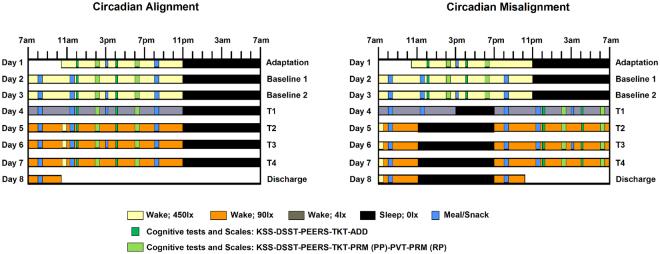
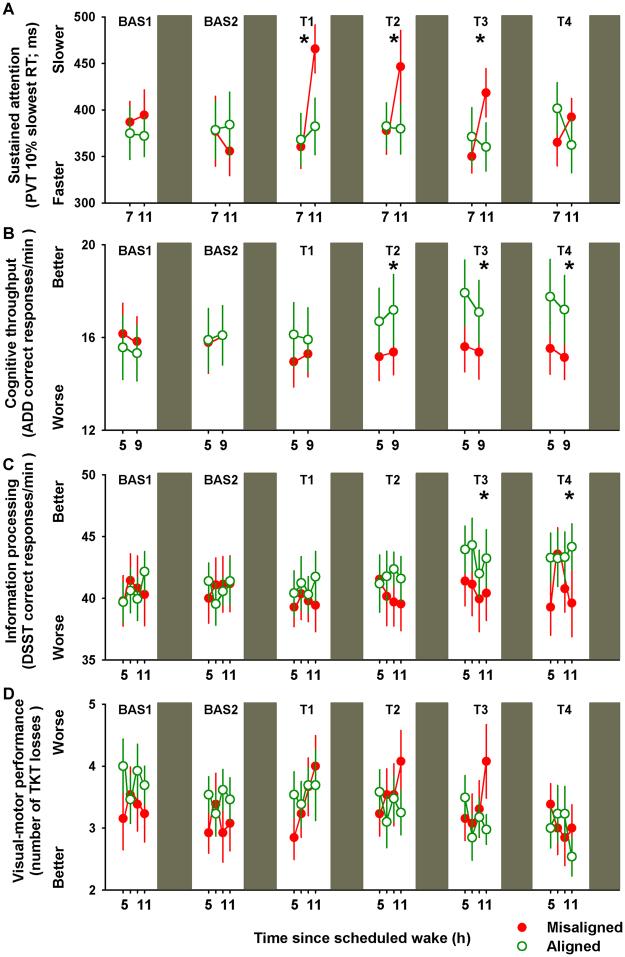
Shift work increases the risk for human errors, such that drowsiness due to shift work has contributed to major industrial disasters, including Space Shuttle Challenger, Chernobyl and Alaska Oil Spill disasters, with extraordinary socio-economical costs. Overnight operations pose a challenge because our circadian biology inhibits cognitive performance at night. Yet how the circadian system modulates cognition over multiple days under realistic shift work conditions remains to be established. Importantly, because task-specific cognitive brain regions show different 24-h circadian dynamics, we hypothesize that circadian misalignment impacts cognition task-dependently. Using a biologically-driven paradigm mimicking night shift work, with a randomized, cross-over design, we show that misalignment between the circadian pacemaker and behavioral/environmental cycles increases cognitive vulnerability on sustained attention, cognitive throughput, information processing and visual-motor performance over multiple days, compared to circadian alignment (day shifts). Circadian misalignment effects are task-dependent: while they acutely impair sustained attention with recovery after 3-days, they progressively hinder daily learning. Individuals felt sleepier during circadian misalignment, but they did not rate their performance as worse. Furthermore, circadian misalignment effects on sustained attention depended on prior sleep history. Collectively, daily circadian misalignment may provide an important biological framework for developing countermeasures against adverse cognitive effects in shift workers.
轮班工作增加了人为错误的风险,例如由于轮班工作导致的困倦导致了重大工业灾难,包括挑战者号航天飞机、切尔诺贝利和阿拉斯加石油泄漏灾难,造成了巨大的社会经济成本。夜间作业是一个挑战,因为我们的生物钟会抑制夜间的认知表现。然而,在现实的轮班工作条件下,生物钟系统如何调节多天的认知,仍有待确定。重要的是,由于特定任务的认知大脑区域显示出不同的 24 小时生物钟动态,我们假设生物钟失调会根据任务的不同而影响认知。我们使用一种模拟夜班轮班工作的生物驱动范式,采用随机、交叉设计,表明生物钟节律与行为/环境周期之间的不匹配会增加在多天内持续注意力、认知吞吐量、信息处理和视觉运动表现方面的认知脆弱性,与生物钟对齐(日班)相比。生物钟失调的影响是任务依赖性的:虽然它们会在 3 天后急性损害持续注意力,但会逐渐阻碍日常学习。在生物钟失调期间,个体感到更困倦,但他们并不认为自己的表现更差。此外,生物钟失调对持续注意力的影响取决于先前的睡眠史。总的来说,每日生物钟失调可能为开发针对轮班工人认知不良影响的对策提供了一个重要的生物学框架。



 Zotero 插件