
高收入、中等收入和低收入国家胃肠道手术后手术部位感染:一项前瞻性、国际、多中心队列研究。
Surgical site infection after gastrointestinal surgery in high-income, middle-income, and low-income countries: a prospective, international, multicentre cohort study.
出版信息
Lancet Infect Dis. 2018 May;18(5):516-525. doi: 10.1016/S1473-3099(18)30101-4. Epub 2018 Feb 13.
BACKGROUND
Surgical site infection (SSI) is one of the most common infections associated with health care, but its importance as a global health priority is not fully understood. We quantified the burden of SSI after gastrointestinal surgery in countries in all parts of the world.
METHODS
This international, prospective, multicentre cohort study included consecutive patients undergoing elective or emergency gastrointestinal resection within 2-week time periods at any health-care facility in any country. Countries with participating centres were stratified into high-income, middle-income, and low-income groups according to the UN's Human Development Index (HDI). Data variables from the GlobalSurg 1 study and other studies that have been found to affect the likelihood of SSI were entered into risk adjustment models. The primary outcome measure was the 30-day SSI incidence (defined by US Centers for Disease Control and Prevention criteria for superficial and deep incisional SSI). Relationships with explanatory variables were examined using Bayesian multilevel logistic regression models. This trial is registered with ClinicalTrials.gov, number NCT02662231.
FINDINGS
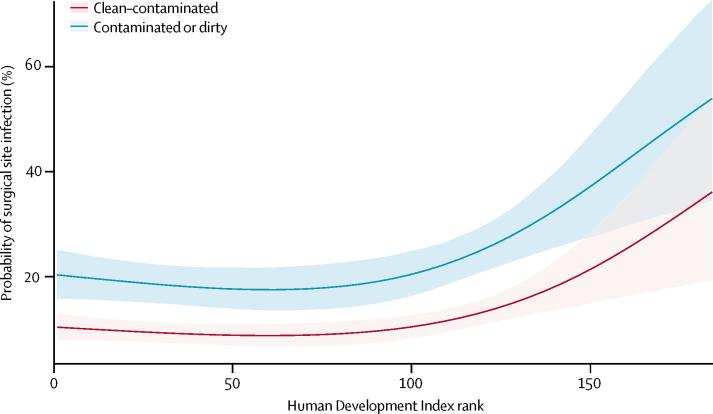
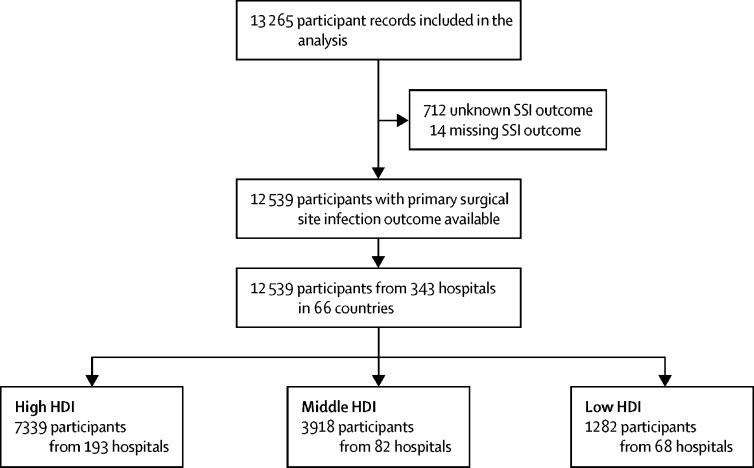
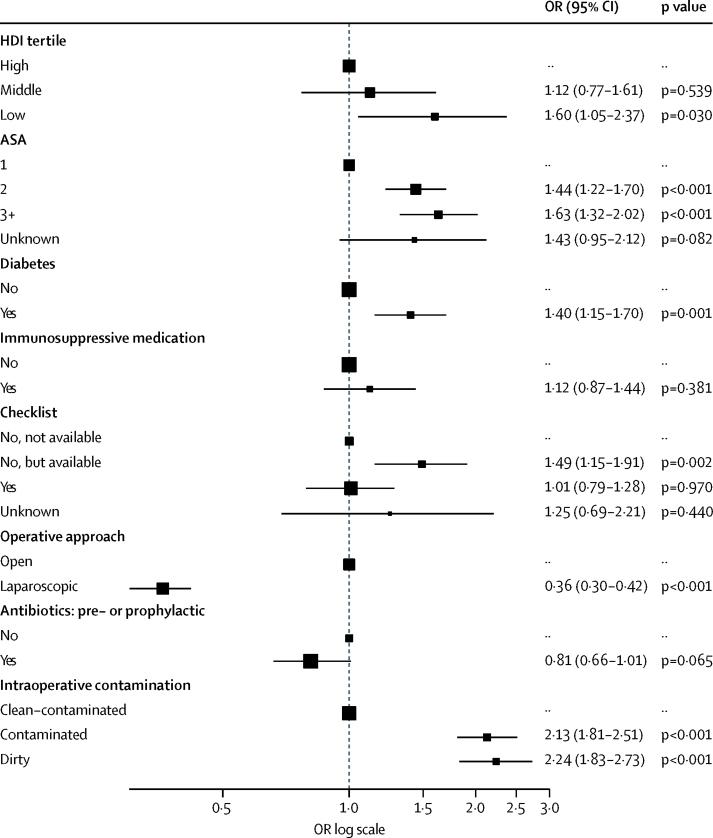
Between Jan 4, 2016, and July 31, 2016, 13 265 records were submitted for analysis. 12 539 patients from 343 hospitals in 66 countries were included. 7339 (58·5%) patient were from high-HDI countries (193 hospitals in 30 countries), 3918 (31·2%) patients were from middle-HDI countries (82 hospitals in 18 countries), and 1282 (10·2%) patients were from low-HDI countries (68 hospitals in 18 countries). In total, 1538 (12·3%) patients had SSI within 30 days of surgery. The incidence of SSI varied between countries with high (691 [9·4%] of 7339 patients), middle (549 [14·0%] of 3918 patients), and low (298 [23·2%] of 1282) HDI (p<0·001). The highest SSI incidence in each HDI group was after dirty surgery (102 [17·8%] of 574 patients in high-HDI countries; 74 [31·4%] of 236 patients in middle-HDI countries; 72 [39·8%] of 181 patients in low-HDI countries). Following risk factor adjustment, patients in low-HDI countries were at greatest risk of SSI (adjusted odds ratio 1·60, 95% credible interval 1·05-2·37; p=0·030). 132 (21·6%) of 610 patients with an SSI and a microbiology culture result had an infection that was resistant to the prophylactic antibiotic used. Resistant infections were detected in 49 (16·6%) of 295 patients in high-HDI countries, in 37 (19·8%) of 187 patients in middle-HDI countries, and in 46 (35·9%) of 128 patients in low-HDI countries (p<0·001).
INTERPRETATION
Countries with a low HDI carry a disproportionately greater burden of SSI than countries with a middle or high HDI and might have higher rates of antibiotic resistance. In view of WHO recommendations on SSI prevention that highlight the absence of high-quality interventional research, urgent, pragmatic, randomised trials based in LMICs are needed to assess measures aiming to reduce this preventable complication.
FUNDING
DFID-MRC-Wellcome Trust Joint Global Health Trial Development Grant, National Institute of Health Research Global Health Research Unit Grant.
背景
手术部位感染(SSI)是与医疗保健相关的最常见感染之一,但它作为全球健康优先事项的重要性尚未被充分认识。我们量化了全球范围内各种国家胃肠道手术后 SSI 的负担。
方法
这项国际、前瞻性、多中心队列研究纳入了在任何国家的任何医疗机构在两周内进行择期或紧急胃肠道切除术的连续患者。根据联合国人类发展指数(HDI),有参与中心的国家被分为高收入、中等收入和低收入组。从 GlobalSurg 1 研究和其他已发现影响 SSI 可能性的研究中获取数据变量,并将其输入风险调整模型。主要结局指标是 30 天 SSI 发生率(根据美国疾病控制与预防中心对浅表和深部切口 SSI 的定义)。使用贝叶斯多水平逻辑回归模型检查与解释变量的关系。这项试验在 ClinicalTrials.gov 注册,编号为 NCT02662231。
结果
2016 年 1 月 4 日至 2016 年 7 月 31 日,共提交了 13265 份记录进行分析。来自 66 个国家的 343 家医院的 12539 名患者纳入研究。7339 名(58.5%)患者来自高 HDI 国家(30 个国家的 193 家医院),3918 名(31.2%)患者来自中 HDI 国家(18 个国家的 82 家医院),1282 名(10.2%)患者来自低 HDI 国家(18 个国家的 68 家医院)。共有 1538 名(12.3%)患者在手术后 30 天内发生 SSI。各国 SSI 发生率存在差异,高 HDI 国家(7339 例患者中 691 例,9.4%)、中 HDI 国家(3918 例患者中 549 例,14.0%)和低 HDI 国家(1282 例患者中 298 例,23.2%)(p<0.001)。每个 HDI 组中 SSI 发生率最高的是脏手术(高 HDI 国家 574 例患者中 102 例,17.8%;中 HDI 国家 236 例患者中 74 例,31.4%;低 HDI 国家 181 例患者中 72 例,39.8%)。在危险因素调整后,低 HDI 国家的患者发生 SSI 的风险最大(调整后的优势比 1.60,95%可信区间 1.05-2.37;p=0.030)。在 610 例有 SSI 和微生物培养结果的患者中,有 132 例(21.6%)感染的抗生素具有耐药性。在高 HDI 国家的 295 例患者中,有 49 例(16.6%)、中 HDI 国家的 187 例患者中,有 37 例(19.8%)、低 HDI 国家的 128 例患者中,有 46 例(35.9%)检测到耐药感染(p<0.001)。
解释
HDI 较低的国家与 HDI 较高或中等的国家相比,SSI 的负担不成比例地更大,并且可能具有更高的抗生素耐药率。鉴于世界卫生组织关于 SSI 预防的建议强调缺乏高质量的干预性研究,因此需要在 LMIC 中进行基于紧急、务实、随机试验,以评估旨在减少这种可预防并发症的措施。
资金
英国国际发展部-医学研究理事会-惠康信托联合全球卫生试验发展赠款,国家卫生研究院全球卫生研究单位赠款。
 Zotero 插件