
镓-BBN-RGD PET/CT 用于乳腺癌患者 GRPR 和整合素 αβ 的成像。
Ga-BBN-RGD PET/CT for GRPR and Integrin αβ Imaging in Patients with Breast Cancer.
机构信息
Department of Nuclear Medicine, Peking Union Medical College Hospital, Chinese Academy of Medical Sciences and Peking Union Medical College, Beijing 100730, China.
Laboratory of Molecular Imaging and Nanomedicine (LOMIN), National Institute of Biomedical Imaging and Bioengineering (NIBIB), National Institutes of Health (NIH), Bethesda, Maryland, 20892, USA.
出版信息
Theranostics. 2018 Jan 1;8(4):1121-1130. doi: 10.7150/thno.22601. eCollection 2018.
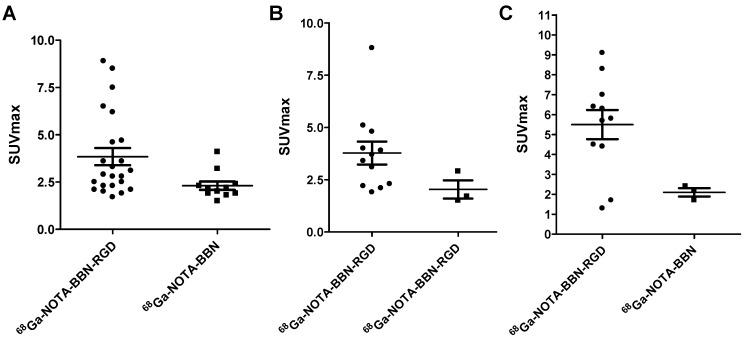
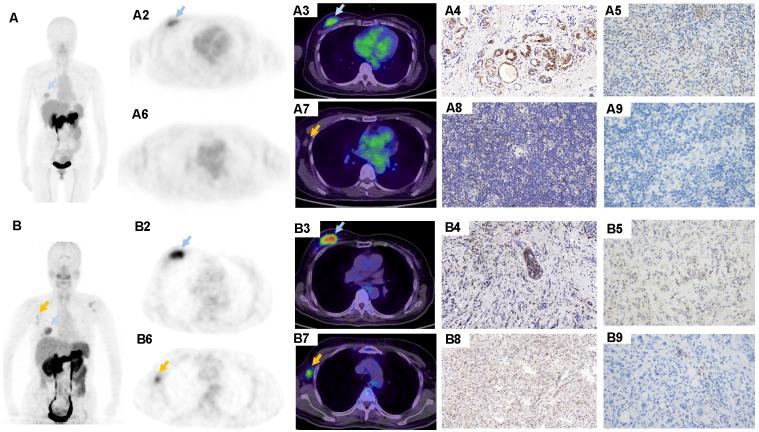
This study was to assess a gastrin-releasing peptide receptor (GRPR) and integrin αvβ3 dual targeting tracer Ga-BBN-RGD for positron emission tomography (PET)/computed tomography (CT) imaging of breast cancer and metastasis. Twenty-two female patients were recruited either with suspected breast cancer on screening mammography (n = 16) or underwent breast cancer radical mastectomy (n = 6). All the 22 patients underwent PET/CT at 30-45 min after intravenous injection of Ga-BBN-RGD. Eleven out of 22 patients also accepted Ga-BBN PET/CT within 2 weeks for comparison. A final diagnosis was made based on the histopathologic examination of surgical excision or biopsy. Both the primary cancer and metastases showed positive Ga-BBN-RGD accumulation. The T/B ratios of Ga-BBN-RGD accumulation were 2.10 to 9.44 in primary cancer and 1.10 to 3.71 in axillary lymph node metastasis, 3.80 to 10.7 in distant lymph nodes, 2.70 to 5.35 in lung metastasis and 3.17 to 22.8 in bone metastasis, respectively. For primary lesions, the SUVmax from Ga-BBN-RGD PET in ER positive group was higher than that in ER negative group (P < 0.01). For both primary and metastatic lesions, SUVmean quantified from Ga-BBN-RGD PET correlated well with both GRPR expression and integrin αvβ3 expression. This study demonstrated significant uptake of a new type of dual integrin αvβ3 and GRPR targeting radiotracer in both the primary lesion and the metastases of breast cancer. Ga-BBN-RGD PET/CT may be of great value in discerning both primary breast cancers, axillary lymph node metastasis and distant metastases.
本研究旨在评估一种胃泌素释放肽受体(GRPR)和整合素αvβ3 双重靶向示踪剂 Ga-BBN-RGD,用于乳腺癌及其转移灶的正电子发射断层扫描(PET)/计算机断层扫描(CT)成像。 22 名女性患者被招募,其中 16 名在筛查性乳房 X 线摄影时怀疑患有乳腺癌,6 名接受了乳腺癌根治性乳房切除术。所有 22 名患者均在静脉注射 Ga-BBN-RGD 后 30-45 分钟进行 PET/CT 检查。其中 11 名患者还在 2 周内接受了 Ga-BBN PET/CT 检查以进行比较。最终诊断基于手术切除或活检的组织病理学检查。 原发癌和转移灶均显示 Ga-BBN-RGD 积聚阳性。Ga-BBN-RGD 积聚的 T/B 比值在原发性癌症中为 2.10 至 9.44,在腋窝淋巴结转移中为 1.10 至 3.71,在远处淋巴结中为 3.80 至 10.7,在肺转移中为 2.70 至 5.35,在骨转移中为 3.17 至 22.8。对于原发性病变,ER 阳性组 Ga-BBN-RGD PET 的 SUVmax 高于 ER 阴性组(P <0.01)。对于原发性和转移性病变,Ga-BBN-RGD PET 定量的 SUVmean 与 GRPR 表达和整合素αvβ3 表达均密切相关。 这项研究表明,新型双重整合素αvβ3 和 GRPR 靶向放射性示踪剂在乳腺癌的原发性病变和转移灶中均有明显摄取。Ga-BBN-RGD PET/CT 可能在鉴别原发性乳腺癌、腋窝淋巴结转移和远处转移方面具有重要价值。



 Zotero 插件