
随机对照试验表明,营养敏感型社会保护干预措施增加了农村学龄前孟加拉国儿童对多种微量营养素粉和铁补充剂的使用。
Randomized control trials demonstrate that nutrition-sensitive social protection interventions increase the use of multiple-micronutrient powders and iron supplements in rural pre-school Bangladeshi children.
机构信息
1Division of Nutrition Sciences,Cornell University,Savage Hall,Room 305,Ithaca,NY 14850,USA.
2International Food Policy Research Institute (IFPRI),Dhaka,Bangladesh.
出版信息
Public Health Nutr. 2018 Jun;21(9):1753-1761. doi: 10.1017/S1368980017004232.
OBJECTIVE
To examine the impact of a nutrition-sensitive social protection intervention on mothers' knowledge of Fe deficiency, awareness of multiple-micronutrient powders (MMP) and the consumption of MMP and other Fe supplements by their children aged 6-59 months.
DESIGN
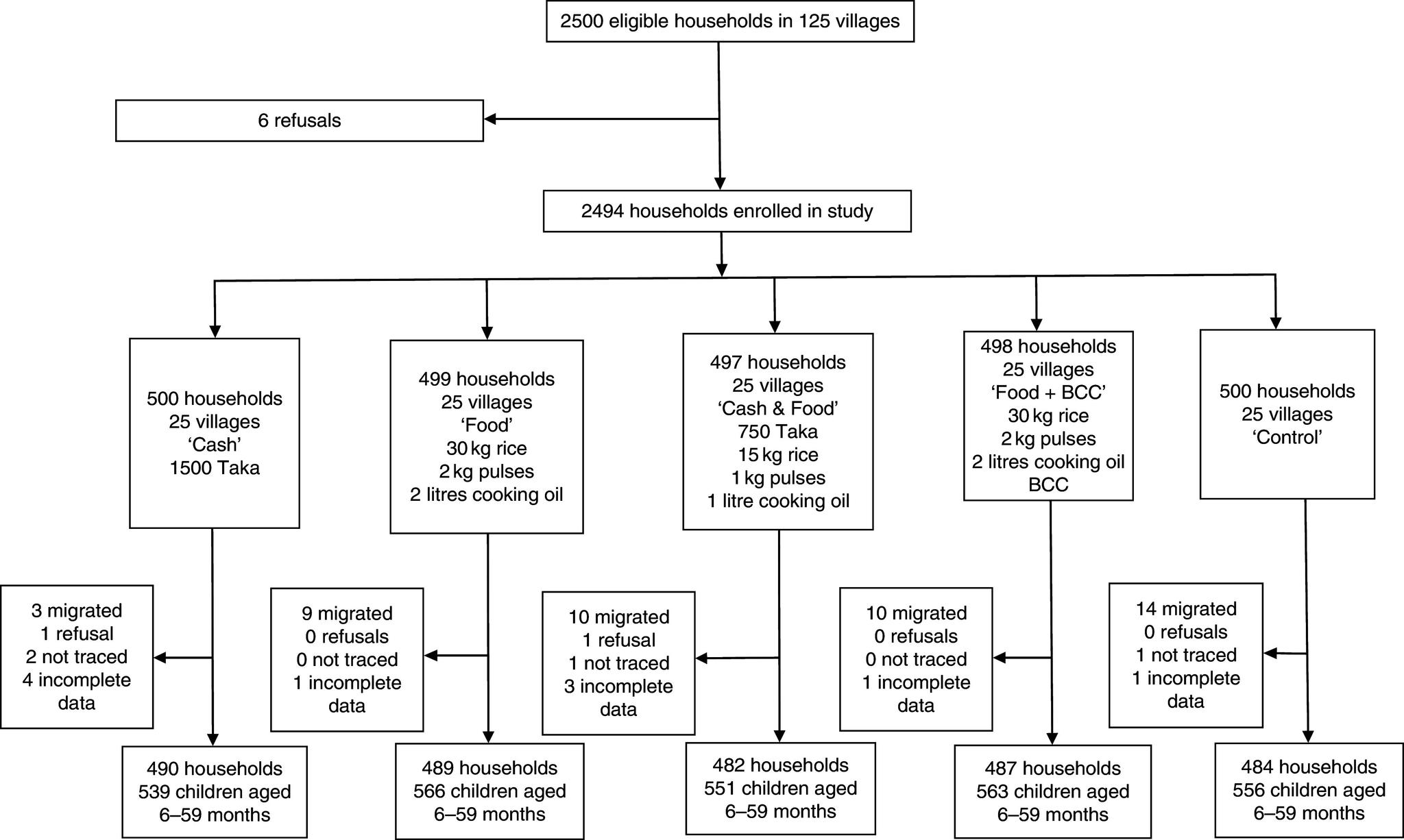
Two randomized controlled trials with treatment arms including cash transfers, food transfers, cash and food transfers, cash and nutrition behaviour change communication (BCC), and food and nutrition BCC were implemented over two years. Both included a control group that received no transfer or BCC. Transfer recipients were mothers living in poor households with at least one child aged less than 2 years at baseline. Probit models were used to analyse endline data.
SETTING
Rural areas in north-west and south Bangladesh.
SUBJECTS
Mothers (n 4840) and children 6-59 months (n 4840).
RESULTS
A transfer accompanied by nutrition BCC increased the share of mothers with knowledge of Fe deficiency (11·9 and 9·2 percentage points for North and South, respectively, P≤0·01), maternal awareness of MMP (29·0 and 22·2 percentage points, P≤0·01), the likelihood that their children 6-59 months had ever consumed MMP (32 and 11·9 percentage points, P≤0·01), consumed MMP in the preceding week (16·9 and 3·9 percentage points, P≤0·01) and consumed either MMP or an Fe supplement in the preceding week (22·3 and 7·1 percentage points, P≤0·01). Improvements were statistically significant relative to groups that received a transfer only.
CONCLUSIONS
Nutrition-sensitive social protection (transfers with BCC added) may be a promising way to advance progress on micronutrient deficiencies.
目的
研究一项营养敏感型社会保护干预对母亲铁缺乏症知识、多种微量营养素粉(MMP)意识以及 6-59 月龄儿童 MMP 和其他铁补充剂消费的影响。
设计
在两年内实施了两项随机对照试验,干预组包括现金转移、食品转移、现金和食品转移、现金和营养行为改变沟通(BCC)以及食品和营养 BCC。均包括对照组,不接受任何转移或 BCC。转移接受者为生活在贫困家庭的母亲,家中至少有一名 2 岁以下的儿童。采用概率模型分析终线数据。
地点
孟加拉国西北部和南部的农村地区。
受试者
母亲(n=4840)和 6-59 月龄儿童(n=4840)。
结果
营养 BCC 伴随的转移增加了具有铁缺乏症知识的母亲比例(北方和南方分别为 11.9%和 9.2%,P≤0.01)、母亲对 MMP 的认识(29.0%和 22.2%,P≤0.01)、6-59 月龄儿童曾经消费 MMP 的可能性(32%和 11.9%,P≤0.01)、前一周消费 MMP 的可能性(16.9%和 3.9%,P≤0.01)和前一周消费 MMP 或铁补充剂的可能性(22.3%和 7.1%,P≤0.01)。与仅接受转移的组相比,这些改善具有统计学意义。
结论
营养敏感型社会保护(加上 BCC 的转移)可能是推进微量营养素缺乏进展的一种有前途的方法。

 Zotero 插件