
靶向二代测序在骨髓增殖性肿瘤中 blast 期的应用。
Targeted next-generation sequencing in blast phase myeloproliferative neoplasms.
机构信息
Division of Hematology, Department of Internal Medicine.
Division of Hematopathology, Department of Laboratory Medicine, and.
出版信息
Blood Adv. 2018 Feb 27;2(4):370-380. doi: 10.1182/bloodadvances.2018015875.
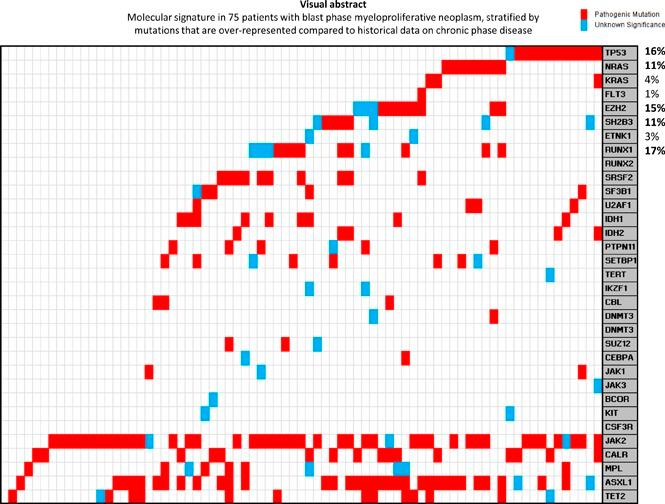
Among 248 consecutive patients with blast phase myeloproliferative neoplasm (MPN-BP), DNA collected at the time of blast transformation was available in 75 patients (median age, 66 years; 64% men). MPN-BP followed primary myelofibrosis in 39 patients, essential thrombocythemia in 20 patients, and polycythemia vera in 16 patients. A myeloid neoplasm-relevant 33-gene panel was used for next-generation sequencing. Driver mutation distribution was 57%, 20%, 9%, and triple-negative 13%. Sixty-four patients (85%) harbored other mutations/variants, including 37% with ≥3 mutations; most frequent were 47%, 19%, 17%, 16%, 15%, and 13%; relative mutual exclusivity was expressed by , , , , , and mutations. Paired chronic-blast phase sample analysis was possible in 19 patients and revealed more frequent blast phase acquisition of , , , , , and mutations/variants. In multivariable analysis, and mutations/variants were associated with shorter survival duration; respective hazard ratios (HRs) (95% confidence interval [CI]) were 2.1 (95% CI, 1.1-3.8) and 3.0 (95% CI, 1.1-6.6). An all-inclusive multivariable analysis confirmed the prognostic relevance of mutations (HR, 1.9; 95% CI, 1.5-5.5) and also showed additional contribution from a treatment strategy that includes transplant or induction of complete or near-complete remission (HR, 0.3; 95% CI, 0.2-0.5). The current study points to specific mutations that might bear pathogenetic relevance for leukemic transformation in MPN and also suggest an adverse survival effect of mutations.
在 248 例连续的骨髓增生性肿瘤(MPN)急变期患者中,有 75 例患者(中位年龄 66 岁,64%为男性)在急变时采集了 DNA。MPN-BP 继原发性骨髓纤维化后发生于 39 例患者,原发性血小板增多症 20 例,真性红细胞增多症 16 例。采用 33 基因骨髓肿瘤相关 panel 进行下一代测序。驱动突变分布为 57%、20%、9%和三阴性 13%。64 例(85%)患者存在其他突变/变异,包括 37%有≥3 种突变;最常见的是 47%、19%、17%、16%、15%和 13%;相对互斥性表达为 、 、 、 、和 突变。19 例患者可行急慢性双相样本分析,显示更多的急变期获得 、 、 、 、和 突变/变异。多变量分析显示 和 突变/变异与生存时间缩短相关;各自的危险比(HR)(95%置信区间[CI])分别为 2.1(95%CI,1.1-3.8)和 3.0(95%CI,1.1-6.6)。全面的多变量分析证实了 突变的预后相关性(HR,1.9;95%CI,1.5-5.5),并且还显示了包括移植或诱导完全或接近完全缓解的治疗策略的额外贡献(HR,0.3;95%CI,0.2-0.5)。本研究指出了特定的突变可能与 MPN 白血病转化具有发病相关性,并提示 突变具有不良的生存效应。
 Zotero 插件