
非黑色素瘤皮肤癌中的癌胚抗原血清水平
Carcinoembryonic Antigen Serum Levels in Nonmelanoma Skin Cancer.
作者信息
Latteri Saverio, Catania Vito Emanuele, Malaguarnera Giulia, Peri Andrea, Bertino Gaetano, Frazzetto Giuseppe, Borzì Antonio Maria, Biondi Antonio, Perrotta Rosario Emanuele, Malaguarnera Michele
机构信息
Department of Medical, Surgical Sciences and Advanced Technologies "G.F. Ingrassia", University of Catania, 95123 Catania, Italy.
Department of Biomedical and Biotechnological Science, University of Catania, 95123 Catania, Italy.
出版信息
Biomedicines. 2018 Feb 23;6(1):24. doi: 10.3390/biomedicines6010024.
BACKGROUND
Carcinoembryonic antigen (CEA) is a glycoprotein, which is present in the foetal colon, some benign conditions and different malignancies, particularly in colon adenocarcinoma. We focused this study on non-melanoma skin cancer (NMSC). NMSC is a common malignancy and it is an important source of morbidity and death in the world. In this study we evaluated whether CEA level increases in NMSC.
PATIENTS AND METHODS
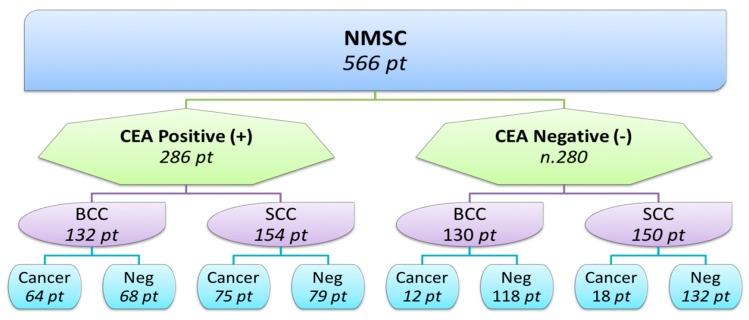
A total of 566 patients with non-melanoma skin cancer (NMSC) were enrolled; 286 patients with NMSC showed CEA levels above normal values, and 280 showed CEA levels below normal values. Patients with high levels of CEA underwent abdominal ultrasound, gastro endoscopy, colonoscopy, and abdominal CT scans.
RESULTS
We studied 566 patients, 286 were positive to CEA and 280 were negative. Of the 286 patients positive to CEA, 132 had basal cell carcinoma (64 patients had an associated cancer) and 154 had squamous cell carcinoma (75 patients were affected by cancer). Of the 280 patients negative to CEA, 130 had basal cell carcinoma (12 were associated with cancer), and 150 had squamous cell carcinoma (18 were associated with cancer). The mean age of the 566 case control subjects were 65-81 years. Of the 10 subjects that were the positive control for CEA, two had cancer. Of the 556 subjects that were the negative control for CEA, three had cancer.
CONCLUSIONS
In patients that present high serum levels of CEA, we give attention to adenocarcinoma tumour first. The pattern of association may be attributable to bias because the group with NMSC were frequently evaluated than those with no history of NMSC. Our results showed that out of 286 patients that were CEA-positive, 139 had cancer, and of the 280 that were CEA-negative, 30 had cancer. Therefore, 20% of patients do not follow the trend. Other markers should be investigated.
背景
癌胚抗原(CEA)是一种糖蛋白,存在于胎儿结肠、一些良性疾病及不同的恶性肿瘤中,尤其是结肠腺癌。我们将本研究聚焦于非黑素瘤皮肤癌(NMSC)。NMSC是一种常见的恶性肿瘤,是全球发病和死亡的重要原因。在本研究中,我们评估了NMSC患者的CEA水平是否升高。
患者与方法
共纳入566例非黑素瘤皮肤癌(NMSC)患者;286例NMSC患者的CEA水平高于正常值,280例患者的CEA水平低于正常值。CEA水平高的患者接受了腹部超声、胃镜、结肠镜及腹部CT扫描。
结果
我们研究了566例患者,286例CEA呈阳性,280例呈阴性。在286例CEA阳性患者中,132例患有基底细胞癌(64例伴有相关癌症),154例患有鳞状细胞癌(75例患有癌症)。在280例CEA阴性患者中,130例患有基底细胞癌(12例伴有相关癌症),150例患有鳞状细胞癌(18例患有癌症)。566例病例对照受试者的平均年龄为65至81岁。在10例CEA阳性对照受试者中,2例患有癌症。在556例CEA阴性对照受试者中,3例患有癌症。
结论
对于血清CEA水平高的患者,我们首先关注腺癌肿瘤。这种关联模式可能归因于偏倚,因为与无NMSC病史的患者相比,NMSC患者组接受评估的频率更高。我们的结果显示,在286例CEA阳性患者中,139例患有癌症,在280例CEA阴性患者中,30例患有癌症。因此,20%的患者不符合该趋势。应研究其他标志物。
 Zotero 插件