
循环 microRNAs 作为标记物在检测和预测儿童先天性心脏缺陷中的临床意义。
Clinical significance of circulating microRNAs as markers in detecting and predicting congenital heart defects in children.
机构信息
School of Public Health, Curtin University of Technology, Kent St, Bentley, WA, 6102, Australia.
Centre for Genetic Origins of Health and Disease, The University of Western Australia and Curtin University, 35 Stirling Highway, Crawley, WA, 6009, Australia.
出版信息
J Transl Med. 2018 Feb 27;16(1):42. doi: 10.1186/s12967-018-1411-0.
BACKGROUND
Circulating microRNAs (miRNAs) are emerging as novel biomarkers for detecting cardiovascular diseases. In this study, we aimed to investigate the usefulness of miRNAs as biomarkers in diagnosing and predicting children with congenital heart defects (CHD), particularly in the context of multiple subtypes of CHD.
METHODS
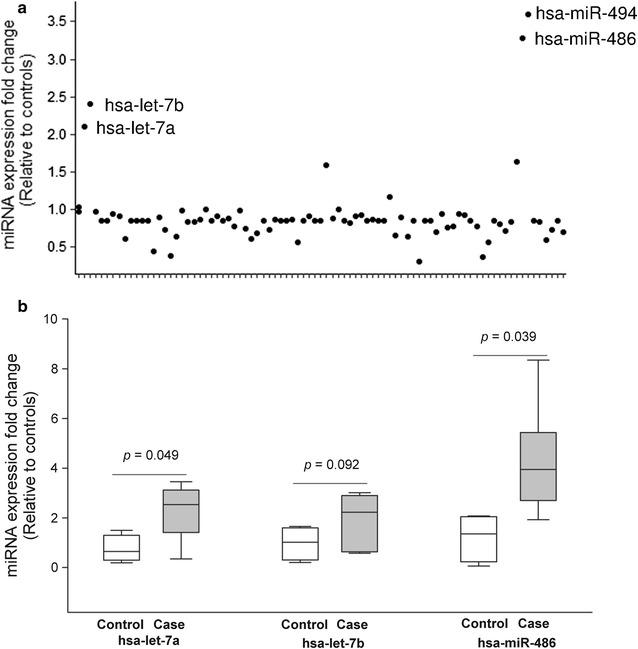
We recruited 26 families, each having a child with CHD and parents who do not have any cardiovascular disorder. 27 families unaffected by cardiovascular disease were also included as controls. Firstly, we screened 84 circulating miRNAs relating to cardiovascular development in 6 children with atrial septal defects (ASD) and 5 healthy children. We validated the selected miRNAs with differential expression in a larger sample size (n = 27 for controls, n = 26 for cases), and evaluated their signal in different types of septal defects. Finally, we examined the identified miRNAs signatures in the parent population and assessed their diagnostic values for predicting CHD.
RESULTS
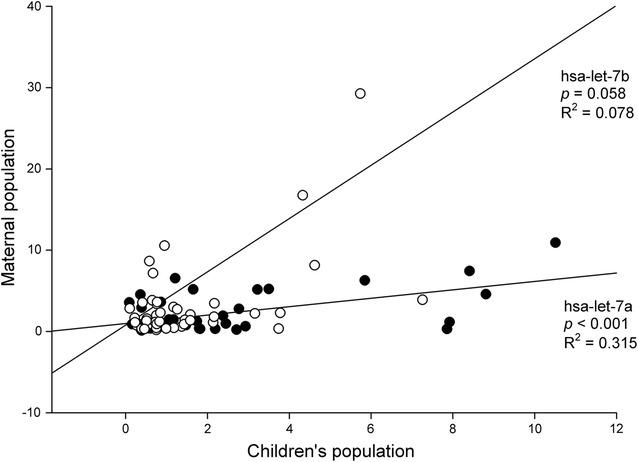
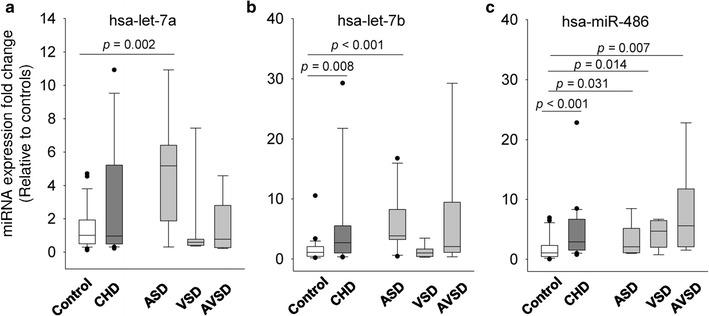
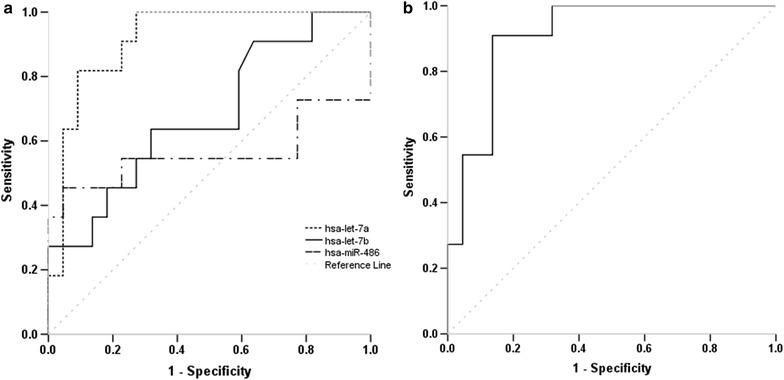
The three miRNAs hsa-let-7a, hsa-let-7b and hsa-miR-486 were significantly upregulated in children with ASD. A further validation study showed that overexpression of hsa-let-7a and hsa-let-7b was specifically present in ASD children, but not in children with other subtypes of septal defects. A similar expression profile of hsa-let-7a and hsa-let-7b was discovered in mothers of ASD children. Receiver-operating characteristic curve analyses indicated that hsa-let-7a and hsa-let-7b had significant diagnostic values for detecting ASD and in maternal samples predicting the occurrence of ASD in offspring.
CONCLUSIONS
Circulating miRNAs are important markers not only for diagnosing CHD, but also for predicting CHD risk in offspring. The distinct miRNA signatures are likely to present in various subtypes of CHD, and the phenotypic heterogeneity of CHD should be considered to develop such miRNA-based assays.
背景
循环 microRNAs(miRNAs)作为心血管疾病检测的新型生物标志物正在出现。本研究旨在探讨 miRNA 作为诊断和预测先天性心脏病(CHD)儿童,特别是多种 CHD 亚型患儿的生物标志物的有用性。
方法
我们招募了 26 个家庭,每个家庭都有一个患有 CHD 的孩子和没有任何心血管疾病的父母。还纳入了 27 个未受心血管疾病影响的家庭作为对照。首先,我们在 6 例房间隔缺损(ASD)患儿和 5 例健康儿童中筛选了与心血管发育相关的 84 种循环 miRNAs。我们在更大的样本量(对照组 n=27,病例组 n=26)中验证了所选 miRNA 的差异表达,并评估了它们在不同类型的隔缺损中的信号。最后,我们在父母群体中检查了鉴定的 miRNA 特征,并评估了它们预测 CHD 的诊断价值。
结果
hsa-let-7a、hsa-let-7b 和 hsa-miR-486 这 3 种 miRNA 在 ASD 患儿中明显上调。进一步验证研究表明,hsa-let-7a 和 hsa-let-7b 的过表达仅存在于 ASD 患儿中,而不存在于其他隔缺损患儿中。ASD 患儿母亲中也发现了 hsa-let-7a 和 hsa-let-7b 的类似表达谱。受试者工作特征曲线分析表明,hsa-let-7a 和 hsa-let-7b 对 ASD 的检测以及在母体样本中预测后代 ASD 的发生具有显著的诊断价值。
结论
循环 miRNAs 不仅是 CHD 诊断的重要标志物,也是预测后代 CHD 风险的重要标志物。独特的 miRNA 特征可能存在于各种 CHD 亚型中,应考虑 CHD 的表型异质性来开发此类基于 miRNA 的检测方法。


 Zotero 插件