
比较效果研究中生存网络荟萃分析与成对荟萃分析的比较:实证研究
Living network meta-analysis compared with pairwise meta-analysis in comparative effectiveness research: empirical study.
作者信息
Nikolakopoulou Adriani, Mavridis Dimitris, Furukawa Toshi A, Cipriani Andrea, Tricco Andrea C, Straus Sharon E, Siontis George C M, Egger Matthias, Salanti Georgia
机构信息
Institute of Social and Preventive Medicine (ISPM), University of Bern, Bern, Switzerland.
Department of Primary Education, University of Ioannina, Ioannina, Greece.
出版信息
BMJ. 2018 Feb 28;360:k585. doi: 10.1136/bmj.k585.
OBJECTIVE
To examine whether the continuous updating of networks of prospectively planned randomised controlled trials (RCTs) ("living" network meta-analysis) provides strong evidence against the null hypothesis in comparative effectiveness of medical interventions earlier than the updating of conventional, pairwise meta-analysis.
DESIGN
Empirical study of the accumulating evidence about the comparative effectiveness of clinical interventions.
DATA SOURCES
Database of network meta-analyses of RCTs identified through searches of Medline, Embase, and the Cochrane Database of Systematic Reviews until 14 April 2015.
ELIGIBILITY CRITERIA FOR STUDY SELECTION
Network meta-analyses published after January 2012 that compared at least five treatments and included at least 20 RCTs. Clinical experts were asked to identify in each network the treatment comparison of greatest clinical interest. Comparisons were excluded for which direct and indirect evidence disagreed, based on side, or node, splitting test (P<0.10).
OUTCOMES AND ANALYSIS
Cumulative pairwise and network meta-analyses were performed for each selected comparison. Monitoring boundaries of statistical significance were constructed and the evidence against the null hypothesis was considered to be strong when the monitoring boundaries were crossed. A significance level was defined as α=5%, power of 90% (β=10%), and an anticipated treatment effect to detect equal to the final estimate from the network meta-analysis. The frequency and time to strong evidence was compared against the null hypothesis between pairwise and network meta-analyses.
RESULTS
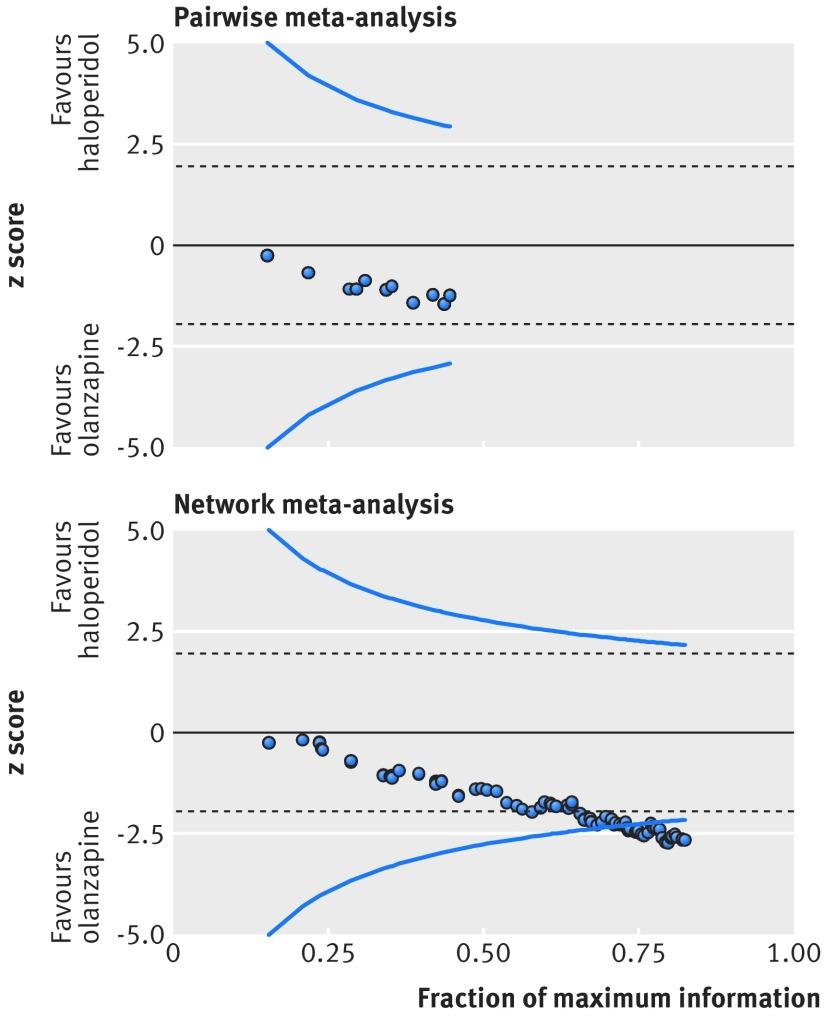
49 comparisons of interest from 44 networks were included; most (n=39, 80%) were between active drugs, mainly from the specialties of cardiology, endocrinology, psychiatry, and rheumatology. 29 comparisons were informed by both direct and indirect evidence (59%), 13 by indirect evidence (27%), and 7 by direct evidence (14%). Both network and pairwise meta-analysis provided strong evidence against the null hypothesis for seven comparisons, but for an additional 10 comparisons only network meta-analysis provided strong evidence against the null hypothesis (P=0.002). The median time to strong evidence against the null hypothesis was 19 years with living network meta-analysis and 23 years with living pairwise meta-analysis (hazard ratio 2.78, 95% confidence interval 1.00 to 7.72, P=0.05). Studies directly comparing the treatments of interest continued to be published for eight comparisons after strong evidence had become evident in network meta-analysis.
CONCLUSIONS
In comparative effectiveness research, prospectively planned living network meta-analyses produced strong evidence against the null hypothesis more often and earlier than conventional, pairwise meta-analyses.
目的
探讨前瞻性计划的随机对照试验(RCT)网络(“动态”网络荟萃分析)的持续更新是否比传统的成对荟萃分析的更新更早地提供有力证据来反对医学干预比较效果的零假设。
设计
对临床干预比较效果的累积证据进行实证研究。
数据来源
通过检索Medline、Embase和Cochrane系统评价数据库,截至2015年4月14日确定的RCT网络荟萃分析数据库。
研究选择的纳入标准
2012年1月后发表的比较至少五种治疗方法且纳入至少20项RCT的网络荟萃分析。要求临床专家在每个网络中确定最具临床意义的治疗比较。基于边或节点拆分检验(P<0.10),排除直接证据和间接证据不一致的比较。
结果与分析
对每个选定的比较进行累积成对和网络荟萃分析。构建统计显著性的监测界限,当越过监测界限时,反对零假设的证据被认为是有力的。显著性水平定义为α=5%,检验效能为90%(β=10%),预期检测的治疗效果等于网络荟萃分析的最终估计值。比较成对和网络荟萃分析中反对零假设的有力证据的频率和时间。
结果
纳入了来自44个网络的49项感兴趣的比较;大多数(n=39,80%)是活性药物之间的比较,主要来自心脏病学、内分泌学、精神病学和风湿病学专业。29项比较有直接和间接证据支持(59%),13项有间接证据支持(27%),7项有直接证据支持(14%)。网络荟萃分析和成对荟萃分析都为7项比较提供了反对零假设的有力证据,但另外10项比较只有网络荟萃分析提供了反对零假设的有力证据(P=0.002)。“动态”网络荟萃分析中反对零假设的有力证据出现的中位时间为19年,“动态”成对荟萃分析为23年(风险比2.78,95%置信区间1.00至7.72,P=0.05)。在网络荟萃分析中出现有力证据后,仍有8项比较的直接比较治疗的研究继续发表。
结论
在比较效果研究中,前瞻性计划的“动态”网络荟萃分析比传统的成对荟萃分析更频繁、更早地产生反对零假设的有力证据。

 Zotero 插件