
自身免疫性疾病中 T 细胞信号转导的翻译后修饰调控。
Regulation of T-Cell Signaling by Post-Translational Modifications in Autoimmune Disease.
机构信息
Department of Molecular Immunology, Toho University School of Medicine, 5-21-16 Omori-Nishi, Ota-ku, Tokyo 143-8540, Japan.
出版信息
Int J Mol Sci. 2018 Mar 12;19(3):819. doi: 10.3390/ijms19030819.
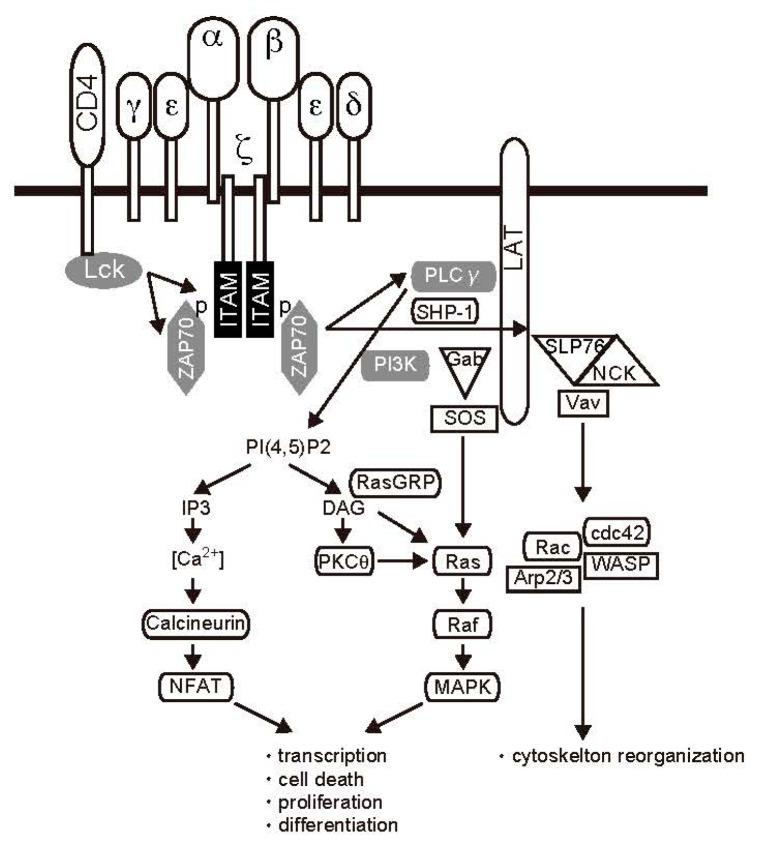
The adaptive immune system involves antigen-specific host defense mechanisms mediated by T and B cells. In particular, CD4⁺ T cells play a central role in the elimination of pathogens. Immunological tolerance in the thymus regulates T lymphocytes to avoid self-components, including induction of cell death in immature T cells expressing the self-reactive T-cell receptor repertoire. In the periphery, mature T cells are also regulated by tolerance, e.g., via induction of anergy or regulatory T cells. Thus, T cells strictly control intrinsic signal transduction to prevent excessive responses or self-reactions. If the inhibitory effects of T cells on these mechanisms are disrupted, T cells may incorrectly attack self-components, which can lead to autoimmune disease. The functions of T cells are supported by post-translational modifications, particularly phosphorylation, of signaling molecules, the proper regulation of which is controlled by endogenous mechanisms within the T cells themselves. In recent years, molecular targeted agents against kinases have been developed for treatment of autoimmune diseases. In this review, we discuss T-cell signal transduction in autoimmune disease and provide an overview of acetylation-mediated regulation of T-cell signaling pathways.
适应性免疫系统涉及由 T 细胞和 B 细胞介导的抗原特异性宿主防御机制。特别是 CD4⁺T 细胞在清除病原体方面发挥着核心作用。胸腺中的免疫耐受调节 T 淋巴细胞以避免自身成分,包括诱导表达自身反应性 T 细胞受体库的未成熟 T 细胞死亡。在外周,成熟的 T 细胞也受到耐受的调节,例如通过诱导失能或调节性 T 细胞。因此,T 细胞严格控制内在信号转导以防止过度反应或自身反应。如果 T 细胞对这些机制的抑制作用被破坏,T 细胞可能会错误地攻击自身成分,从而导致自身免疫性疾病。T 细胞的功能得到翻译后修饰的支持,特别是信号分子的磷酸化,这些修饰的适当调节受 T 细胞自身内部的内源性机制控制。近年来,已经开发出针对激酶的分子靶向药物来治疗自身免疫性疾病。在这篇综述中,我们讨论了自身免疫性疾病中的 T 细胞信号转导,并概述了乙酰化介导的 T 细胞信号通路调节。


 Zotero 插件