
沙蝇区系组成(双翅目:长角亚目)和巴西亚马逊中部一个农村定居点不同生态区莱什曼原虫 DNA(动基体目:锥虫科)的检测。
Composition of sand fly fauna (Diptera: Psychodidae) and detection of Leishmania DNA (Kinetoplastida: Trypanosomatidae) in different ecotopes from a rural settlement in the central Amazon, Brazil.
机构信息
Universidade do Estado do Amazonas (Programa de Pós-graduação em Medicina Tropical/Programa de Pos-graduação em Clima e Ambiente), Manaus, Amazonas, Brasil.
Fundação de Medicina Tropical Dr. Heitor Vieira Dourado, Manaus, Amazonas, Brasil.
出版信息
Parasit Vectors. 2018 Mar 13;11(1):180. doi: 10.1186/s13071-018-2743-6.
BACKGROUND
Phlebotomine sand flies (Diptera: Psychodidae) are vectors of Leishmania species, the etiological agents of leishmaniasis, which is one of the most important emerging infectious diseases in the Americas. In the state of Amazonas in Brazil, anthropogenic activities encourage the presence of these insects around rural homes. The present study aimed to describe the composition and distribution of sand fly species diversity among the ecotopes (intradomicile, peridomicile and forest) in an area of American cutaneous leishmaniasis transmission and detect natural infection with Leishmania DNA to evaluate which vectors are inside houses and whether the presence of possible vectors represents a hazard of transmission.
RESULTS
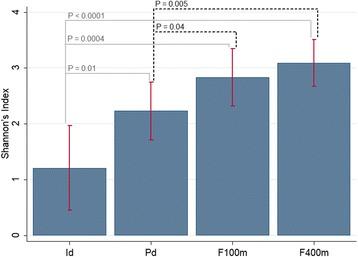
Phlebotomine sand flies were collected using light traps. A total of 2469 specimens representing 54 species, predominantly females (71.2%), were collected from four sites. Polymerase chain reaction analysis was performed on 670 samples to detect Leishmania DNA. Most of the samples (79.5%) were collected in the forest, with areas closer to rural dwellings yielding a greater abundance of suspected or proven vectors and a larger number of species containing Leishmania DNA. Nyssomyia umbratilis and Bichromomyia flaviscutellata were found near rural homes, and Ny. umbratilis was also found inside homes. Leishmania DNA was detected in different species of sand flies in all ecotopes, including species with no previous record of natural infection.
CONCLUSIONS
There is no evidence that vectors of American cutaneous leishmaniasis are becoming established inside homes, but there are sand flies, including Ny. umbratilis and other possible vectors, in environments characterized by a human presence. These species continue to be predominant in the forest but are prevalent in areas closer to ecotopes with a greater human presence. The existence of proven or suspected vectors in this ecotope is due to the structural organization of rural settlements and may represent a hazard of transmission. Although the detection of Leishmania DNA in species that were not previously considered vectors does not mean that they are transmitting the parasite, it does show that the parasite is circulating in ecotopes where these species are found.
背景
白蛉(双翅目:长角亚目)是利什曼原虫的传播媒介,利什曼原虫是美洲最重要的新发传染病之一。在巴西亚马孙州,人为活动鼓励这些昆虫在农村家庭周围存在。本研究旨在描述在一个美洲皮肤利什曼病传播区的生态位(家庭内、家庭周围和森林)中,白蛉物种多样性的组成和分布,并检测利什曼原虫 DNA 的自然感染,以评估哪些媒介在房屋内,以及这些媒介的存在是否构成传播的危险。
结果
使用灯光诱捕器采集白蛉。从四个地点共采集到 2469 只代表 54 种的标本,主要是雌性(71.2%)。聚合酶链反应分析对 670 个样本进行了检测,以检测利什曼原虫 DNA。大多数样本(79.5%)来自森林,靠近农村居民点的地区产生了更多的疑似或证实的媒介,以及更多含有利什曼原虫 DNA 的物种。Nyssomyia umbratilis 和 Bichromomyia flaviscutellata 在农村家庭附近发现,而 Ny. umbratilis 也在家庭内发现。在所有生态位中,包括以前没有自然感染记录的物种,都发现了不同种类的白蛉中的利什曼原虫 DNA。
结论
没有证据表明美洲皮肤利什曼病的媒介正在进入家庭,但在有人类存在的环境中存在白蛉,包括 Ny. umbratilis 和其他可能的媒介。这些物种在森林中仍然占主导地位,但在靠近与人类存在相关的生态位的地区更为普遍。在这个生态位中存在已证实或疑似的媒介,是由于农村住区的结构组织,可能构成传播的危险。尽管在以前不被认为是媒介的物种中检测到利什曼原虫 DNA 并不意味着它们在传播寄生虫,但它确实表明寄生虫在这些物种存在的生态位中循环。


 Zotero 插件