
轴突末端两条平行的膜降解途径的实时观察。
Live Observation of Two Parallel Membrane Degradation Pathways at Axon Terminals.
机构信息
Division of Neurobiology, Freie Universität Berlin, Königin Luise Straße 1-3, 14195 Berlin, Germany; Graduate School of Biomedical Sciences, UT Southwestern Medical Center, Dallas, TX 75390, USA.
Division of Neurobiology, Freie Universität Berlin, Königin Luise Straße 1-3, 14195 Berlin, Germany.
出版信息
Curr Biol. 2018 Apr 2;28(7):1027-1038.e4. doi: 10.1016/j.cub.2018.02.032. Epub 2018 Mar 15.
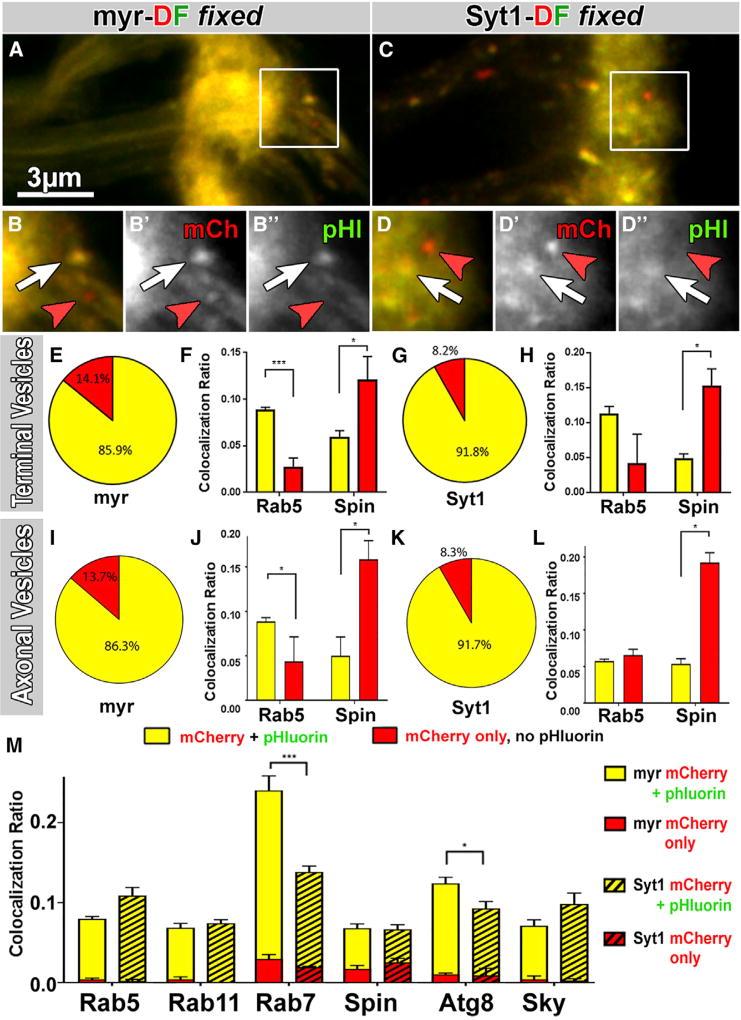
Neurons are highly polarized cells that require continuous turnover of membrane proteins at axon terminals to develop, function, and survive. Yet, it is still unclear whether membrane protein degradation requires transport back to the cell body or whether degradation also occurs locally at the axon terminal, where live observation of sorting and degradation has remained a challenge. Here, we report direct observation of two cargo-specific membrane protein degradation mechanisms at axon terminals based on a live-imaging approach in intact Drosophila brains. We show that different acidification-sensing cargo probes are sorted into distinct classes of degradative "hub" compartments for synaptic vesicle proteins and plasma membrane proteins at axon terminals. Sorting and degradation of the two cargoes in the separate hubs are molecularly distinct. Local sorting of synaptic vesicle proteins for degradation at the axon terminal is, surprisingly, Rab7 independent, whereas sorting of plasma membrane proteins is Rab7 dependent. The cathepsin-like protease CP1 is specific to synaptic vesicle hubs, and its delivery requires the vesicle SNARE neuronal synaptobrevin. Cargo separation only occurs at the axon terminal, whereas degradative compartments at the cell body are mixed. These data show that at least two local, molecularly distinct pathways sort membrane cargo for degradation specifically at the axon terminal, whereas degradation can occur both at the terminal and en route to the cell body.
神经元是高度极化的细胞,需要在轴突末端不断更新膜蛋白以发育、发挥功能和存活。然而,目前仍不清楚膜蛋白降解是否需要运输回细胞体,或者降解是否也发生在轴突末端,在那里对分选和降解的活体观察一直是一个挑战。在这里,我们通过在完整的果蝇大脑中进行活体成像方法,报告了在轴突末端直接观察到两种货物特异性膜蛋白降解机制。我们表明,不同的酸化感应货物探针在轴突末端被分拣成不同类型的降解“枢纽”隔间,用于突触小泡蛋白和质膜蛋白。这两种货物在不同枢纽中的分拣和降解在分子上是不同的。令人惊讶的是,突触小泡蛋白在轴突末端的局部分拣进行降解是 Rab7 非依赖性的,而质膜蛋白的分拣是 Rab7 依赖性的。组织蛋白酶样蛋白酶 CP1 特异性地定位于突触小泡枢纽,其递呈需要囊泡 SNARE 神经元突触融合蛋白。货物分离仅发生在轴突末端,而细胞体中的降解隔室是混合的。这些数据表明,至少有两种局部的、分子上不同的途径可以特异性地在轴突末端对膜货物进行分拣以进行降解,而降解既可以发生在末端,也可以发生在向细胞体的运输过程中。




 Zotero 插件