
采用气相色谱-质谱联用技术(GC-MS)对1550种化学物质进行定量筛选的方法开发。
Development of quantitative screen for 1550 chemicals with GC-MS.
作者信息
Bergmann Alan J, Points Gary L, Scott Richard P, Wilson Glenn, Anderson Kim A
机构信息
Department of Environmental and Molecular Toxicology, Oregon State University, 1007 Agricultural and Life Sciences Bldg., Corvallis, OR, 97331, USA.
出版信息
Anal Bioanal Chem. 2018 May;410(13):3101-3110. doi: 10.1007/s00216-018-0997-7. Epub 2018 Mar 19.
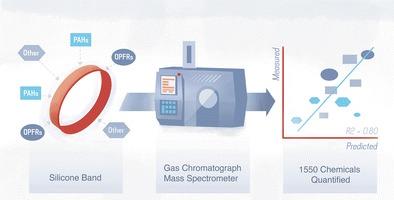
With hundreds of thousands of chemicals in the environment, effective monitoring requires high-throughput analytical techniques. This paper presents a quantitative screening method for 1550 chemicals based on statistical modeling of responses with identification and integration performed using deconvolution reporting software. The method was evaluated with representative environmental samples. We tested biological extracts, low-density polyethylene, and silicone passive sampling devices spiked with known concentrations of 196 representative chemicals. A multiple linear regression (R = 0.80) was developed with molecular weight, logP, polar surface area, and fractional ion abundance to predict chemical responses within a factor of 2.5. Linearity beyond the calibration had R > 0.97 for three orders of magnitude. Median limits of quantitation were estimated to be 201 pg/μL (1.9× standard deviation). The number of detected chemicals and the accuracy of quantitation were similar for environmental samples and standard solutions. To our knowledge, this is the most precise method for the largest number of semi-volatile organic chemicals lacking authentic standards. Accessible instrumentation and software make this method cost effective in quantifying a large, customizable list of chemicals. When paired with silicone wristband passive samplers, this quantitative screen will be very useful for epidemiology where binning of concentrations is common. Graphical abstract A multiple linear regression of chemical responses measured with GC-MS allowed quantitation of 1550 chemicals in samples such as silicone wristbands.
环境中有数十万种化学物质,有效的监测需要高通量分析技术。本文基于响应的统计建模,提出了一种针对1550种化学物质的定量筛选方法,使用反卷积报告软件进行识别和积分。该方法用代表性环境样品进行了评估。我们测试了添加已知浓度196种代表性化学物质的生物提取物、低密度聚乙烯和硅胶被动采样装置。利用分子量、logP、极性表面积和离子丰度分数建立了多元线性回归(R = 0.80),以预测化学响应在2.5倍因子范围内。校准范围之外的线性在三个数量级内R > 0.97。定量限中位数估计为201 pg/μL(1.9倍标准偏差)。环境样品和标准溶液中检测到的化学物质数量和定量准确性相似。据我们所知,这是针对大量缺乏真实标准品的半挥发性有机化学物质最精确的方法。可使用的仪器和软件使该方法在定量大量可定制化学物质列表时具有成本效益。当与硅胶腕带被动采样器配合使用时,这种定量筛选对于浓度分组常见的流行病学研究将非常有用。图形摘要 使用气相色谱 - 质谱法测量的化学响应的多元线性回归允许对硅胶腕带等样品中的1550种化学物质进行定量。



 Zotero 插件