
韩国乳腺癌幸存者血浆 25-羟维生素 D 浓度的决定因素。
Determinants of Plasma 25-Hydroxyvitamin D Concentrations among Breast Cancer Survivors in Korea.
机构信息
Research Institute of Human Ecology, Seoul National University, Seoul 08826, Korea.
Department of Surgery, Soonchunhyang University Bucheon Hospital, Bucheon 14584, Korea.
出版信息
Nutrients. 2018 Mar 20;10(3):380. doi: 10.3390/nu10030380.
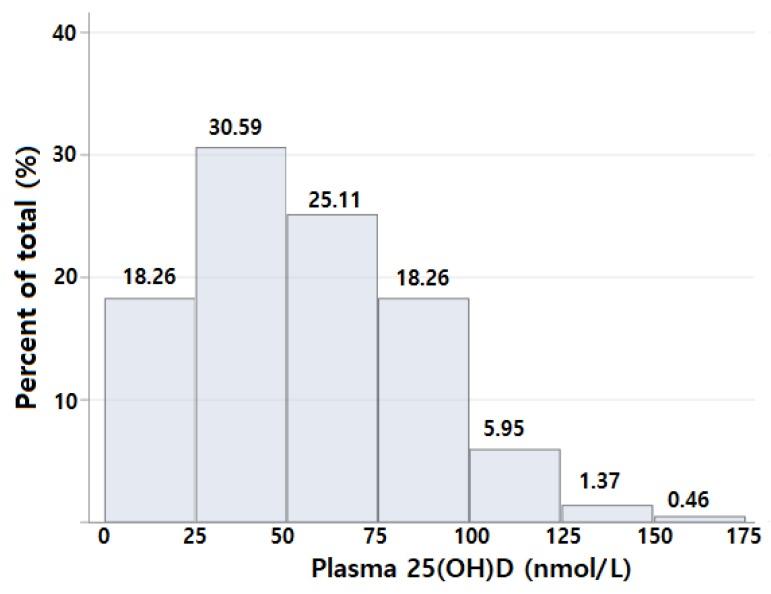
We identified demographic, lifestyle, and clinical factors associated with vitamin D status among breast cancer survivors. The vitamin D prediction model may be a useful surrogate of circulating 25-hydroxvitamin D (25(OH)D) concentrations when this measure was not available. We included a total of 216 Korean breast cancer survivors aged 21-79 years who had been diagnosed with stage I to III primary breast cancer and had breast cancer surgery at least 6 months before enrolment. We used linear and logistic regressions to identify determinants for the plasma 25(OH)D concentrations and vitamin D insufficiency (plasma 25(OH)D concentration < 50 nmol/L). We observed that 48.85% of breast cancer survivors had a plasma 25(OH)D concentration less than 50 nmol/L. We identified the following determinants for plasma 25(OH)D concentrations: time since diagnosis (β = -0.005 for 1 month increment), supplementary vitamin D intake (β = 0.06 for 10 μg/day increment), season of the blood draw (β = 0.35 for summer; β = 0.32 for fall; β = 0.26 for winter vs. spring), smoking status (β = 0.28 for former vs. never), use of any supplement (β = -0.35 for non-use vs. use), and the parity number (β = -0.30 for three or more vs. one) were associated with the plasma 25(OH)D concentrations. In addition to the aforementioned variables, body mass index (BMI) was associated with the prevalence of vitamin D insufficiency. We identified the determinants for the plasma 25(OH)D concentrations among Korean breast cancer survivors. Future studies are needed to investigate the role of vitamin D in the progression of breast cancer among Korean breast cancer survivors.
我们确定了与乳腺癌幸存者维生素 D 状况相关的人口统计学、生活方式和临床因素。当无法获得循环 25-羟维生素 D(25(OH)D)浓度时,维生素 D 预测模型可能是其有用的替代物。我们共纳入了 216 名年龄在 21-79 岁之间的韩国乳腺癌幸存者,这些患者被诊断为 I 期至 III 期原发性乳腺癌,并且在入组前至少 6 个月接受了乳腺癌手术。我们使用线性和逻辑回归来确定血浆 25(OH)D 浓度和维生素 D 不足(血浆 25(OH)D 浓度<50nmol/L)的决定因素。我们发现 48.85%的乳腺癌幸存者的血浆 25(OH)D 浓度低于 50nmol/L。我们确定了以下决定血浆 25(OH)D 浓度的因素:诊断后时间(每月增加 0.005)、补充维生素 D 摄入(每天增加 10μg 为 0.06)、采血季节(夏季为 0.35;秋季为 0.32;冬季为 0.26,春季为 0.26)、吸烟状况(以前吸烟为 0.28,从不吸烟为 0.28)、使用任何补充剂(不使用为 0.35,使用为 0.35)和产次(三个或更多为 0.30,一个为 0.30)与血浆 25(OH)D 浓度相关。除了上述变量外,体重指数(BMI)与维生素 D 不足的患病率相关。我们确定了韩国乳腺癌幸存者血浆 25(OH)D 浓度的决定因素。需要进一步的研究来探讨维生素 D 在韩国乳腺癌幸存者中乳腺癌进展中的作用。

 Zotero 插件