
一种pH值不依赖的酸性哌嗪-四苯乙烯聚集诱导发光剂作为用于溶酶体追踪的独特生物探针。
An acidic pH independent piperazine-TPE AIEgen as a unique bioprobe for lysosome tracing.
作者信息
Cai Yuanjing, Gui Chen, Samedov Kerim, Su Huifang, Gu Xinggui, Li Shiwu, Luo Wenwen, Sung Herman H Y, Lam Jacky W Y, Kwok Ryan T K, Williams Ian D, Qin Anjun, Tang Ben Zhong
机构信息
Guangdong Innovative Research Team , State Key Laboratory of Luminescent Materials and Devices , South China University of Technology , Guangzhou 510640 , China . Email:
Department of Chemistry , Hong Kong Branch of Chinese National Engineering Research Center for Tissue Restoration and Reconstruction , The Hong Kong University of Science & Technology , Clear Water Bay , Kowloon , Hong Kong , China . Email:
出版信息
Chem Sci. 2017 Nov 1;8(11):7593-7603. doi: 10.1039/c7sc03515b. Epub 2017 Sep 18.
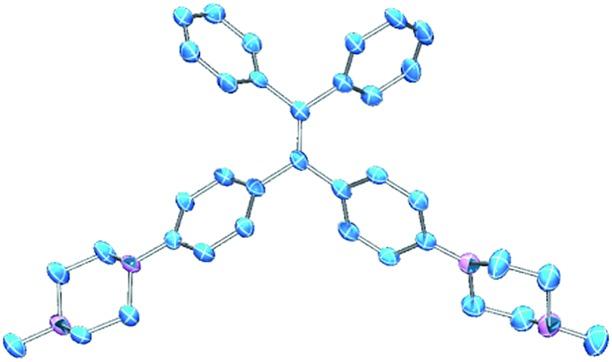
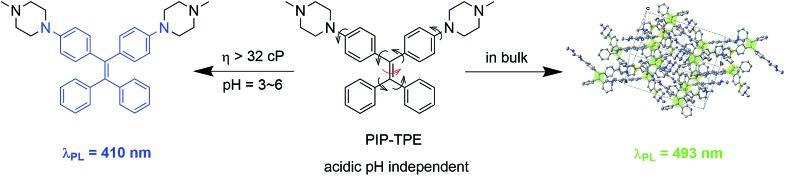
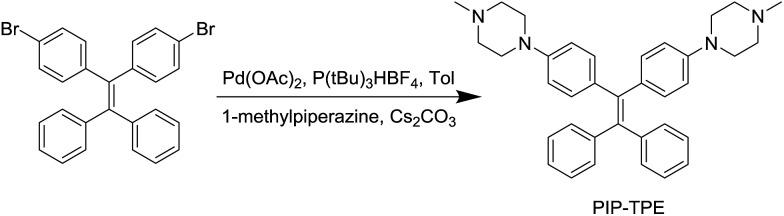
Lysosomes are involved in a multitude of cellular processes and their dysfunction is associated with various diseases. They are the most acidic organelles (pH 3.8-6.6, size 0.1-1.2 μm) with the highest viscosity (47-190 cP at 25 °C) in the cell. Because of their acidity, pH dependent non-AIE active fluorescent lysosomal probes have been developed that rely on protonation inhibited photoinduced electron transfer (PET). In this work, an acidic pH independent lysosome targetable piperazine-TPE (PIP-TPE) AIEgen has been designed with unique photophysical properties making it a suitable probe for quantifying viscosity. In a non-aggregated state PIP-TPE shows deep-blue emission as opposed to its yellowish-green emission in the bulk. It possesses high specificity for lysosomes with negligible cytotoxicity and good tracing ability due to its better photostability compared to LysoTracker Red. In contrast to most known lysosome probes that rely solely on PET, restriction of intramolecular motion (RIM) due to the larger viscosity inside the lysosomes is the mechanism responsible for PIP-TPE's fluorescence. PIP-TPE's high selectivity is attributed to its unique molecular design that features piperazine fragments providing a perfect balance between lipophilicity and polarity.
溶酶体参与多种细胞过程,其功能障碍与多种疾病相关。它们是细胞中酸性最强(pH 3.8 - 6.6,大小0.1 - 1.2μm)且粘度最高(25℃时为47 - 190 cP)的细胞器。由于其酸性,已开发出依赖质子化抑制光致电子转移(PET)的pH依赖性非聚集诱导发光(AIE)活性荧光溶酶体探针。在这项工作中,设计了一种酸性pH不依赖的可靶向溶酶体的哌嗪 - 四苯乙烯(PIP - TPE)聚集诱导发光剂,其具有独特的光物理性质,使其成为一种适用于定量粘度的探针。在非聚集状态下,PIP - TPE发出深蓝色发射光,与其在本体中的黄绿色发射光形成对比。它对溶酶体具有高特异性,细胞毒性可忽略不计,并且由于其与LysoTracker Red相比具有更好的光稳定性,具有良好的追踪能力。与大多数仅依赖PET的已知溶酶体探针不同,由于溶酶体内较大的粘度导致分子内运动受限(RIM)是PIP - TPE荧光的产生机制。PIP - TPE的高选择性归因于其独特的分子设计,其特征在于哌嗪片段在亲脂性和极性之间提供了完美的平衡。
 Zotero 插件