
古塞单抗,一种针对泛发性脓疱型银屑病和红皮病型银屑病的人白细胞介素-23 单克隆抗体:一项为期 52 周、多中心、开放标签的 3 期临床试验的疗效和安全性分析。
Guselkumab, a human interleukin-23 monoclonal antibody in Japanese patients with generalized pustular psoriasis and erythrodermic psoriasis: Efficacy and safety analyses of a 52-week, phase 3, multicenter, open-label study.
机构信息
Department of Dermatology, Kochi Medical School, Kochi University, Kochi, Japan.
Janssen Pharmaceutical K.K., Tokyo, Japan.
出版信息
J Dermatol. 2018 May;45(5):529-539. doi: 10.1111/1346-8138.14294. Epub 2018 Mar 22.
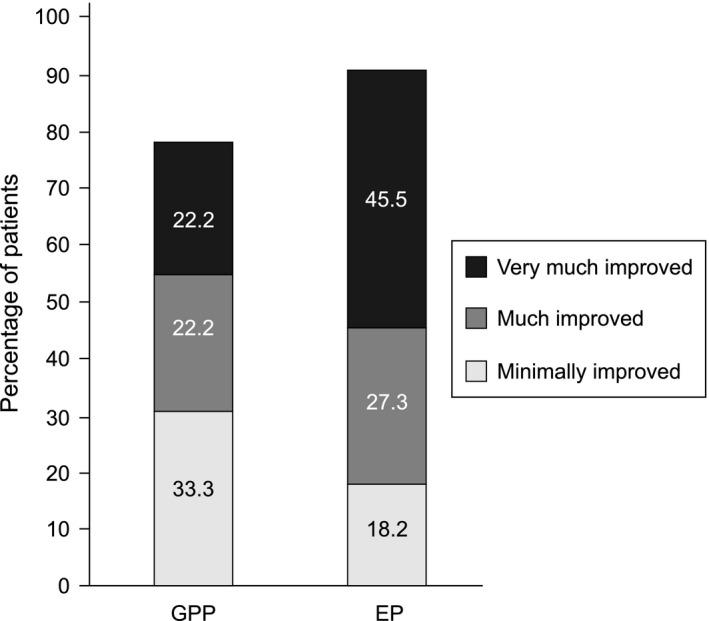
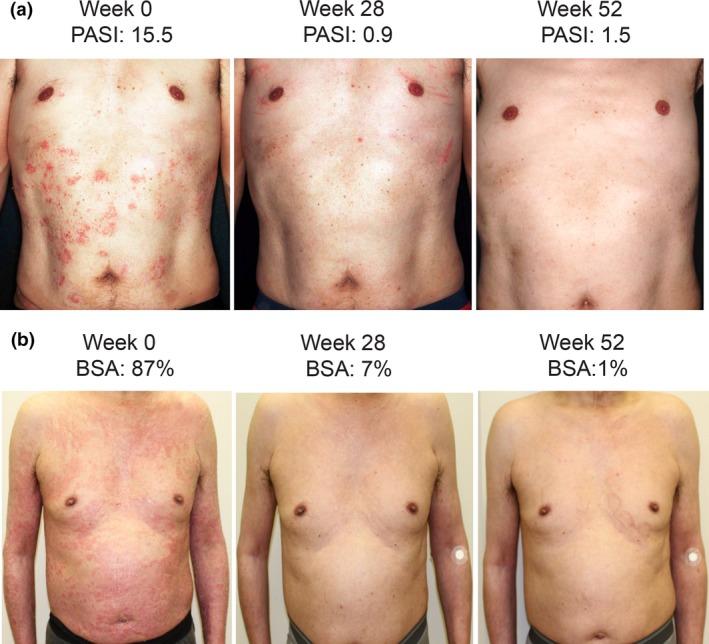
Generalized pustular psoriasis (GPP) and erythrodermic psoriasis (EP) are the rare and severe subtypes of psoriasis, which are often difficult to treat. The aim of this phase 3, open-label study was to evaluate efficacy and safety of guselkumab, a human interleukin-23 monoclonal antibody, in Japanese patients with GPP and EP. Guselkumab 50 mg was administrated to GPP (n = 10) and EP (n = 11) patients at weeks 0, 4 and thereafter every 8 weeks (q8w). Beginning at week 20, patients were escalated to 100 mg q8w if they met the dose escalation criteria. The primary end-point was the proportion of patients achieving treatment success (Clinical Global Impression score of "very much improved", "much improved" or "minimally improved") at week 16. Safety evaluations included assessment of treatment-emergent adverse events (TEAE) through week 52. At week 16, the proportions of GPP and EP patients achieving treatment success were 77.8% (7/9) and 90.9% (10/11), respectively. Furthermore, guselkumab treatment consistently showed improvement in responses of secondary end-points such as Psoriasis Area and Severity Index, Investigator's Global Assessment, Japanese Dermatological Association severity index and improvement in body surface area involvement. Improvements in quality of life, as assessed by the Dermatology Life Quality Index, were also observed through week 52. The most commonly reported TEAE was nasopharyngitis (28.6%, 6/21). Safety findings were consistent with those observed previously in other studies. In conclusion, guselkumab treatment demonstrated efficacy and showed no safety concerns in Japanese patients with GPP and EP through week 52.
泛发性脓疱型银屑病(GPP)和红皮病型银屑病(EP)是银屑病罕见且严重的亚型,往往难以治疗。本 3 期、开放标签研究的目的是评估 Guselkumab(一种人白细胞介素-23 单克隆抗体)在日本 GPP 和 EP 患者中的疗效和安全性。GPP(n=10)和 EP(n=11)患者在第 0、4 周和此后每 8 周(q8w)接受 50mg Guselkumab 治疗。从第 20 周开始,如果符合剂量升级标准,患者升级至 100mg q8w。主要终点是治疗 16 周时达到治疗成功的患者比例(临床总体印象评分为“非常好”、“好”或“轻度改善”)。安全性评估包括通过第 52 周评估治疗出现的不良事件(TEAE)。治疗 16 周时,GPP 和 EP 患者达到治疗成功的比例分别为 77.8%(7/9)和 90.9%(10/11)。此外,Guselkumab 治疗持续显示出改善次要终点的反应,如银屑病面积和严重程度指数、研究者全球评估、日本皮肤病协会严重程度指数和改善体表面积受累。通过第 52 周,还观察到生活质量的改善,通过皮肤病生活质量指数评估。最常见的报告的 TEAE 是鼻咽炎(28.6%,6/21)。安全性发现与先前在其他研究中观察到的一致。总之,Guselkumab 治疗在第 52 周时在日本 GPP 和 EP 患者中显示出疗效且无安全性问题。




 Zotero 插件