
生物实验的解释随着基因本体论及其注释的发展而变化。
Interpretation of biological experiments changes with evolution of the Gene Ontology and its annotations.
机构信息
Stanford Institute for Immunity, Transplantation and Infection (ITI), Stanford University, Stanford, CA, 94305, USA.
Stanford Center for Biomedical Informatics Research (BMIR), Department of Medicine, Stanford University, Stanford, CA, 94305, USA.
出版信息
Sci Rep. 2018 Mar 23;8(1):5115. doi: 10.1038/s41598-018-23395-2.
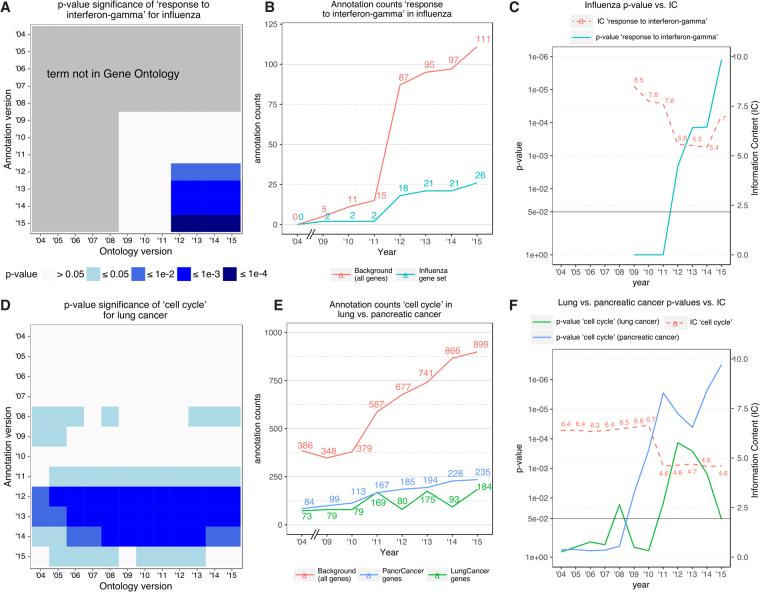
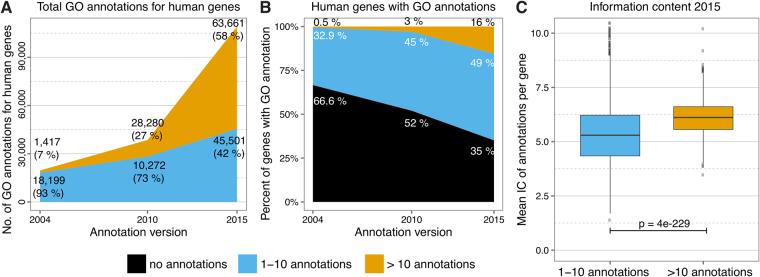
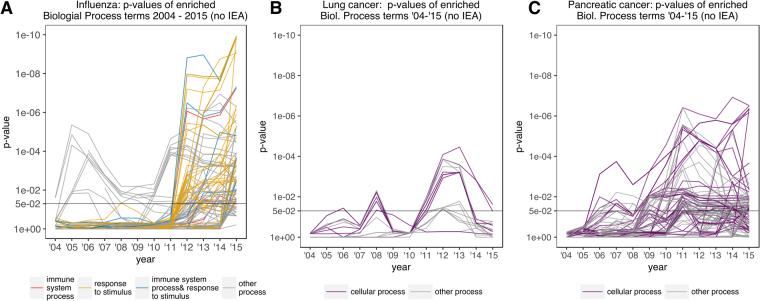
Gene Ontology (GO) enrichment analysis is ubiquitously used for interpreting high throughput molecular data and generating hypotheses about underlying biological phenomena of experiments. However, the two building blocks of this analysis - the ontology and the annotations - evolve rapidly. We used gene signatures derived from 104 disease analyses to systematically evaluate how enrichment analysis results were affected by evolution of the GO over a decade. We found low consistency between enrichment analyses results obtained with early and more recent GO versions. Furthermore, there continues to be a strong annotation bias in the GO annotations where 58% of the annotations are for 16% of the human genes. Our analysis suggests that GO evolution may have affected the interpretation and possibly reproducibility of experiments over time. Hence, researchers must exercise caution when interpreting GO enrichment analyses and should reexamine previous analyses with the most recent GO version.
基因本体论(GO)富集分析被广泛用于解释高通量分子数据,并对实验背后的潜在生物学现象提出假说。然而,这种分析的两个构建块——本体和注释——在快速发展。我们使用来自 104 种疾病分析的基因特征,系统地评估了在十年的时间里,GO 的进化对富集分析结果的影响。我们发现,使用早期和最近的 GO 版本进行的富集分析结果之间一致性较低。此外,GO 注释中仍然存在强烈的注释偏向,其中 58%的注释是针对人类基因的 16%。我们的分析表明,GO 的进化可能随着时间的推移影响了实验的解释和可能的可重复性。因此,研究人员在解释 GO 富集分析时必须谨慎,并且应该使用最新的 GO 版本重新检查以前的分析。

 Zotero 插件