
比较 ER 阳性/HER2 阴性乳腺癌的肿瘤浸润淋巴细胞水平和 21 基因复发评分。
Comparisons of tumor-infiltrating lymphocyte levels and the 21-gene recurrence score in ER-positive/HER2-negative breast cancer.
机构信息
Department of Surgery, Gangnam Severance Hospital, Yonsei University College of Medicine, Seoul, Korea.
Department of Pathology, Gangnam Severance Hospital, Yonsei University College of Medicine, Seoul, Korea.
出版信息
BMC Cancer. 2018 Mar 24;18(1):320. doi: 10.1186/s12885-018-4228-6.
BACKGROUND
Recent studies have shown that tumors with extensive tumor-infiltrating lymphocytes (TILs) have a higher probability of pathologic complete response, even in luminal/human epidermal growth factor 2 (HER2)-negative breast cancer. We compared TIL levels and the 21-gene recurrence score (RS) in estrogen receptor (ER)-positive/HER2-negative breast cancer.
METHODS
We evaluated the percentage of stromal TILs in 198 ER-positive/HER2-negative patients in whom RS was obtained by examining slides of surgical specimens by standardized methodology proposed by the international TIL Working Group. TIL levels were categorized as high (≥ 60%), intermediate (11-59%), or low (≤ 10%). All tumors were treatment-naïve.
RESULTS
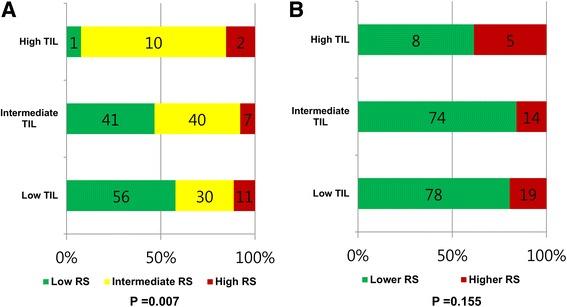
Ninety-seven (49.0%), 88 (44.4%), and 13 patients (6.6%) had low, intermediate, and high TIL levels, respectively. There was a significant but weak correlation between continuous RS and continuous TIL levels (Pearson's R = 0.201, p = 0.004). The mean RS was significantly highest in high TIL tumors (17.8 ± 10.7 in low TIL tumors, 19.4 ± 8.7 in intermediate TIL tumors, and 26.2 ± 8.2 in high TIL tumors; p = 0.014). However, when we compared categorized RS and TIL levels, we found that tumors with high TIL levels tended to have higher RS (≥ 26) but it was not significant (p = 0.155). Furthermore, multivariate analysis revealed that high RS was not an independent factor associated with high TIL levels. Chemo-endocrine therapy was more frequently performed among patients with high TILs and less frequently among those with low or intermediate TILs (p < 0.001).
CONCLUSIONS
Despite of a weak correlation between continuous TIL levels and RS, we found that tumors with high TIL levels tended to have a higher RS in ER-positive/HER2-negative breast cancer. Further study is warranted considering the clinical outcomes.
背景
最近的研究表明,浸润淋巴细胞(TILs)广泛存在的肿瘤发生病理完全缓解的可能性更高,即使在 luminal/人表皮生长因子 2(HER2)阴性乳腺癌中也是如此。我们比较了雌激素受体(ER)阳性/HER2 阴性乳腺癌中 TIL 水平和 21 基因复发评分(RS)。
方法
我们通过标准化方法评估了 198 例 ER 阳性/HER2 阴性患者的间质 TIL 百分比,该方法由国际 TIL 工作组提出,用于检查手术标本的切片。TIL 水平分为高(≥60%)、中(11-59%)或低(≤10%)。所有肿瘤均为初治。
结果
97 例(49.0%)、88 例(44.4%)和 13 例(6.6%)患者的 TIL 水平分别为低、中、高。连续 RS 与连续 TIL 水平之间存在显著但较弱的相关性(Pearson R=0.201,p=0.004)。高 TIL 肿瘤的平均 RS 显著最高(低 TIL 肿瘤为 17.8±10.7,中 TIL 肿瘤为 19.4±8.7,高 TIL 肿瘤为 26.2±8.2;p=0.014)。然而,当我们比较分类 RS 和 TIL 水平时,我们发现高 TIL 水平的肿瘤倾向于具有更高的 RS(≥26),但这并不显著(p=0.155)。此外,多变量分析显示,高 RS 不是与高 TIL 水平相关的独立因素。高 TIL 组更常接受化疗内分泌治疗,低 TIL 或中 TIL 组较少接受化疗内分泌治疗(p<0.001)。
结论
尽管连续 TIL 水平与 RS 之间存在较弱的相关性,但我们发现 ER 阳性/HER2 阴性乳腺癌中高 TIL 水平的肿瘤倾向于具有更高的 RS。考虑到临床结果,需要进一步研究。



 Zotero 插件